Earlier quoted context omitted.
On the contrary, finding edible food is certainly important, but avoiding poisonous/diseased food is even more important.
If we can detect ripe, surely we can infer not ripe.
There's probably an app for that.
61–70 of 83 posts
Photon counting sensors have been available for quite a while. This is unfortunately not new. It’s not ’color’ it’s multi channel imaging. X-ray tubes produce wide spectrum of x-rays, these type of sensors are able to put different bands to different buckets. Coloring is arbitrary and conveniently chosen in the example to look like visible wavelength response as if the patient was dissected. It does not work for more…
Surgery rarely looks like that. We are messy creatures. Our parts all overlap and fold among each other. It never looks as open as in the scan, short of dissecting the patient well beyond what is ever needed for any actual procedure.
The example image certainly looks cool, but it is too 2d. It doesn't have the 3d structure visible in traditional x-rays. An expert can look at an old photographic x-ray and see the layers of tissue and bone atop each other. It is a rather good 2d visualization of a complex 3d shape. Giving tissues more solid color take away from the translucence and, imho as a non-doctor, removes much of the information.
Photon counting sensors have been available for quite a while. This is unfortunately not new. It’s not ’color’ it’s multi channel imaging. X-ray tubes produce wide spectrum of x-rays, these type of sensors are able to put different bands to different buckets. Coloring is arbitrary and conveniently chosen in the example to look like visible wavelength response as if the patient was dissected. It does not work for more…
Which similar to images we see of space where they have altered detectors' responses from different wavelengths of light to be images in the visible spectrum. So we produce beautiful images, but they aren't accurate to what space would look like to the naked eye.
Earlier quoted context omitted.
Which similar to images we see of space where they have altered detectors' responses from different wavelengths of light to be images in the visible spectrum. So we produce beautiful images, but they aren't accurate to what space would look like to the naked eye.
That's what I understood at first, but what seems to be the case is that light from deep space undergoes "red shift", and by the time it reaches us, visible spectrum has been shifted into x-ray spectrum. The "false color" is just a correction back to almost the original visible spectrum. The degree of red shift is how we determine distance.
> visible spectrum has been shifted into x-ray spectrum.
No, x-rays are way more energetic than visible light (MUCH shorter wavelenths..). Red shift, as the name implies, refers to shifting of wavelengths to the red/infrared side of the spectrum, not towards the blue/ultraviolet/x-ray/gamma ray side. The most distant, oldest thing we can see is in the microwave wavelengths, and that's the remnants of the big bang.
The real issue is with dust, and the inverse square law (that the intensity of radiation follows).
Some objects are obscured by dust, and so the only way to see them is by looking at wavelengths that are able to penetrate the dust.
The further an object is, the less intense the radiation is reaching us, so we have to stare at it for a very long time in order to collect enough photons to form good images. This is why views of Andromeda through a telescope with your eyeballs do not look like this visible light image of Andromeda: https://apod.nasa.gov/apod/ap991114.html
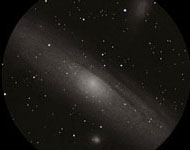
Instead it looks more like this under the absolute best viewing conditions on Earth with a quality telescope (nominal is a blurred version of this): http://www.deepskywatch.com/images/articles/see-in-telescope...
The videos on their press page are stunning. Especially the ankle rotation video. https://www.marsbioimaging.com/mars/media-pack/ https://drive.google.com/file/d/1JyRdqyU-j5PambGUgfs4Cx5uKf3...
Doesn't look that much better than a thin slice CT with custom colormaps ("CLUTs"), using a regular greyscale for the high density tissue (bone), and a reduced alpha channel for the low density tissue rendered in yellow. You can get that with a Dicom station and 5 minutes, or for free using Osirix at home and trial/error if you are not used to CTs. Ask for the CD next time you get a scan, or download one of the many…
I’m looking up the things you mentioned and they’re interesting, though. I’d love to see imaging and home-computed assessments become a bigger part of the “quantified self” movement.
Photon counting sensors have been available for quite a while. This is unfortunately not new. It’s not ’color’ it’s multi channel imaging. X-ray tubes produce wide spectrum of x-rays, these type of sensors are able to put different bands to different buckets. Coloring is arbitrary and conveniently chosen in the example to look like visible wavelength response as if the patient was dissected. It does not work for more…
Which similar to images we see of space where they have altered detectors' responses from different wavelengths of light to be images in the visible spectrum. So we produce beautiful images, but they aren't accurate to what space would look like to the naked eye.
Earlier quoted context omitted.
And get 3 times the does of radiation? Seems impractical, but possibly true.
X-ray sources are not "monochromatmic" and produce photons across a wide range: http://www.ctlab.geo.utexas.edu/wp-content/uploads/2015/06/F...
Earlier quoted context omitted.
> I wish we could have a peek inside the patient as if we had opened it up but this is not yet that. What's stopping us? Are you saying that there's no way to tell different kinds of tissues apart (e.g. not even with an MRI)? I imagine if we did, we could also add "color" (via post-processing) and enable a "dissection". Or are you saying it has something to do specifically with color?
I think the point was that the x-ray 'colors' do not have 1:1 mapping with the colors that our eyes see. So the color is useful to discern different tissues and bones and stuff, but the colors won't look like the colors of those things in real life. We see in a range of wavelengths 0.4--0.7 um. X-rays have no intersection with our visible range. Therefore the best you can do is define some function that maps x-rays i…
Earlier quoted context omitted.
That's what I understood at first, but what seems to be the case is that light from deep space undergoes "red shift", and by the time it reaches us, visible spectrum has been shifted into x-ray spectrum. The "false color" is just a correction back to almost the original visible spectrum. The degree of red shift is how we determine distance.
Red shift only comes into play for distant galaxies. Nothing in our galaxy, or nearby galaxies, is going to be red shifted in any significant way. > visible spectrum has been shifted into x-ray spectrum. No, x-rays are way more energetic than visible light (MUCH shorter wavelenths..). Red shift, as the name implies, refers to shifting of wavelengths to the red/infrared side of the spectrum, not towards the blue/ultra…
https://home.cern/about/updates/2018/07/first-3d-colour-x-ra...