Obviously this is a long, long way from a functional brain being grown. But I have to wonder where the moral line is drawn when you're talking about growing an organ that (may-or-may-not) hold the ability to form a level of consciousness.
The quick answer is to say it's not ethical. But what if the brain is given full autonomy and ability to communicate with others and then let the brain decide if it wants an organic or machine body?
Neanderthal ‘minibrains’ grown in dish
31–40 of 55 posts
Re: Neanderthal ‘minibrains’ grown in dish
#32Obviously this is a long, long way from a functional brain being grown. But I have to wonder where the moral line is drawn when you're talking about growing an organ that (may-or-may-not) hold the ability to form a level of consciousness.
Re: Neanderthal ‘minibrains’ grown in dish
#33Obviously this is a long, long way from a functional brain being grown. But I have to wonder where the moral line is drawn when you're talking about growing an organ that (may-or-may-not) hold the ability to form a level of consciousness.
The quick answer is to say it's not ethical. But what if the brain is given full autonomy and ability to communicate with others and then let the brain decide if it wants an organic or machine body?
Re: Neanderthal ‘minibrains’ grown in dish
#34Is this ethical?
Re: Neanderthal ‘minibrains’ grown in dish
#35Re: Neanderthal ‘minibrains’ grown in dish
#36Earlier quoted context omitted.
If I may be so bold, I think that line will get pushed farther out every generation - who will simply accept past work as the then status quo ante. Just a hundred years back, cloning would have been considered morally reprehensible. Today, many people accept it as fact. Each generation only pushes the boundary just a bit (in the grand scheme of things) further; and only things far beyond the immediate realm of practi…
Luckily this is not the only direction: > To test his theory, he nailed his wife’s dog to a board and chopped it open while the poor thing was still alive. https://knowledgenuts.com/2013/09/29/descartes-dissected-his...
There are research institutions doing this to everything from fruit flies, bats, dogs to monkeys in some cases.
Hell, I even heard stories that doing it to monkeys is risky. Even smaller monkeys are smart enough to get loose, steal keys, remember access codes, cooperate, fake medical problems and they will exact revenge for what was done to cellmates. And some primates like gorillas have that, and sufficient strength to lift a small car easily.
In a way, it's even done to humans. With the caveat that researchers aren't allowed to cause the damage in a human. However a sufficient number of humans have "acquired trauma to the brain" (got shot in the head/shoot themselves in the head/otherwise manage to insert large objects into their brain and are "lucky" enough to survive), and the medical papers on that by the treating physician are disseminated and studied. Sometimes the patients are available for further testing (often they are compensated for such studies, as it leads to new treatments and even medicines). And yes, for the treatment, one of the first steps is to immobilise the head in a metal contraption. I think you can see why movements of the head are unlikely to improve matters.
Example paper in humans: https://www.ncbi.nlm.nih.gov/pubmed/16395622
Example paper in animals: https://www.ncbi.nlm.nih.gov/pubmed/29326273
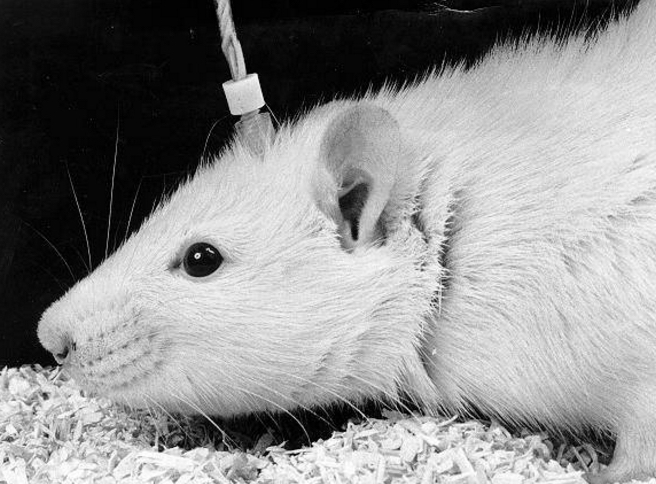
Here's a non-gruesome picture of it: http://www.kurzweilai.net/images/rat-with-implant.jpg
(note that that rat still has a perforated cranial membrane with equipment keeping it perforated and will start suffering from extreme headaches in about a day, and die in weeks, from this procedure. They tend to be put down after a day or two because after that they just lie there and scream)
Re: Neanderthal ‘minibrains’ grown in dish
#37>>> "We're trying to recreate Neanderthal minds," Muotri says." Get the pitchforks. This scientist has gone too far. Really. I'm a totally against growing "minds" in jars. I'd be against doing this with any animal brain, let alone something functionally equivalent to human. There are ethical lines that shouldn't be crossed. The concept of a non-corporeal mind living a non-sensory existence in a jar of goo is too horr…
Re: Neanderthal ‘minibrains’ grown in dish
#38Earlier quoted context omitted.
The quick answer is to say it's not ethical. But what if the brain is given full autonomy and ability to communicate with others and then let the brain decide if it wants an organic or machine body?
I disagree. The quick answer is to say it is ethical.
Re: Neanderthal ‘minibrains’ grown in dish
#39>>> "We're trying to recreate Neanderthal minds," Muotri says." Get the pitchforks. This scientist has gone too far. Really. I'm a totally against growing "minds" in jars. I'd be against doing this with any animal brain, let alone something functionally equivalent to human. There are ethical lines that shouldn't be crossed. The concept of a non-corporeal mind living a non-sensory existence in a jar of goo is too horr…
With humans it comes from papers describing the treatment of "brain trauma". Within animals, where the majority of research is done, depending on the animal, they just nail them to a board, or nail a board or a wire into their skull, cut out half the brain, insert some sensors, and record data in the few hours that the pain does not totally immobilise the animals, usually while making the animal perform some trick, like navigating a maze, or looking at prey, or ...
Re: Neanderthal ‘minibrains’ grown in dish
#40>>> "We're trying to recreate Neanderthal minds," Muotri says." Get the pitchforks. This scientist has gone too far. Really. I'm a totally against growing "minds" in jars. I'd be against doing this with any animal brain, let alone something functionally equivalent to human. There are ethical lines that shouldn't be crossed. The concept of a non-corporeal mind living a non-sensory existence in a jar of goo is too horr…
How is a 'mind' ever supposed to develop in a neural system with no sensory input?