Live data from Hacker News

As Population Growth Slows, Populism Surges

nytimes.com

11–20 of 22 posts

Re: As Population Growth Slows, Populism Surges

#11
post #8

Earlier quoted context omitted.

I think there are strong headwinds to this, but there are some things that the government can do. For example, insuring that high-speed internet access is available in rural and small-town areas, similar to how they have in the past made sure that affordable postal delivery and phone service were not for big cities only. High-speed internet access makes it easier for certain kinds of jobs to be done from almost anywh…

Y’all are making the assumption rural areas want these things without asking How about we include their own list of real needs (not just “More jobs” rhetoric) in the real debates rather than going in circles with hypotheticals on social media Maybe the government can start there Cause I grew up in a rural area. The aren’t luddites. But they also don’t want YOUR context pushed on their ways Read some Paulo Freire

If you want people to come and spend money in your small towns, you're going to have to give them some reason to do that. If you don't want that, that's certainly your business, but with the consolidation of agriculture and the mechanization of manufacturing that have been going on the last several decades, it's not clear to me what else your local economies can be based on. And indeed, the depopulation of rural areas and small towns that this article is discussing suggests that a lot of local economies are having a very hard time.

If you have a better idea for a solution, by all means, tell us.

What "real needs" do you have in mind?

Re: As Population Growth Slows, Populism Surges

#12

>“The trend toward population decline, set off by a sustained decrease in fertility rates beginning in the 1960s, has been driven to a significant extent by increasing prosperity and life span.” In the US, I’m pretty sure it’s because ppl can’t afford to have kids.

After a certain point, family size is negatively correlated with income. http://m.startribune.com/minnecensus-family-size-and-its-rel...

Re: As Population Growth Slows, Populism Surges

#13
post #3

Parts of this article seem like a rather circular analysis. In the world’s largest cities, where populations are densely concentrated and growing, economies are generally thriving and cosmopolitanism is embraced. Where populations are sparse or shrinking, usually in rural places and small cities, economies are often stagnant, and populism sells. What does "thriving" mean here? GDP? Do any countries track GDP by city?…

The causal start is advancing industrialization. This both reduces fertility rates and favors cities over the countryside. The relation is very consistent over many different countries, and it is easy to see what the causal chains are for each of them. >Why is internationalism a practical necessity in cities? Are there no cities in the world with quite ethnically homogenous populations? Have the authors visited easte…

I think the first part of your argument is debatable, especially in modern times. In recent eras advancing industrialisation has meant telecoms, the internet, computers. All technologies that allow people to live and work anywhere. Working from home or working remotely is now becoming commonplace for the first time since the pre-industrial era.

Industrialization might have correlated with population movements from rural areas to the cities in the past. It's not so clear it still means that now. And as for falling fertility rates, that's surely more related to improvements in healthcare. You can say those improvements wouldn't have happened without industrialization, but that's just redefining industrialization as progress in general. In which case "cosmopolitanism is caused by progress" becomes the argument: an opinion, surely.

These cities are far more interconnected, both internally and externally, than the countryside.

You're talking about interconnectedness, the first thing the article's authors specified, but I was talking about internationalism, the second. The term "interconnectedness" is too vague to discuss; if it means people depending on each other, well, I've seen many claim over the years that cities are isolating and true communities where neighbours rely on each other are a suburban and rural phenomenon. I have no data either way. It seems easier to reason about internationalism, and that claim is dubious.

Also, I hate it when someone claims they have an alternative explanation, but don't present it so that we can examine it critically.

I didn't pick any specific explanation because there are so many to pick from.

For instance, if we drill into the definition of "populism", whereby it sets "ordinary people" against "elites", the most direct and simple explanation is that maybe in recent times there have been transfers of power away from ordinary people towards elites, and "populism" is simply politicians reacting to the concerns that this has caused. Obviously power being held by elites is a feature of many eras in history, has never been popular with the common man, and has nothing in particular to do with population growth or decline.
Re: As Population Growth Slows, Populism Surges

#14

Maybe it's time for governments to start coming up with policies to attract technology businesses to small cities and perhaps even towns. These businesses would have to be comfortable having many remote workers, since there's no way they're going to get everyone they want to hire to move there, but maybe they could be given sufficient incentive to set up a headquarters there. It's not unusual, of course, for localiti…

There has been an effort to attract technology business to small cities and rural areas since the mid-1990s. I recall driving through West Virginia around 2000 and seeing a sign labeling a stretch of highway as "West Virginia's Tech Corridor." Knowing West Virginia, any company that built along there would have zero taxes, heck they probably wouldn't have to pay for the land.

Purely monetary incentives don't work. You have to look at the full range of what incentives people to move to a place. And companies are still run by people who are swayed by those same incentives.

Even in the Bay Area, companies with large campuses and competitive pay are opening offices in San Francisco because their talent is demanding it.

Re: As Population Growth Slows, Populism Surges

#15
post #8

Earlier quoted context omitted.

I think there are strong headwinds to this, but there are some things that the government can do. For example, insuring that high-speed internet access is available in rural and small-town areas, similar to how they have in the past made sure that affordable postal delivery and phone service were not for big cities only. High-speed internet access makes it easier for certain kinds of jobs to be done from almost anywh…

Y’all are making the assumption rural areas want these things without asking How about we include their own list of real needs (not just “More jobs” rhetoric) in the real debates rather than going in circles with hypotheticals on social media Maybe the government can start there Cause I grew up in a rural area. The aren’t luddites. But they also don’t want YOUR context pushed on their ways Read some Paulo Freire

I grew up in a town of ~16,000 (it's ~14,000 now) that was the biggest town in its county. I have many friends who still live in small towns. High speed internet is definitely something they want.

Re: As Population Growth Slows, Populism Surges

#16
post #8

Earlier quoted context omitted.

Y’all are making the assumption rural areas want these things without asking How about we include their own list of real needs (not just “More jobs” rhetoric) in the real debates rather than going in circles with hypotheticals on social media Maybe the government can start there Cause I grew up in a rural area. The aren’t luddites. But they also don’t want YOUR context pushed on their ways Read some Paulo Freire

If you want people to come and spend money in your small towns, you're going to have to give them some reason to do that. If you don't want that, that's certainly your business, but with the consolidation of agriculture and the mechanization of manufacturing that have been going on the last several decades, it's not clear to me what else your local economies can be based on. And indeed, the depopulation of rural area…

Apparently you missed the part about not bothering with hypotheticals on social media

Re: As Population Growth Slows, Populism Surges

#17
post #3

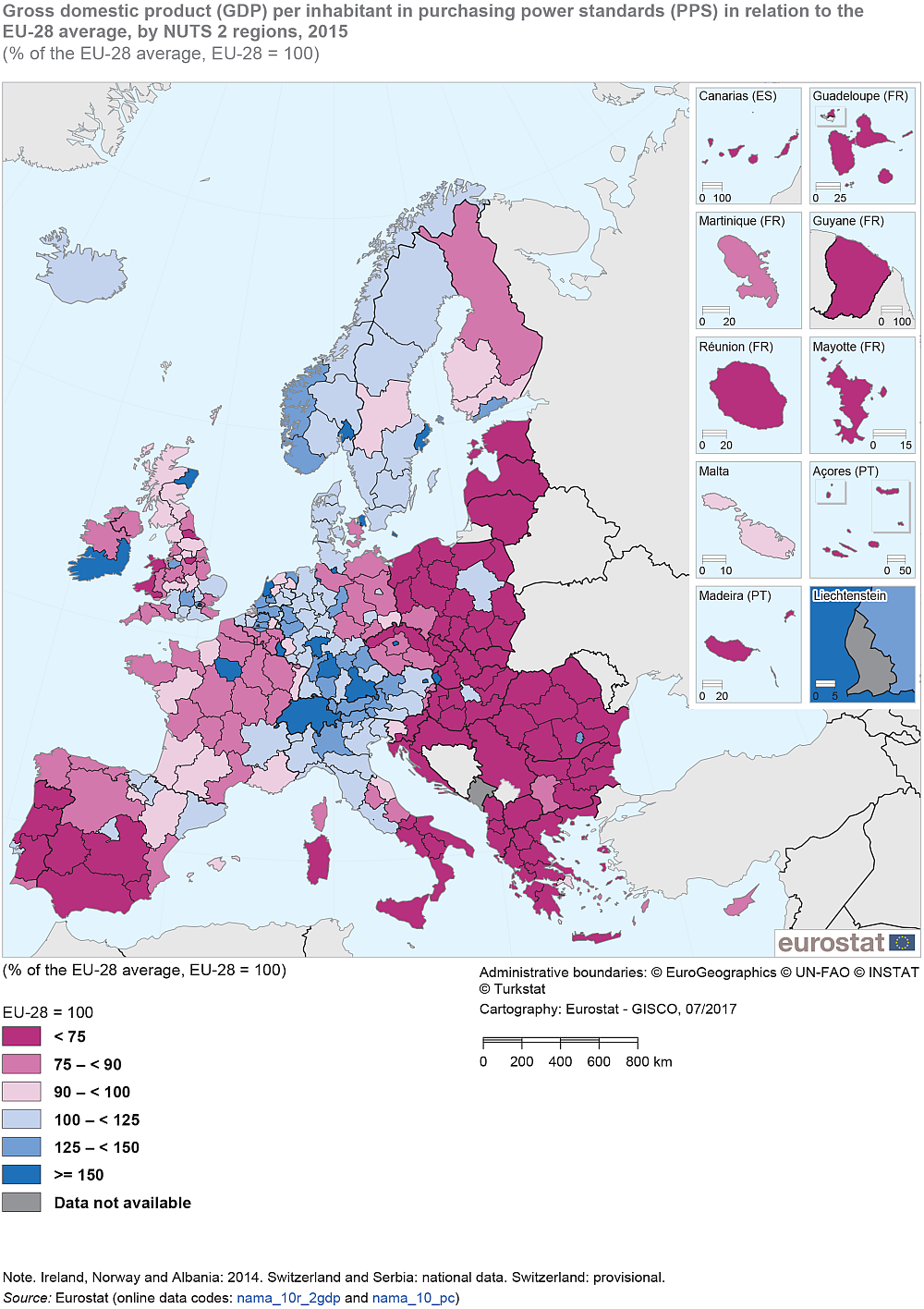
Parts of this article seem like a rather circular analysis. In the world’s largest cities, where populations are densely concentrated and growing, economies are generally thriving and cosmopolitanism is embraced. Where populations are sparse or shrinking, usually in rural places and small cities, economies are often stagnant, and populism sells. What does "thriving" mean here? GDP? Do any countries track GDP by city?…

You can infer GDP per city from NUTS2 regions: http://ec.europa.eu/eurostat/statistics-explained/images/2/2...

Given that most cities have large commuting penumbras I think that's a reasonable approximation. You can clearly identify e.g Paris, and infer that Dublin and Aberdeen are largely responsible for the prosperity of their regions.

"Cosmopolitanism is the ideology that all human beings belong to a single community, based on a shared morality." - or so says Wikipedia.

> Why is internationalism a practical necessity in cities?

A city is, at its heart, a trade nexus. Even a town is usually built around some key market or industry. More people == more opportunities for trade and networking; Metcalfe's law for humans. Having foreigners around means more trade routes. Nobody's seriously tried to close their cities to trade since the Qing dynasty.

> Are there no cities in the world with quite ethnically homogenous populations? Have the authors visited eastern European or Russian cities?

If you're going to talk about Eastern europe, then there are two things you need to be very careful of: one is miscategorising everyone as the same ethnicity because they all have pale skin (e.g. Magyars are not the same ethnicity as Slavs), and the other is overlooking the realities of genocide and ethnic cleansing that forced populations apart across the 20th century. Poland looks a lot more ethnically homogenous after the 10% of its population that used to be Jewish was exterminated.

Most of the Austro-Hungarian empire was cosmopolitan and multi-lingual in its cities, for example.

When people talk about "elites", they need to be very careful to identify their target as being the actual people with money and power. Otherwise this ends up collapsing to mean "jews" or "liberals" (remember "rootless cosmopolitan" is a subtle anti-semitic slur). It's particularly ludicrous when you get e.g. UK cabinet ministers who come from wealth and private schools complaining about "elites interfering with brexit" when what they actually mean is "journalists pointing out problems".

Re: As Population Growth Slows, Populism Surges

#18
post #13

Earlier quoted context omitted.

The causal start is advancing industrialization. This both reduces fertility rates and favors cities over the countryside. The relation is very consistent over many different countries, and it is easy to see what the causal chains are for each of them. >Why is internationalism a practical necessity in cities? Are there no cities in the world with quite ethnically homogenous populations? Have the authors visited easte…

I think the first part of your argument is debatable, especially in modern times. In recent eras advancing industrialisation has meant telecoms, the internet, computers. All technologies that allow people to live and work anywhere. Working from home or working remotely is now becoming commonplace for the first time since the pre-industrial era. Industrialization might have correlated with population movements from ru…

> And as for falling fertility rates, that's surely more related to improvements in healthcare.

But of a very specific sort: improvements in access to contraception. It's also strongly affected by women's access to jobs outside the home.

Falling fertility is our great victory over Malthusianism, it should be celebrated more.

(Just re-read the article to check something, and isn't it going to a great effort to avoid saying the word "race"?)

Re: As Population Growth Slows, Populism Surges

#19
post #16

Earlier quoted context omitted.

If you want people to come and spend money in your small towns, you're going to have to give them some reason to do that. If you don't want that, that's certainly your business, but with the consolidation of agriculture and the mechanization of manufacturing that have been going on the last several decades, it's not clear to me what else your local economies can be based on. And indeed, the depopulation of rural area…

Apparently you missed the part about not bothering with hypotheticals on social media

I have the impression that you could contribute to this conversation if you would engage with it, but you seem to be interested only in taking pot shots at the rest of us. Do you want to make yourself understood, or do you just want to scare us off?

Re: As Population Growth Slows, Populism Surges

#20

Maybe it's time for governments to start coming up with policies to attract technology businesses to small cities and perhaps even towns. These businesses would have to be comfortable having many remote workers, since there's no way they're going to get everyone they want to hire to move there, but maybe they could be given sufficient incentive to set up a headquarters there. It's not unusual, of course, for localiti…

There has been an effort to attract technology business to small cities and rural areas since the mid-1990s. I recall driving through West Virginia around 2000 and seeing a sign labeling a stretch of highway as "West Virginia's Tech Corridor." Knowing West Virginia, any company that built along there would have zero taxes, heck they probably wouldn't have to pay for the land. Purely monetary incentives don't work. Yo…

All true. I didn't say it would be easy. And I never suggested one could just pick a stretch of road and put it there — I think you have to have at least a small city.
Post reply on HN