Live data from Hacker News

'Anti-authority' tech rebels take on ISPs, connect NYC with cheap Wi-Fi

cbc.ca

221–230 of 237 posts

Re: 'Anti-authority' tech rebels take on ISPs, connect NYC with cheap Wi-Fi

#221
post #29

I'm in NYC. I know a few people who played with it. It barely works. I'm all for this kind of tech solutions, but for crying out loud pretending that this is a replacement for ISPs in NYC really discredits techies.

Our average speeds connecting to our supernodes is around 100Mbps. I'm not sure what you are referring to.

How does it work for torrenting?

Does VoIP work?

What if I want to run a server at home?
Re: 'Anti-authority' tech rebels take on ISPs, connect NYC with cheap Wi-Fi

#222

Earlier quoted context omitted.

Why doesn't a startup run their own fibre? Are building owners that protective? Actually scratch that, I tried getting a 1 gig cross manhattan link. Cost more than 1g to London.

Building owners? Before you get anywhere near the buildings, you have to dig up the streets to run cabling around the city. Any idea how much that costs?

Pilot is doing this cheaper than others, look into how they get their fiber in the ground...

Re: 'Anti-authority' tech rebels take on ISPs, connect NYC with cheap Wi-Fi

#223

Earlier quoted context omitted.

It depends on the location. If you are talking about downtown Manhattan you can get dark fiber between any major buildings for about $5k/mo. If you are not in a mojor building then Zayo would do it for about $20k build out worst case scenario + same $5k/mo, since Zayo touches a boatload of manholes. There was also Metro Optical but I dont know how large is their footprint. They are quite creative. But in general, go…

Yes, that sounds about right -- we pay about $4k for 1gig midtown-midtown However GTT offered me 1gig from New York office to London Docklands for $2400! Under $2k for p2p to office in Washington DC. If local internet is $500pcm , get two lines into the building for $1k/month, charge 50 people $30 a month and give them 1 gig and 25:1 contention ratio, plus the cost of dropping the fibre and a router, leaving $6k a ye…

$4K sounds incredibly overpriced.

Re: 'Anti-authority' tech rebels take on ISPs, connect NYC with cheap Wi-Fi

#224
post #12

Who's responsible when someone torrents copyrighted material through that Internet exchange point? "NYC Mesh will comply with all federal laws in the countries it operates, however, as policy, no data is collected and therefore no data exists to provide requestors." This is cute, but if you aren't hunting down people abusing the mesh, the whole connection to the internet will go away for a ToS violation.

Didn't one of the major ISPs get their ass handed to them in court for trying to say that they were somehow exempt from keeping exactly this sort of information? I mean, you can SAY it, but it would be sort of insane to make a statement like that without a lawyer signing off on it. The law doesn't have a "this is too hard for us" or "we didn't build our network for this" exemption, does it?

Re: 'Anti-authority' tech rebels take on ISPs, connect NYC with cheap Wi-Fi

#225

Earlier quoted context omitted.

Remember the guys who had it easy learning at university? Imagine you are one of them- good at using existing rules, good at ingesting and reusing existing knowledge. But deep down know you are unable to recombine, think outside the box or just experiment childishly - to truly innovate - then those tinkerers poking the unknown could render you a obsolete dinosaur any day. Which explains while there is always a caste…

Or, just maybe, they've poked an antenna up in the air in NYC and noticed the 5GHz spectrum is totally polluted and barely usable. You want WISP competition (co-op business model or not), then lobby the FCC to free up some spectrum for it. Cheap gear is here, spectrum is the scarcity.

You are right. http://reboot.fcc.gov/spectrumdashboard/searchSpectrum.seam

So here is the plan- we jam a frequency of a local TV-station, nobody views, who is just sitting on the spectrum for license worth. After proofing for one year and one day, that nobody listened to it and nobody cared- we pronounce that this spectrum is unclaimed and should be returned to the government to be auctioned off.

Under normal circumstances this should not go through legally- but hey, there is booty, there is a government in debt and there are interested parties.

Its the perfect storm and just having legal rights - didn't help the native Americans either, didn't it?

Come to think of it- maybe planning the heist in public was - ill advised.

Re: 'Anti-authority' tech rebels take on ISPs, connect NYC with cheap Wi-Fi

#226
post #76
post #25

Earlier quoted context omitted.

We are replacing ISPs in NYC for our members. This is now, not the future. The main thing holding us back is scaling up the number of installs. All networks, including us, add to this expensive infrastructure. The difference with our infrastructure is it is owned and shared by members.

Sure thing. And I offer free WiFi access to all my household members, houseguests, and next-door neighbors. The main thing holding me back is scaling up the number of installs too. I'm hoping a billion dollars of donations can square that away for me and my wider-area neighbor.

This is essentially what I do. I do have my housemates pay a share because they have access to a hardwire connection, but I have an open AP which my neighbors, guests, and anyone within line of sight down the street use. I have plenty of bandwidth that goes unused so I don't mind - I pay to have fast bursts of traffic, so I don't have a problem letting other people use what I don't. The only thing holding me back from having more people use it is locations nearby for repeaters. But I may put more effort into getting neighbors interested in hosting repeaters so that may change.

Re: 'Anti-authority' tech rebels take on ISPs, connect NYC with cheap Wi-Fi

#227

Earlier quoted context omitted.

> The number of edges scales O(n^2), where n is the number of people in the network. I don't see how this is true for any reasonable definition of "edge". It's certainly not the case that every node directly communicates with every other node; if they did, you wouldn't need a mesh.

A mesh network is defined as a network where the nodes connect to as many other nodes as possible. In the limit this is a complete graph with O(n^2) edges. It's true that in practice you won't have a complete graph but it's still less efficient than a more hierarchical, tree-like network structure.

the fact that a wifi network node only covers a very limited area is sufficient to show that your theoretical limit is never going to be reached -> by a large margin. You can probably assume that in a dense network, every node will be reachable by every other node through at most 7 hops. But thats it [1]

https://en.wikipedia.org/wiki/Small-world_network

Re: 'Anti-authority' tech rebels take on ISPs, connect NYC with cheap Wi-Fi

#228

Earlier quoted context omitted.

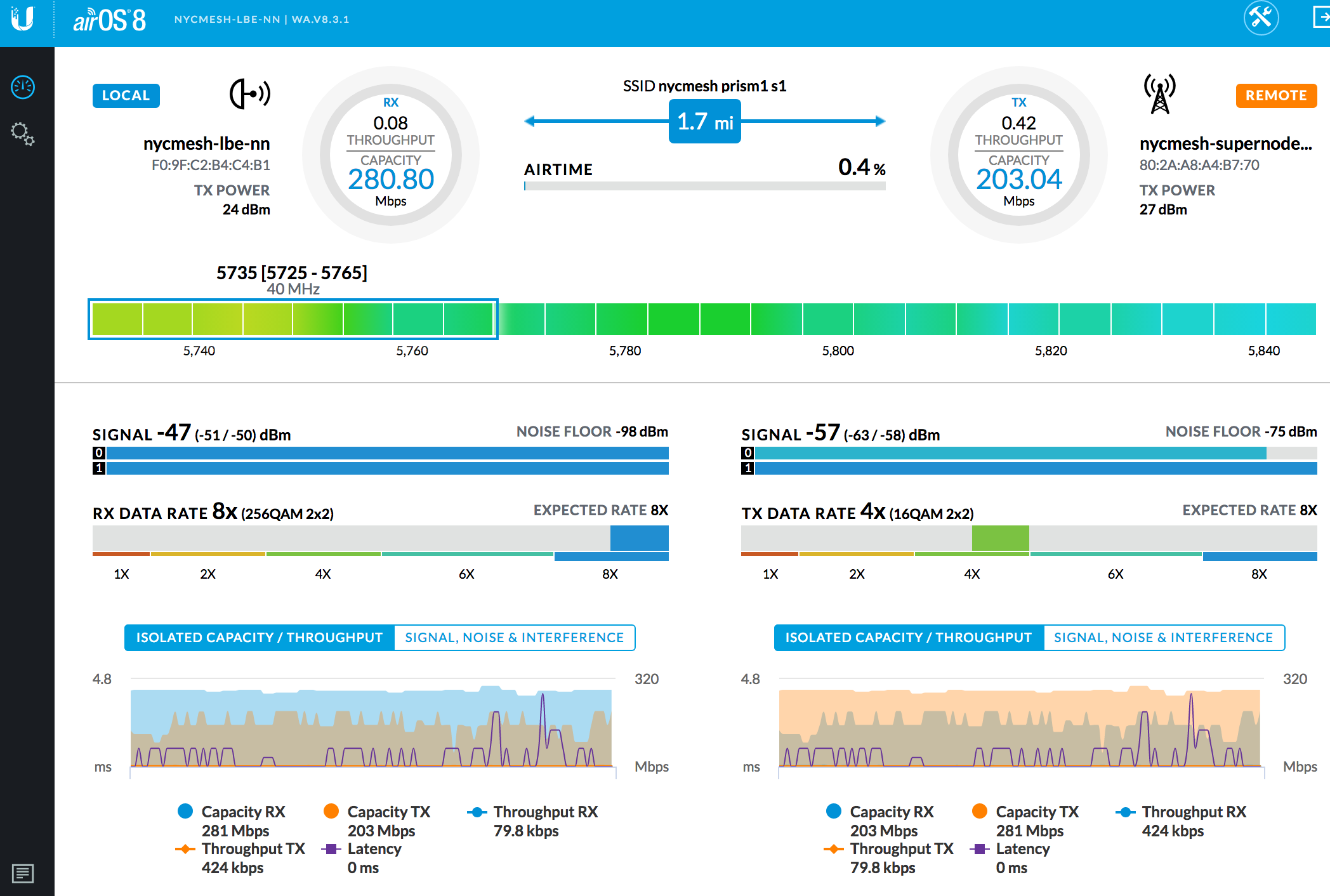
Yes the noise floor is bad, but we get about a 2 mile range which covers a huge amount of people in Manhattan. The Ubiquiti sector antennas use TDMA so it is not standard 802.11ac.

Screenshot of a UBNT p2mp at 2 miles in Manhattan please. The dashboard will show the distance. Please post.

https://nycmesh.net/panorama/1.7miles.png

That's a LiteBeam Gen1 installed in the east village on 5th St connected to 375 Pearl St downtown. The gen1 actually has a stronger signal than the gen2, so this is a bit better than our usual connection.

Re: 'Anti-authority' tech rebels take on ISPs, connect NYC with cheap Wi-Fi

#229

Earlier quoted context omitted.

> The number of edges scales O(n^2), where n is the number of people in the network. I don't see how this is true for any reasonable definition of "edge". It's certainly not the case that every node directly communicates with every other node; if they did, you wouldn't need a mesh.

A mesh network is defined as a network where the nodes connect to as many other nodes as possible. In the limit this is a complete graph with O(n^2) edges. It's true that in practice you won't have a complete graph but it's still less efficient than a more hierarchical, tree-like network structure.

Am I missing something here?

Let me approach your math with a reasonable argument:

Assume a 1 sq mile area (1mi x 1mi).

Assume each node has a 50 yard diameter reach.

If you space a node every 50 yards, you will have 35 nodes on a side, for a total of 1,225 total nodes.

Each node will only be able to physically connect to 3 other nodes on the edges, and 4 other for interior nodes.

That means the node connectivity is only .00326 for an interior node.

The longest path is diagonal across the square. Given the 35 modes on a side, and A^2 +B^2 = C^2, that means 35^2 = 35^2 = C^2. And c^2 = 2,450, meaning C = 50 (rounding up).

So I’m not sure how O^2 even applies in this example. Yes, it’s theoretically a max, but theory >Is this not correct?

Re: 'Anti-authority' tech rebels take on ISPs, connect NYC with cheap Wi-Fi

#230

There's an impressive amount of negativity in these comments. A community-run mesh network? HN should be all over it, but it appears to have turned into a bunch of network engineers telling us why they are very smart and it won't work, or is "insignificant". More power to you, NYC Mesh.

What's so ironically funny, is that this article is also on HN's front page:

https://www.newyorker.com/culture/cultural-comment/brilliant...

HN Comments: https://news.ycombinator.com/item?id=16980503

The jealousy amongst peers for non-recognition.

"More power to you, NYC Mesh." is the correct answer. Thumbs up tlrobinson.

Post reply on HN