Favorite quote: "Those at the top have learned how to suck out money from the rest in ways that the rest are hardly aware of—that is their true innovation." Rings true to me. That's why labor markets are purely competitive but the markets for products are dominated by price fixing. It's why you get more jail time for stealing a car than cheating your employees or customers to the tune of millions of dollars. And so o…
> markets We regularly hear people concerned about the hypothetical existential threat of a paperclip maximizer AI being invented in the future, yet this concern reliably ignores the AI overlords we already have : paperclip^Wprofit maximizing corporations. The VM for this type of AI has an incredibly slow clock rate and an extreme CISC ISA that often modifies itself in the RTC interrupt. The AIs are not a future thre…
Joseph Stiglitz Says American Inequality Didn’t Just Happen
171–180 of 222 posts
Re: Joseph Stiglitz Says American Inequality Didn’t Just Happen
#172Earlier quoted context omitted.
The S&P 500 is rebalanced periodically, meaning companies are removed and added. That makes it not a good assessment of the hypothesis, one needs to find something that is pinned to the S&P 500 one year, then tracks the same 500 companies over a given period of time, including those that drop out and excluding those that grow to be included in the time period of interest.
If the theory was correct, you'd see companies join the stock market with high valuations, and then trend downwards to oblivion as those long term chickens come to roost. But this is just not happening. Look how richly rewarded AMZN is for long term choices.
Periodic exceptions appear, almost always in winner-take-all network spaces over this period (energy companies being a possiblee exception), frequently showing a rapid rise and more precipitous fall. AT&T, IBM, Microsoft, Google, Amazon, among them.
https://www.forbes.com/sites/stevedenning/2012/01/25/shift-i...
Re: Joseph Stiglitz Says American Inequality Didn’t Just Happen
#173I've heard the argument before that you want to encourage, as the article calls it, rent seeking because it demonstrates flaws in the market/regulation and if more people exploit them they become more visible. When they're sufficiently visible they can be addressed by the public. It seems like this cycle must exist in order to make progress in economic regulation. It also feels like a society needs a strong leader wh…
Re: Joseph Stiglitz Says American Inequality Didn’t Just Happen
#174Earlier quoted context omitted.
> The thing that’s crazy is that this can cost 2-3 million dollars in many places in the Bay Area. The housing crises in affluent cities is absolutely the driving factor of our growing inequality issues. how can this be so? i agree it sucks that {insert middle class profession} can't afford a 3br in the bay area or NYC, but how can that be the root cause of inequality across an entire nation? there are tons of afford…
I also don't agree it's the root cause, but certainly it's a big contributing factor. Buying that 3 bedroom house in a more affordable area might be a smart idea, or it might severely limit one's economic mobility. Most of the jobs that mint new members of the upper / upper-middle class are based in big cities. Living elsewhere might mean trading class mobility for housing security, a trade-off that some don't have t…
i feel that this claim is exaggerated. anecdotally, i live in a suburb of a midsize city. i rent a 3br house for under $2k a month and there are tons of tech companies within a 25-45 minute drive of my dwelling. an entry level job at any of them would easily put a person in the high end of middle class incomes for this area.
to be sure, companies in the wealthiest US cities offer experienced employees compensation that is unmatched anywhere else. but for entry level and/or average skilled developers, it seems like SF, NYC, etc. are the only places where you aren't guaranteed an upper-middle class lifestyle.
Re: Joseph Stiglitz Says American Inequality Didn’t Just Happen
#175Earlier quoted context omitted.
If the theory was correct, you'd see companies join the stock market with high valuations, and then trend downwards to oblivion as those long term chickens come to roost. But this is just not happening. Look how richly rewarded AMZN is for long term choices.
Long term return on invested capital has been declining since the 1960s. Periodic exceptions appear, almost always in winner-take-all network spaces over this period (energy companies being a possiblee exception), frequently showing a rapid rise and more precipitous fall. AT&T, IBM, Microsoft, Google, Amazon, among them. https://www.forbes.com/sites/stevedenning/2012/01/25/shift-i...
Need to take into account the ever-greater share of the GNP consumed by the government.
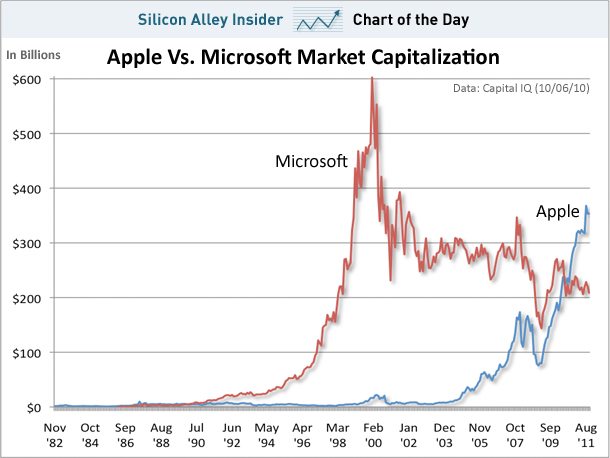
MSFT has been around for >30 years. Still waiting for their sacrifice of the long term to produce a precipitous fall.
Re: Joseph Stiglitz Says American Inequality Didn’t Just Happen
#176Earlier quoted context omitted.
The S&P 500 is rebalanced periodically, meaning companies are removed and added. That makes it not a good assessment of the hypothesis, one needs to find something that is pinned to the S&P 500 one year, then tracks the same 500 companies over a given period of time, including those that drop out and excluding those that grow to be included in the time period of interest.
If the theory was correct, you'd see companies join the stock market with high valuations, and then trend downwards to oblivion as those long term chickens come to roost. But this is just not happening. Look how richly rewarded AMZN is for long term choices.
Yes, Bezos made it clear that he was going to reinvest all profits for a long time. Although obviously some people thought this was a great strategy, it was considered quite unusual.
Google is another example of a company that has done very well while making it clear they were not going to dance to Wall Street's tune.
But the existence of notable exceptions doesn't disprove the overall trend. An awful lot of companies these days don't seem to be able to find any better use for their retained earnings than stock buybacks ... at a time when technological change is only continuing to accelerate. Even if overall R&D spending is up, as might not be too surprising in an era of record profits, it could be up a lot more.
Re: Joseph Stiglitz Says American Inequality Didn’t Just Happen
#177Earlier quoted context omitted.
Long term return on invested capital has been declining since the 1960s. Periodic exceptions appear, almost always in winner-take-all network spaces over this period (energy companies being a possiblee exception), frequently showing a rapid rise and more precipitous fall. AT&T, IBM, Microsoft, Google, Amazon, among them. https://www.forbes.com/sites/stevedenning/2012/01/25/shift-i...
> Long term return on invested capitalhas been declining since the 1960s. Need to take into account the ever-greater share of the GNP consumed by the government. MSFT has been around for >30 years. Still waiting for their sacrifice of the long term to produce a precipitous fall.
Re: Joseph Stiglitz Says American Inequality Didn’t Just Happen
#178But the American revolution being a revolution (as many of the others at the time) was for the benefit of the rich landowners. And the devolved nature of the Republic meaning that reforms that the UK and Europe went through haven't happened has nothing to do with it?
You fail to take into account the New Deal and many decades of progressive taxation, the Civil Rights act, etc. The current inequality crisis only got started for real in the 1980s.
The weak party system is another problem makes it much easier for fringe candidates and entryisiam to take place
Re: Joseph Stiglitz Says American Inequality Didn’t Just Happen
#179Earlier quoted context omitted.
> In 1950 he would have become a professor or gone to work for Bell Labs. Why wouldn't he have started one of the numerous profitable companies of the 50s? It seems more likely that an entrepreneur would do that rather than work in another field. > In 1998 he was able to start his own company and become a billionaire. This appears to prove Stiglitz' point doesn't it? There was no deficit of innovation in the mid 20th…
>This appears to prove Stiglitz' point doesn't it? There was no deficit of innovation in the mid 20th century, all without massive economic inequality. The main argument of Keynesianism always comes down to the baseline of wealth for all people though. The average person today is far wealthier than the average person in 1950, and that's the real goal. Not necessarily equality of outcomes for each individual.
The report below shows global wealth from 1960 - 2015.
Per capita average ingome has increased, from $8.8/day to $17.7/day, or about $3100/yr to $6200/yr. (Fig 2.1, p. 19.)
The ratio of income disparity between the US and the world's poorest country has increased, from 47:1 in 1950 (Tanzania) to 73:1 2000 (Sierra Leone). (Fig 22.3, p. 25.)
https://piie.com/publications/chapters_preview/348/2iie3489....
Multiple authorities state that the state of the poorest people in the world is worse now than at the beginning of tyhee Industrial Revolution. E.g., Gregory Clark, A Farewell to Alms, Chapter 1. Available online.
Re: Joseph Stiglitz Says American Inequality Didn’t Just Happen
#180Earlier quoted context omitted.
Long term return on invested capital has been declining since the 1960s. Periodic exceptions appear, almost always in winner-take-all network spaces over this period (energy companies being a possiblee exception), frequently showing a rapid rise and more precipitous fall. AT&T, IBM, Microsoft, Google, Amazon, among them. https://www.forbes.com/sites/stevedenning/2012/01/25/shift-i...
> Long term return on invested capitalhas been declining since the 1960s. Need to take into account the ever-greater share of the GNP consumed by the government. MSFT has been around for >30 years. Still waiting for their sacrifice of the long term to produce a precipitous fall.
Microsoft eventually climbed above its Dec 9, 1999 close. In late 2016.