Live data from Hacker News

An Update on Last Week’s Accident

tesla.com

71–80 of 447 posts

Re: An Update on Last Week’s Accident

#71
post #22

Earlier quoted context omitted.

Are you saying that the two paragraphs before this quote are inaccurate?

Consider this graf: > In the US, there is one automotive fatality every 86 million miles across all vehicles from all manufacturers. For Tesla, there is one fatality, including known pedestrian fatalities, every 320 million miles in vehicles equipped with Autopilot hardware. If you are driving a Tesla equipped with Autopilot hardware, you are 3.7 times less likely to be involved in a fatal accident. Let's put aside t…

Also, they've had 3 fatalities so far. If one fully occupied model x (5 people) crashes and kills everyone... it's back to the average. If the people in the other car die too, it's less than average.

That safety advantage can be wiped out in a single accident. Tesla has been lucky that all 3 have been occupied by a single person.
Re: An Update on Last Week’s Accident

#72

Really not much additional info here aside from the number of warnings the driver had. Also, the standard "Tesla is 10x safer" metrics that get pulled out each time a crash gets sensationalized. What I think they fail to address, especially in this case, is that the autopilot did something a human driver who was paying attention would never do. Autopilot does a great job of saving people from things even a wary drive…

I thought the auto pilot warned the driver to take control of the vehicle or is that incorrect? There is probably a lot more we don't know and it would be premature to place the blame on the auto pilot and Tesla. This isn't a lvl 5 system. It still requires the drivers attention and that is something we need to consider ( he obviously didn't have his hands on the wheel).

Technically tesla's statement says he was warned at some point to take control during his drive. That could have been 5 seconds into his commute, or it could have been 5 seconds before he hit the barrier. He may have taken control at that time, and then reengaged it later. He may or may not have been warned to take control before hitting the barrier.

Tesla's statement is not clear on this at all.

Re: An Update on Last Week’s Accident

#73
post #27

very deceptively crafted sentence. if i drove on AP for 15 minutes and i was alerted to put my hands on the wheel 2 minutes in. It would fit tesla's specially crafted statement. It makes it look like user was warned and didn't respond by putting their hands on the wheel but its completely false. The AP drove him straight into the barrier with no warning.

Here is the confusing sentence: (dots added) "The driver had received several visual and one audible hands-on warning earlier in the drive ... and the driver’s hands were not detected on the wheel for six seconds prior to the collision." https://www.tesla.com/blog/update-last-week’s-accident

It's not clear to me whether the "several visual and one audible hands-on" happened right before the crash (6-10 seconds), or the minutes before.

Re: An Update on Last Week’s Accident

#74
post #2

"The driver had received several visual and one audible hands-on warning earlier in the drive and the driver’s hands were not detected on the wheel for six seconds prior to the collision." Shouldn't you have more audible warnings than visual if you are aware that not complying will lead to an accident?

This feels particularly evasive. If you want to claim that your technology is 10x safer, you should be able to back that up with self-insurance, and not try to put the blame on the driver. If the autopilot does not think it is capable of driving safely, it should pull over to the shoulder of the road, not beep and flash.

Speaking of insurance, but not self-insurance:

I'm guessing that if I buy a Tesla with autopilot, I'm not going to find any insurers who will charge me discounted rates that reflect autopilot being 10x safer.

Re: An Update on Last Week’s Accident

#75

Earlier quoted context omitted.

It doesn't seem like pulling to the right would be safe in this situation. I think that automatically slowing down would be, though. Even slowing at a rate similar to a human letting their foot off the gas (to avoid unexpected behavior) would reduce the chance of fatality in a crash.

People pull over to the shoulder safely everyday. If an autopilot car cannot do this, it should not be on the road.

In this situation I think the lane to the right is not the shoulder. So in a situation where there are only seconds to respond to an obstacle, there might be cars blocking the Tesla on the right.

Re: An Update on Last Week’s Accident

#76
I have a lot of respect for Tesla, but this incident convinced me not to buy one any time soon. I have children with car seats. The fires that break out with battery right under the middle makes it impossible to save someone in the driver seat, let alone in the back.

More importantly, self driving cars are not the same - Waymo has lidar, Tesla and Uber don’t (correct me if wrong). If a system is clearly struggling with the detection of still objects in the middle of a highway, on a sunny day, it cannot be trusted. If I ever bought a Tesla, I wouldn’t use autopilot unless their hardware proves reliable.

Re: An Update on Last Week’s Accident

#77

Their statement blames: -The driver -The crushed barrier -Statistics But they do not take responsibility themselves. It's apparent and in my opinion shameful. If Tesla's goal of this is to just share the facts, why didn't they state what AutoPilot did? In addition to statements like "...the driver’s hands were not detected on the wheel for six seconds prior to the collision.", wouldn't it make sense to have a stateme…

To be fair, a famous person wasn't involved in this crash.

Re: An Update on Last Week’s Accident

#78
post #38
post #28

Earlier quoted context omitted.

https://www.tesla.com/blog/update-last-week%E2%80%99s-accide... >very deceptively crafted sentence. >The AP drove him straight into the barrier with no warning. Exactly - anyone who owns autopilot knows this.

It seems gross that they spend so much of this saying "yeah he died and it may be our fault, but statistically you're still better off as our customer." The atlantic had a relevant piece on the morality there this morning https://www.theatlantic.com/technology/archive/2018/03/got-9... And that's assuming they can identify that autopilot is statistically safer. If autopilot isn't used in the same conditions as all hum…

If that's literally the best case scenario, then that's pretty damn pitiful and a gross misleading of facts using statistics. It's a shame. Let's use "AP disengage" as the equating metric to human-caused crashes and see how it stacks up.

Re: An Update on Last Week’s Accident

#79
post #9

Earlier quoted context omitted.

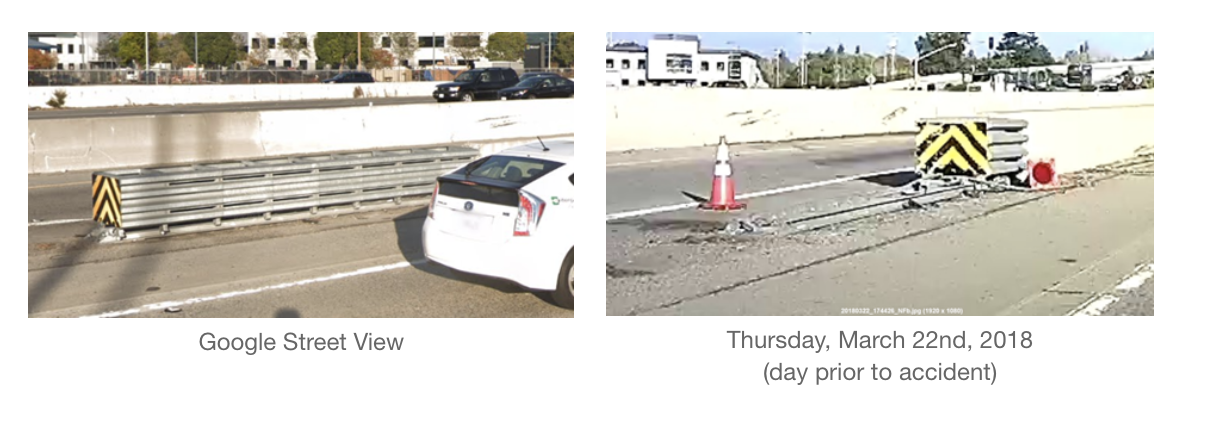
> the autopilot did something a human driver who was paying attention would never do. Then how did the crushed barrier get crushed before the Tesla hit it? Clearly, the stretch of road is unsafe enough to trick humans drivers (and, clearly, Tesla should improve).

I'm obviously not privy to the details of the prior crash, but I'm pretty sure any healthy human would not deliberately drive into the barrier. The most likely scenarios I can think of would be not paying attention and drifting into the barrier, attempting to avoid a car merging into the lane (and not paying enough attention), or being struck by another car and being forced into the barrier.

I think the answer is that the path into the barrier looks just like an actual lane, and that this was enough confusion that a human driver apparently had made the same exact mistake a week earlier. https://imgur.com/a/iMY1x

https://techcrunch.com/wp-content/uploads/2018/03/screen-sho...

Re: An Update on Last Week’s Accident

#80

Earlier quoted context omitted.

This feels particularly evasive. If you want to claim that your technology is 10x safer, you should be able to back that up with self-insurance, and not try to put the blame on the driver. If the autopilot does not think it is capable of driving safely, it should pull over to the shoulder of the road, not beep and flash.

No one shipping a Level 2 system provides insurance for it. The definition of Level 2 is that the driver has responsibility.

That's very troubling. If you saw the Uber crash cam on the driver it's obvious that the "responsible drivers" are completely non-responsive, on their phones, half asleep. A system that lulls the driver into a false sense of security does NOT pass responsibility to said driver.
Post reply on HN