Live data from Hacker News

Being frugal is for the rich

theoutline.com

111–120 of 305 posts

Re: Being frugal is for the rich

#111
post #97

Earlier quoted context omitted.

Sure, but that's not some kind of neutral, organic development. It's something the rich choose to do, in collusion with politicians, to increase their own wealth and power. Shifting all the "liability" onto workers, creating an economy where everyone but the wealthiest are fungible serfs, is a specific set of values and decisions advanced by these people because it benefits them.

It is _partly_ organic, or rather, technological. General Motors did everything in house (partly) for the same reason the hotel did: the computers needed to keep track of today's supply chain / subcontracting payments & management didn't exist. The efficient thing was to have one centralised payroll department cutting checks. But politics played a big role too. It deserves to be noted here that almost all the employe…

Businesses like Costco have supply chain dynamics as complex as any hotel chain, if not moreso, and they still manage to treat their employees better and more equitably.

I don’t disagree that technology has changed these dynamics, but the way power and wealth has been distributed in response to these changes is almost exclusively upward and to fewer and fewer people. Nothing about that is neutral or organic, unless you’re talking about the trajectory of wealth and political power under some Marxist analysis of Capital accumulation.

Re: Being frugal is for the rich

#112

Earlier quoted context omitted.

Rates do not matter unless they are over big time scales. You have conveniently picked a year just past the banking crisis... Does the absolute inflation and purchasing power adjusted value even match 90s?

Sounds to me like you’ve already made up your mind if “rates do not matter”. Because objectively they do.

AstralStorm's point is somewhat divergent from the thread of the conversation. It is that, for playing "catch-up" to years of wage stagnation, this month's wage growth rate doesn't mean much. We need years of high wage growth, not just one month or even one year. In this sense, AstralStorm is right that instantaneous rates do not in fact matter. And you sound like you're going to just label everyone who disagrees with you as having their mind already made up, rather than actually thinking about what they say.

That said, the original discussion was about the rate of wage growth as a measure of how tight the labor market is. In that sense, the instantaneous rate is fine.

So why am I harassing you about your answer to AstralStorm, when AstralStorm was disagreeing based on something that was outside the scope of the discussion at hand? Because of the way you answered, with dismissiveness rather than actually thinking about the point raised. That's not cool.

Re: Being frugal is for the rich

#113

I'm glad the wouldn't let something as Patently Right Wing as "being thrifty" to escape their journalistic gaze. it's super important to make sure that no stone goes unturned in the constant battle to find out who's keeping them down over there on "The Great Left". /s

There's nothing wrong with being thifty, but there is a lot of wrong in using "you're not thrifty" to explain systemic income inequality

if any portion of success can be explained by patterns of behavior, then portions of "systemic" income inequality can as well.

I'm emphatically NOT suggesting that poor people are only poor because they don't understand how to balance a checkbook, avoid predatory loans, and how to use the tax system to their advantage.

Re: Being frugal is for the rich

#114

Earlier quoted context omitted.

> continuing to build a world where they are more and more necessary My grandmother can still, to this day, recount living in an apartment with no furniture except a mattress, with my grandfather who was employed as an engineer in New York. It took, by her estimate, about two years to have enough furniture before she was willing to invite over any sorts of company. Today you can furnish an apartment reasonably with a…

That's a patently false statement. Inflation has been 3% a year for decades and wages have stayed flat. Your example of home furnishings has been improved by industrialization. Property value have skyrocketed, vehicle prices have skyrocketed, college, healthcare... Things you NEED have become way more expensive. Luxury goods have gotten cheaper.

Wages have remained flat when inflation is taken into account, i.e. real wages are flat, nominal wages continue to increase. We also have seen upward movement in median household income recently, and we should expect that trend to continue. So the idea of flat wages may be coming to an end.

What hasn't remained flat is the wages paid to the top N% which has greatly increased and accelerated the wealth gap. It is this gap that leaves people less satisfied despite being generally better off.

Re: Being frugal is for the rich

#115
post #93

The word missing from this discussion is "structural" - there are deep structural changes to how the job market and economy now works that limit the economic prospects of millennials (as a group) in ways that can't readily be overcome with thriftiness and hard work. Here's an excerpt of the article that really clarified this for me: "Thirty years ago, she says, you could walk into any hotel in America and everyone in…

Except they also had less. This is the ... I'm not sure of the right word, paradox? duality? ... anyway, the problem/benefit of globalisation, that it leads to cheaper stuff. We all have more today, even on less money. Thought experiment: ask yourself when it was better to be poor: 1950, or 2018. In 1950 you could... go to the library? In 2018, even the very poor likely have a mobile phone, the internet, a games cons…

"Ironically, I think that is pretty much how all cities work since crime went away. The days of the poor occupying prime real estate near a city is pretty much over."

This seems backwards. The poor never occupied prime (at the time) real estate, but cities did used to be more compact. The rise of crime (from the 60s) was one of the factors driving suburbanisation, as those who could afford to do so moved to more distant suburbs to be safer. Not just to have bigger lawns.

Their NIMBYism comes in part from this experience. Making sure your suburb stays expensive has the effect of helping it to stay safe, because it will only be occupied by people as rich as you, and will be able to afford plenty of police. Of course this is not the only effect. This protective blanket of high prices is an extremely blunt instrument, there is a lot of collateral damage. Nevertheless I think it's important to realise that NIMBYism isn't coming from nowhere.

Re: Being frugal is for the rich

#116

Earlier quoted context omitted.

> continuing to build a world where they are more and more necessary My grandmother can still, to this day, recount living in an apartment with no furniture except a mattress, with my grandfather who was employed as an engineer in New York. It took, by her estimate, about two years to have enough furniture before she was willing to invite over any sorts of company. Today you can furnish an apartment reasonably with a…

That's a patently false statement. Inflation has been 3% a year for decades and wages have stayed flat. Your example of home furnishings has been improved by industrialization. Property value have skyrocketed, vehicle prices have skyrocketed, college, healthcare... Things you NEED have become way more expensive. Luxury goods have gotten cheaper.

>Inflation has been 3% a year for decades and wages have stayed flat.

Every time I read this claim and go looking for data, I find data that says that real wages are roughly flat, which means that they have kept pace with inflation. (That's the definition of real wages: that they are in inflation-adjusted terms.) It seems a common journalistic (and often political) talking point to say exactly what you said, which makes the math or reading comprehension challenged assume something quite different. While the author or speaker is not technically lying, they are merely misleading the reader/listener with a confusing (and sometimes confused) combination of nominal inflation and real wages.

See figures 3 and 4 here: https://www.epi.org/publication/charting-wage-stagnation/

> Property value have skyrocketed, vehicle prices have skyrocketed

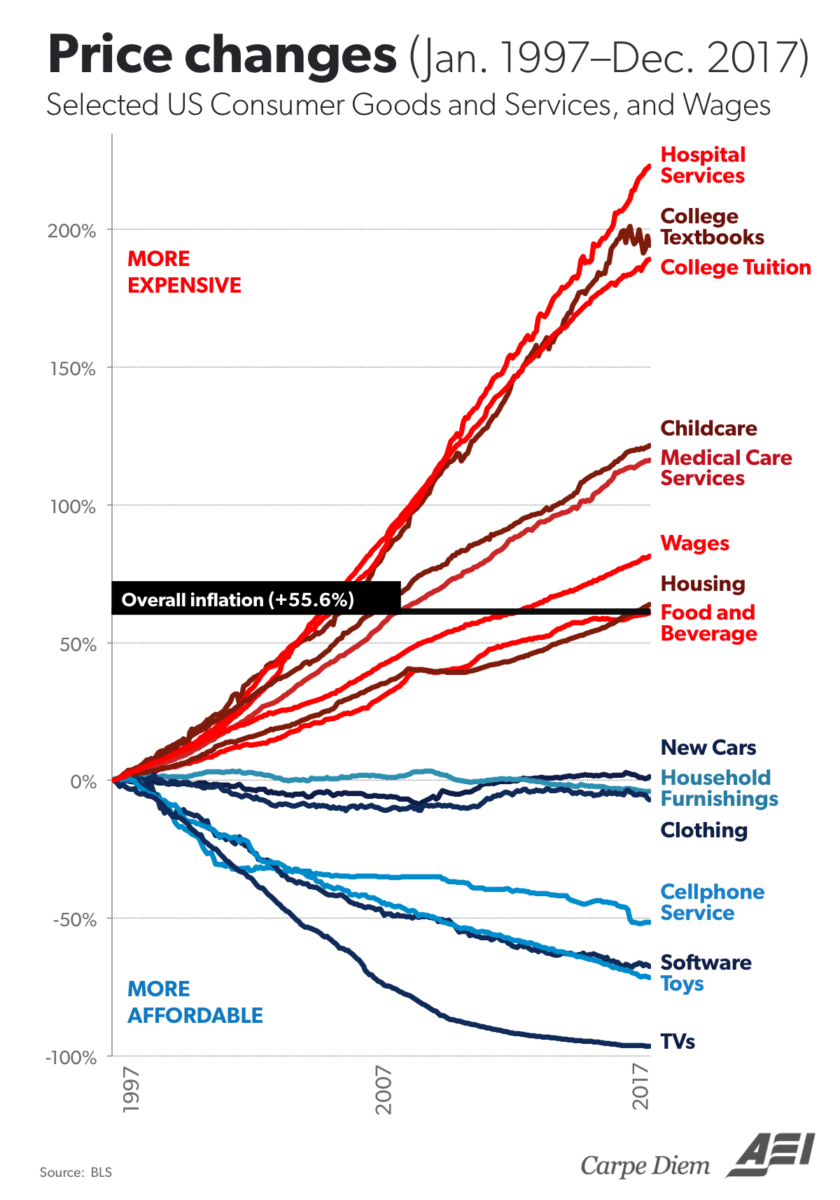
This next chart is in nominal dollars (meaning, not inflation adjusted): http://ritholtz.com/wp-content/uploads/2018/02/pricechanges....

It shows that vehicles have not gotten more expensive (even as they've gotten much, much better, safer, more reliable, etc) and that housing and food/beverages have inflated by less than wages and by roughly the same amount as general inflation (which is no great surprise, given that they are a substantial component of the inflation calculation and that it would be difficult to sustain inflation over a long period of time in a consumer-driven economy in the absence of [nominal] wage growth for consumers).

College and healthcare have indeed risen much more quickly than wages or general inflation.

Do you have contrary sources?

Re: Being frugal is for the rich

#117

I would also make the economic argument that a rich person that is still frugal is actively exacerbating income inequality. If Warren Buffett is indeed still paying only $3 for breakfast every day, that's giving a big middle finger to the economy. Money is half of the circulatory system of the economy. When it pools too long in one spot, it clots, and then a thrombosed clot can cause damage somewhere else. He really…

Why do you think spending more than he needs or wants to on breakfast is the most valuable use of his money? Surely re-investing it or other expenses will help far more people. As a sidenote, if you are spending all of your money after paying your bills off, it sounds like you're not saving anything, which is a recipe for disaster. You should most certainly not consider such a person to be miserly.

Consumption is the most valuable use of money. Saving is trading consumption now for consumption later. The later you delay your own consumption, the longer it will be until the person eventually providing your goods and services will actually be paid for them. Investment is somewhere in between, where you pay something in advance for the consumption to occur later.

I don't really care if Buffett spends on one $3000 breakfast sandwich, or 1000 $3 breakfast sandwiches, or 10000 $0.30 vaccinations, so long as he spends. He certainly has ample savings and investments for himself, and doesn't seem to intend to support his own descendants in a lavish lifestyle. That spending is what pays other people's living expenses. It is up to him to spend in a way that reflects his personal values and preferences, but if he chooses to accumulate wealth, rather than circulate it, that benefits only him, and no one else. Spending only $3 on a breakfast signals that Warren Buffet does not greatly value breakfasts, or the cultural practice of breakfasting.

That's fine. I'm not a big fan of it myself. But when I skip breakfast, I may be signaling that I don't have $3 to spend on breakfast.

Strictly speaking, hardly anyone does genuine saving anyway. Most people with money to save will deposit it in a bank, which then invests it and just pretends it is being saved through mathematical fictions. The recipe for anti-disaster is to spend on insurance and to buy financial instruments that promise a steady income. Burying your gold just makes you worry about where your gold is buried.

Once you have that $X in your portfolio, and are living comfortably on the 3% return from it that you can safely spend annually, then in my opinion, it is then your economic responsibility to spend that whole budgeted amount on things you like. If you aren't spending more, you must be entirely satisfied. And if you are entirely satisfied, you don't need more money to spend. If you don't need more money to spend, you don't need to buy additional income. And if you don't want to spend and don't need to invest, then what are you saving it for? If you continue past that point, you are crossing a rich-person event horizon where you can't send money out as fast as it comes in. You will start sucking ownership out of the economy and asphyxiating businesses that would otherwise be viable. In the end, you will either have to start frantically giving away money, people will have to start stealing it from you on a massive scale, or you will become a wealth singularity as everyone around you starves.
Re: Being frugal is for the rich

#118

Earlier quoted context omitted.

> continuing to build a world where they are more and more necessary My grandmother can still, to this day, recount living in an apartment with no furniture except a mattress, with my grandfather who was employed as an engineer in New York. It took, by her estimate, about two years to have enough furniture before she was willing to invite over any sorts of company. Today you can furnish an apartment reasonably with a…

Did your grandparents retire? At what age? How are they doing now? For comparison, when do you plan to retire? Now do the same run down for your entire cohort.

My grandfather retired at 67 due to failing health. He was primarily supported by his military pension, and to a smaller extent by a pension from working at a major grocery store. My grandmother only worked odd jobs, but collects a small amount of social security. She's still doing quite well and spends most of her time reading library books and painting (though notice both of those are extremely cheap hobbies).

I'm a distinctly unfair comparison, since I could retire as early as 55 to 60 (I doubt I will, I do terribly when left without something to do, but who knows.) That being said, I recognize my situation is very unlike most of my peers.

My cohort falls into three categories:

+ Those with high income and good financial management. Like me they are capable of retiring without any government assistance at 60ish in most situations.

+ Those with high income, but no financial management skills. Even now with no family to support and no "required" debts, they struggle to remain afloat. Simply throwing more money into the fire doesn't help it turns out.

+ Those with low income. Universally, and not for lack of intelligence, they have no 401k, no major longterm savings. If they retire it will be through programs such as Social Security (assuming it still exists). This is the group that worries me the most, because I don't have any answer for how to improve their situation. They're simply caught in the spiral of not having enough money to make progress on saving.

Please don't take my argument as "Everything is perfect now!". Mostly my argument is, "Things aren't majorly worse and are generally better." Nor am I making the claim that the future will forever be better - Social Security might collapse, pension programs dry up, etc. We shouldn't stop assisting the poor, teaching financial literacy, or behaving intelligently. Simply that the average condition of people is better than it was.

Re: Being frugal is for the rich

#119
post #85

The word missing from this discussion is "structural" - there are deep structural changes to how the job market and economy now works that limit the economic prospects of millennials (as a group) in ways that can't readily be overcome with thriftiness and hard work. Here's an excerpt of the article that really clarified this for me: "Thirty years ago, she says, you could walk into any hotel in America and everyone in…

What can the average person do about this system? It seems like it's only becoming more widespread.

Vote for candidates who will make healthcare a right and college affordable. While young people are bleeding out financially, rich people are getting a tax cut and they're running up the debt on the younger generation.

Re: Being frugal is for the rich

#120
post #7

Earlier quoted context omitted.

I guess this is the real motive behind the article: But here’s the thing. Regardless of intent, these Millennials are telling an older generation of elite Americans — the very people whose policies and financial decisions kneecapped the economy — what they want to hear: that everything is more or less okay, and young people just need to be more thoughtful about their money. And that’s a shitty idea to perpetuate. Bec…

> continuing to build a world where they are more and more necessary My grandmother can still, to this day, recount living in an apartment with no furniture except a mattress, with my grandfather who was employed as an engineer in New York. It took, by her estimate, about two years to have enough furniture before she was willing to invite over any sorts of company. Today you can furnish an apartment reasonably with a…

I think that you're correct.

People who knew me early on in certain contexts thought that I was "rich" comparatively speaking.

They didn't see the 10 year old car, 4 roommates (in a cheap city), camping vacations, sale clothes, etc. I was debt free quickly. I'm in a fairly well compensated gig now but kept the habits. The car is a 2003, my house is older, vacations are in nicer hotels but we drive, etc.

That's not to say that people have challenges that are tough... but so did I!

Post reply on HN