I feel as if the first part of that was somewhat related to the acquiring of Auctomatic.
Why There Aren't More Googles
81–90 of 161 posts
Re: Why There Aren't More Googles
#82I am seriously having issues visualizing someone saying "this is not a good idea" to google founders. Perhaps I am too young or perhaps S&L were terrible salesmen, but I simply fail to see how come a relevant search seemed like a bad idea to VCs they talked to: and this is not 1995 we're talking here, back when Google was starting it was clear to many that everything was going to be online, and finding stuff will be…
Google will be obsolete once the semantic web arrives ;) I remember being pretty skeptical of Google. Better search seemed like a nice idea, but it wasn't clear how they were going to compete with the established players who all had more money, more users, more engineers, more features, etc. Also, Google wasn't the only company trying to build a better search engine. It seemed like there was a new one every month.
Hate to break it to you, but the semantic web is a fairly tale, and is not arriving anytime soon.
Re: Why There Aren't More Googles
#83Earlier quoted context omitted.
I agree with your point here. Some ideas seem so radically out of touch, that they actually are out of touch. The founder of Intuit once said that 'your competition isn't other companies, but the way things are done now'. Some companies like to invent ideas about what people actually do. Therefore: observe how people spend their time, and make something that makes that better or more valuable. Then you can make sure…
That's a great quote, but I can't find the source. Do you have one?
You bet Paul, check out #3 on the following link: http://www.fitzblog.com/bid/2082/Seven-Startup-Lessons-from-...
I generally shy away from the numbered list blog format, but this is a classic read IMO.
Re: Why There Aren't More Googles
#84The startups who turn down acquisition offer do better thing might have a bit of reporting bias. ie. the ones that fail, we never think about. Except of course, there was a big famous example -- Friendster. http://www.nytimes.com/2006/10/15/business/yourmoney/15frien...
Holding off on early acquisition is a necessary but by no means sufficient condition of massive success.
That is, refusing early offers doesn't guarantee you'll be the next Google, but accepting one guarantees you won't.
Re: Why There Aren't More Googles
#85Earlier quoted context omitted.
Google will be obsolete once the semantic web arrives ;) I remember being pretty skeptical of Google. Better search seemed like a nice idea, but it wasn't clear how they were going to compete with the established players who all had more money, more users, more engineers, more features, etc. Also, Google wasn't the only company trying to build a better search engine. It seemed like there was a new one every month.
Hate to break it to you, but the semantic web is a fairly tale, and is not arriving anytime soon.
note the ;)
Re: Why There Aren't More Googles
#86The startups who turn down acquisition offer do better thing might have a bit of reporting bias. ie. the ones that fail, we never think about. Except of course, there was a big famous example -- Friendster. http://www.nytimes.com/2006/10/15/business/yourmoney/15frien...
[deleted]
Re: Why There Aren't More Googles
#87The startups who turn down acquisition offer do better thing might have a bit of reporting bias. ie. the ones that fail, we never think about. Except of course, there was a big famous example -- Friendster. http://www.nytimes.com/2006/10/15/business/yourmoney/15frien...
The other classic counterexample would be Be.
Re: Why There Aren't More Googles
#88It's great to hear discussion around Umair's thought patterns that add even more depth... I think what he was trying to say might be a little different from PG's interpretation... Umair might have said, "every company that had the potential to be economically revolutionary over the last five years sold out [to an acquirer devoid of strategic imagination or the capabilities to discontinuously continue their trajectory…
That clearly doesn't square with how you saw it These statements don't conflict. They didn't sell out to the highest bidder, because the highest bidder wasn't offering enough, but they had a number.
Right, I see.
I totally understand them...they were in a position to pick a number that said, "You know what, if someone actually puts this up, we can take the deal and have absolutely no regrets."
[If this stands to reason], it wasn't "outrageously high because they didn't want to sell"; it was just the true price.
They knew how enormous GOOG's potential was and acquirers didn't, hence the asymmetric information situation that leads to your thesis that "turning down reasonable offers is the most reliable test you could invent for whether a startup will make it big."
At least, that's how I'm reading it ;-)
Yay or nay, pg?
Re: Why There Aren't More Googles
#89For those needing funding in the middle range one option might be Band of Angels.
http://www.bandangels.com/entrepreneurs/index.php
I don't really know much about them, though.
Re: Why There Aren't More Googles
#90I am seriously having issues visualizing someone saying "this is not a good idea" to google founders. Perhaps I am too young or perhaps S&L were terrible salesmen, but I simply fail to see how come a relevant search seemed like a bad idea to VCs they talked to: and this is not 1995 we're talking here, back when Google was starting it was clear to many that everything was going to be online, and finding stuff will be…
Sergey and Larry were famous in the valley for supposedly being clueless about how business worked.
http://www.mathewingram.com/work/2006/12/04/let-me-cut-you-w...
I also know a guy that Sergey tried to recruit in the early years. Imagine if you saw this logo:
http://blogoscoped.com/files/google-com-history/1998.jpg
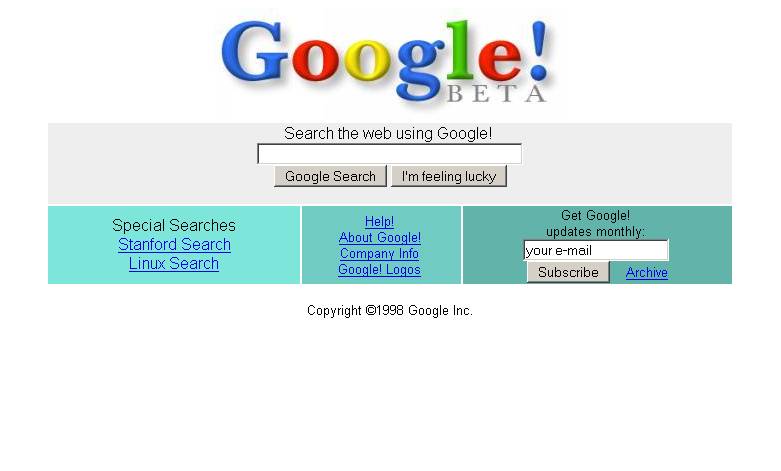
..on a business card printed out from a laser printer on ordinary office paper. The guy pushing this on you is some grad school dropout with a strange voice who keeps saying he's going to change the world.
Look like a winner to you?