Live data from Hacker News

Utility poles

blog.plover.com

51–60 of 213 posts

Re: Utility poles

#51
> There are three because that is one way to change the three-phase power to single-phase, something I wish I understood better.

No, that's not correct.

Three transformers is for changing 3 phase medium power, to 3 phase regular voltage (for commercial customers).

For single phase home customers, you run a single one of those phases along a street and attach center tapped transformers to it.

The center tap means from the top to the center is 120v, and from the center to the bottom is another 120v. This gives something called "split phase", and is how homes in the US are wired.

This allows you to get 240v in the house if you need it by attaching to the top and bottom of the transformer.

The center tap of the transformer is also attached to the ground, and to the neutral power line (back to the generator). This gives what is called "zero voltage" (voltage is always relative, there is no such thing as absolute zero voltage - so you just have to pick something, and call it zero).
Re: Utility poles

#52
post #48
post #41

Regarding three-phase power: The electrical outlets in your home have two power-carrying prongs. The third prong is just for safety (it connects to the ground), and should never carry power unless something is going horribly wrong. In that case, the power should hopefully prefer to reach the ground through that third wire than through your human body. Anyhow, the voltage in those two power-carrying wires is constantl…

Now: For two phase in your home, why is one side considered "hot" and the other side considered "neutral", resulting in keyed plug blades?

The two hot wires are perfectly out of phase, so connecting to both of them gives you 240V outlets (used for large appliances like clothes dryers).

Your standard 120V appliance outlets are only using a single phase and neutral. IIRC the smaller prong is hot and the larger prong is neutral.

Re: Utility poles

#53

Earlier quoted context omitted.

The pole numbering also helps in things like the work PG&E has to do checking for trees and other obstacles posing a risk to transmission lines. The report indicating where the work needs to be done (for instance to cut down a tree) uses the pole number as a point of reference.

Yes, I am intimately familiar with this as this was also part of the services that I was involved in delivering. One of the deliverables for utility clients we provided was every "fall in" or "drop in" line violation for high power transmission lines, including their "between" location in relation to adjacent poles on the corridor. I could talk about this subject for hours so let me know if you have any other questio…

What's a typical range of amperage for a distribution line?

Re: Utility poles

#54
post #34

> The cans are full of mineral oil, or sometimes vegetable oil! (Why are they full of oil? I don't know; I guess for insulation. But I could probably find out.) I think the oil's for cooling, actually.

I thought it was interesting so I looked it up. https://en.m.wikipedia.org/wiki/Transformer_oil

[deleted]

Re: Utility poles

#55
post #29
post #21

In Australia we have a life extension program for hardwood poles which slides a steel formed sock/support down the side to stabilise it for many a year more after a hard life. We had some issues with corrosive dog wee. Tar treatment sometimes works. Also steel collars to keep possums off the top structure. In Europe there are other platforms above the transform and wire complex for bird nests. Storks, cranes all abov…

Except for South Australia. I don't know if it was due to termites, lack of hard woods, fireproofing or an excess of steel and concrete but we embed concrete between two steel beams to create the iconic stobie pole which has doomed countless motorists. https://en.wikipedia.org/wiki/Stobie_pole

Stobie poles are used a lot in Italy and southern Europe. They all seem to be from the 1920s and have really bad "concrete cancer" and the underlying steel is rusting out. Quite picturesque in a "oh crap, there is 220v on top of this rusting pile..." kind of way.

"the prime of miss jean brodie" is set in pre-WWII scotland and an opening credit scene walks past two concrete lamp posts. My mother (who was an architectural historian) leaned over and said "anachronistic: that wasn't introduced until the 1950s" which goes to show fanaticism over street furniture and the poles is deep deep down...

Re: Utility poles

#56
post #34

> The cans are full of mineral oil, or sometimes vegetable oil! (Why are they full of oil? I don't know; I guess for insulation. But I could probably find out.) I think the oil's for cooling, actually.

I thought it was interesting so I looked it up. https://en.m.wikipedia.org/wiki/Transformer_oil

> Its functions are to insulate, suppress corona discharge and arcing, and to serve as a coolant.

Re: Utility poles

#57

I absolutely love reading about a topic from a super enthusiastic non-expert. I want to subscribe to a weekly series called "Reasonably Intelligent Person Obsesses Over Something"

Something that completely fascinates me are cell towers/equipment. They are everywhere, yet I know almost nothing about them and rarely get to see them up close. Even less often (pretty much never) meet anyone who work on the equipment. I imagine each base station is basically a mini datacenter. I was at Mammoth Mountain recently for the first time and got to see the cell towers at the top of one of the lifts up clos…

I would absolutely love a big writeup on how they're set up and what the components are, as well as all the real-estate stuff that certainly surrounds them. I'm also noticing a lot of new towers that look like big cylinders on a pole, sort of like a TACAN so I often wonder what's up with that.

I do know that the traditional ones are triangle shaped such that they each form the intersection of a hexagon tessellation (hence the cell in cellphone) such that you have three towers pointed into every hexagonal cell.

Re: Utility poles

#58
post #21

In Australia we have a life extension program for hardwood poles which slides a steel formed sock/support down the side to stabilise it for many a year more after a hard life. We had some issues with corrosive dog wee. Tar treatment sometimes works. Also steel collars to keep possums off the top structure. In Europe there are other platforms above the transform and wire complex for bird nests. Storks, cranes all abov…

As I understand it one of the largest concerns in AU are the wildfires damaging circuits connecting the disparate grids. There was some conversation about replacing some of the network poles with fire resistant poles in order to try and avoid the high number of outages caused by fires during the dry season. I'd be interested to know how that project went, and if it was successful.

Fire resistance is one of those complicated things. Its not necessarily true that wooden poles are a worse risk than other ones. Steel loses structural integrity under fire heat (ok.. please do not talk about jet fuel and planes...) so for some forms of fire, a wooden pole can survive.

I think most references to fire risk with electricity distribution are actually arguing for underground wiring in the longer term.

Re: Utility poles

#59
post #48

Earlier quoted context omitted.

Now: For two phase in your home, why is one side considered "hot" and the other side considered "neutral", resulting in keyed plug blades?

The two hot wires are perfectly out of phase, so connecting to both of them gives you 240V outlets (used for large appliances like clothes dryers). Your standard 120V appliance outlets are only using a single phase and neutral. IIRC the smaller prong is hot and the larger prong is neutral.

Fun fact - the reason outlets in new construction are installed upside down (ground prong on top) is that the groudn prong can stop this from happening if something falls on it:

https://i.redd.it/bm1gqw8hzppz.jpg

Of course that's an ungrounded plug so they're in trouble either way, but you get the idea.

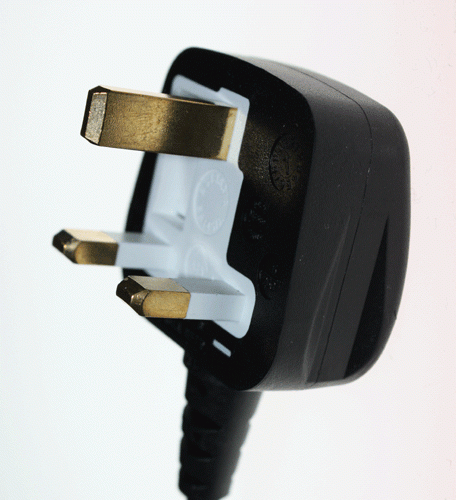
Another option (which I've never seen in the US) is plugs where the first chunk of the line/neutral prongs are insulated:

http://www.liddellappliancetesting.co.uk/ESW/Images/insulate...

Re: Utility poles

#60
post #45
post #41

Regarding three-phase power: The electrical outlets in your home have two power-carrying prongs. The third prong is just for safety (it connects to the ground), and should never carry power unless something is going horribly wrong. In that case, the power should hopefully prefer to reach the ground through that third wire than through your human body. Anyhow, the voltage in those two power-carrying wires is constantl…

This is the weirdest rationalization of three-phase power I've ever read. By your reasoning and disregarding cos phi issues, monophase power is also constant-zero power, since it's two wires anyway and one is always the opposite of the other. The best explanation of why three I was ever given hinged on "it's the number-of-phases argmin for the needed volume of wiring".

Three phase power is extraordinarily useful for electric motors. Mount three electromagnets radially and wire each up to a different phase, and you get a rotating magnetic field that spins on the axis. Electric generators produce three-phase power pretty naturally through the inverse process of spinning a magnet through the resistance provided by three groups of windings.
Post reply on HN