Live data from Hacker News

America's misguided culture of overwork

salon.com

51–60 of 192 posts

Re: America's misguided culture of overwork

#51
post #35

This guy has lots of facts wrong - makes you wonder about his accuracy in research: - no federally mandated six weeks of vacation time (though 4-5 weeks are the norm, even in private sector) - University tuition has been introduced recently (though still low, but will rise as obvious source of gov revenue) - Free nursing care / child care for a small percentage of toddlers only - No labor minister of that name (he is…

Vacations norm is more 5 to 6 weeks with 38h to 41h work week. That is, for all the people I know in Germany. (I know nobody with only 4 weeks). Please note that these are paid holidays, you have a lot of days off too (Christmas, etc.) The University tuition is about €500/year. Nursing/Day care for the kids (we have 3.5 and 1.5 year old kids) is from free to €200/€500 per month for both of them (it depends of your in…

There is a legal minimum amount of vacation though - IIRC it's something like 25 days/year.
Re: America's misguided culture of overwork

#52

This guy has lots of facts wrong - makes you wonder about his accuracy in research: - no federally mandated six weeks of vacation time (though 4-5 weeks are the norm, even in private sector) - University tuition has been introduced recently (though still low, but will rise as obvious source of gov revenue) - Free nursing care / child care for a small percentage of toddlers only - No labor minister of that name (he is…

It is four weeks (minimum). Please check: http://www.gesetze-im-internet.de/burlg/__3.html

It is 24 working days and since Saturdays count as working days: 24 / 6 = 4

It is called "Bundesurlaubsgesetz" -- my translation: Federal Vacation Law.

Does anything like that exist somewhere else?

Re: America's misguided culture of overwork

#53
post #18

Earlier quoted context omitted.

Well, it is more subtle than that, the distinction between wealth and money. For example, the Rothschilds cash fortune isn't comparable to the paper worth of someone like Gates. But arguably in any practical sense, the lifestyle they live, they're wealthier. European ideas about wealth are less about cash and more about (inherited/inheritable) tangible assets and connections to people at a similar level.

It's quite striking to read up on the differences in definitions of social classes between Europe and the US. In the US, class is almost entirely about income bracket, in Europe, class is mostly about your social network.

What's also interesting is that (as a culture) we don't stigmatize working class who've become rich, nor upper class who've become poor - but only efforts to cross the class boundary. Perjorative terms like "nouveau riche" and "mockney".

Re: America's misguided culture of overwork

#54

Earlier quoted context omitted.

But the Dutch, French, Scandinavian, and others aren't, and the those systems is very comparable to that of Germany. Many of the ideas originate from far before WWII, and had a strong presence (and development) in Europe since events such as the French revolution. It's America-centrism to think that all welfare and modernism is brought to the world by the USA. One typical anecdote a former exchange student told me, t…

Go educate yourself, the average Western-European citizen has more luxury, more free time, and better health-care than the average citizen of the United States (I know, I have visited the US often). Help me educate myself. Provide some evidence.

Of those three areas, only the "more free time" element is easy to compare:

http://en.wikipedia.org/wiki/Working_time

From those statistics it does look like the average citizen of the United States probably does work more hours in a year than the average citizen of the EU.

[Edited to remove the comment about "but not by a huge factor"]

Re: America's misguided culture of overwork

#55
post #45
post #33

I believe the author is wrong about GDP contribution of free tuition: "You know, it’s 50,000 dollars for tuition at NYU and it’s zero at Humboldt University in Berlin. So NYU adds catastrophic amounts of GDP per capita and Humboldt adds nothing." Granted, there are several approaches to calculating GDP but none of them ignores the government spending.

Ah, but does it cost the government of Germany 50,000 dollars for a years tuition?

Probably less but not zero as the author states.

Re: America's misguided culture of overwork

#56
This article is pure speculative narrative.

That is, whereas most essays make a thesis, then present evidence and arguments to support that thesis, this article presents a whole story spun out of thin air, involving FDR, national health insurance, vacations, the Chinese.

As such, it presents an interesting problem. You could argue with some detail --- such as the role Germany plays as a competitive partner in China -- and still it would have much of nothing to do with the rest of the essay. The thing is so loosely coupled it's impervious to criticism. I'm not sure whether to be impressed or disgusted.

I found this to be more of the same fairy tale we Americans have been telling ourselves for decades -- if only we were the Europeans. Things would be so much better. While Germans are doing some great things, we will never be Germany. Or Norway. Or Sweden. Personally I'd like to move beyond that and talk about the real country we live in.

Re: America's misguided culture of overwork

#57

Earlier quoted context omitted.

Go educate yourself, the average Western-European citizen has more luxury, more free time, and better health-care than the average citizen of the United States (I know, I have visited the US often). Help me educate myself. Provide some evidence.

Of those three areas, only the "more free time" element is easy to compare: http://en.wikipedia.org/wiki/Working_time From those statistics it does look like the average citizen of the United States probably does work more hours in a year than the average citizen of the EU. [Edited to remove the comment about "but not by a huge factor"]

"More free time" isn't the claim I was skeptical of.

Re: America's misguided culture of overwork

#58

Earlier quoted context omitted.

Go educate yourself, the average Western-European citizen has more luxury, more free time, and better health-care than the average citizen of the United States (I know, I have visited the US often). Help me educate myself. Provide some evidence.

Of those three areas, only the "more free time" element is easy to compare: http://en.wikipedia.org/wiki/Working_time From those statistics it does look like the average citizen of the United States probably does work more hours in a year than the average citizen of the EU. [Edited to remove the comment about "but not by a huge factor"]

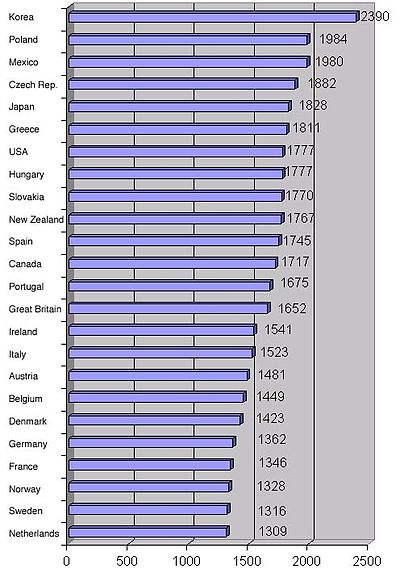
http://upload.wikimedia.org/wikipedia/commons/thumb/6/64/Yea...

I'm surprised that what are generally considered the richest countries are all at the bottom: Netherlands, Sweden, Norway, France, Germany, etc. The difference in working hours between those and the US is huge: 1307 - 1362 hours/year compared to 1777 hours/year.

Re: America's misguided culture of overwork

#59

Earlier quoted context omitted.

Go educate yourself, the average Western-European citizen has more luxury, more free time, and better health-care than the average citizen of the United States (I know, I have visited the US often). Help me educate myself. Provide some evidence.

Of those three areas, only the "more free time" element is easy to compare: http://en.wikipedia.org/wiki/Working_time From those statistics it does look like the average citizen of the United States probably does work more hours in a year than the average citizen of the EU. [Edited to remove the comment about "but not by a huge factor"]

My arithmetic may be wrong, but comparing the US figures with those of Germany, Americans work about 2 months more per year (8 hour days, 5 day weeks). Which is a lot.

Re: America's misguided culture of overwork

#60
It feels funny that Germany is being marked as the prototypical socialist country. We don't think of us like that.

It seems even in the US the state is paying for things (streets, school?), so the US is also socialist? It seems to me that by the definition that most US commentators seem to use, any country with taxes is socialist.

As for the health insurance, note that it is only mandatory for employed people. If you are a freelancer or business owner/entrepreneur, you can drop out of the social insurance system for the most parts (except if the government decides to use taxes to compensate for troubles with the pension plans, which is outrageous to me). In fact, it is a problem to get into the social insurance system if you are not employed.

While health insurance is expensive here, I don't think it makes us into a socialist country. In the real socialist and communist countries you were supposed to give up everything for the benefit of the state, and your idea of fun free time was hopefully voluntary farm work.

Post reply on HN