Live data from Hacker News

Being a perfectionist is an obstacle and how to beat it

mediatag.io

61–70 of 83 posts

Re: Being a perfectionist is an obstacle and how to beat it

#61
post #34

Earlier quoted context omitted.

>Is tapping into your flow state a similar thing to "being in the zone"? Yep, exactly! I could see people who try to control things too much having a hard time getting into that state/zone and replacing it with a long cycle of fussing, but that's just how I imagine it might work. Thanks for the reply :^)

That actually makes me think about 2 things now: 1. Being in the zone is good, but you may be functioning mostly on instinct, so the more experience you have, the better results you ll get. By that I mean that it s where that thing called craft helps you. You then have some techniques that you can rely on, and not only your gut feelings. 2. While being in the zone, it's still good to jump out of it and criticize your…

Flow states have been studied for a while now: https://en.wikipedia.org/wiki/Flow_(psychology)

I feel this diagram sums it up very succinctly: https://upload.wikimedia.org/wikipedia/commons/thumb/f/f6/Ch...
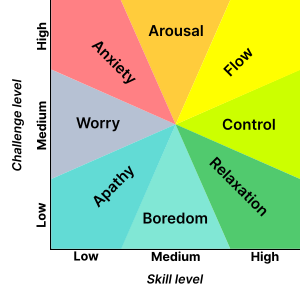
Powerful stuff.

Re: Being a perfectionist is an obstacle and how to beat it

#62
I think it may be too simple to say that perfectionism is bad. To me, it's one of two halves of the creative process. (At least in theoretical research, which is what I do, but I think this generalizes to other fields.)

You have one half where you need completely crazy and wild ideas, where it's vitally important to get started and not be paralyzed because you think that something is stupid or wrong or will not work. Here perfectionism is an enemy.

But you have the other half where you look at what you did and you try to figure out how good it is, and how it can be improved. Here, perfectionism is important because it's what will point out to you the flaws in what you have done so far.

I think the best work is created by iterating between these two mindsets. (It's even better if you can iterate with someone, where you go over what the other did until you converge.)

So I think perfectionism is something that can drive you to improve, as long as you retain the capacity to turn it off half the time, especially where you're trying to get started.

Re: Being a perfectionist is an obstacle and how to beat it

#63
post #20

I'm really skeptical of this attitude. In a lot of fields I've seen people who commit themselves to "just getting it done." The result is that they do get a lot of work done: and it's bad, it's mediocre, it doesn't have value. On the other hand, one can easily think of creators who spent a long time on one work (maybe "too much" time), and the result was work of lasting value. Of course, this relates more to artistic…

> Great things come from people being impractical Yes, but in my experience this is more an exception, compared to the vast majority of people who never ship anything, because "it's not quite right yet". That's where the danger lies. And I think there are plenty of similarities between art and tech, regarding this. For a web app, it will have to be shared before growing in quality and becoming great. Github, Basecamp…

As someone who spent the first ten years of their career desperately trying to salvage one steaming heap of technical debt and security disasters after another, I think we have wildly diverging opinions of the consequences of software development driven primarily by just trying to get something committed and out there.

In my opinion, every single one of these companies was effectively a zombie: dead, but unaware of it.

Re: Being a perfectionist is an obstacle and how to beat it

#64
post #46

Earlier quoted context omitted.

99% of people who rant against perfectionism don't understand how wholly perfectionism takes over your thought process and that people who suffer from perfectionism are not characterized by "perfect" finished products, or even necessarily describing themselves as such. Rather, it can be a crippling subconscious mindset that inhibits productivity, creativity, and learning. In other words, the "causes" you identify in…

I say that if you really were perfectionist you would deliver. If it's not delivered you can't really call it perfect.

That's a fine opinion, but it's ignorant of the entire body of CBT research.

And inasmuch as you merely disagree with it because you think it's the wrong term, well, that's even shakier ground, because the formal definition of language follows from its real-world usage.

Re: Being a perfectionist is an obstacle and how to beat it

#65
post #62

I think it may be too simple to say that perfectionism is bad. To me, it's one of two halves of the creative process. (At least in theoretical research, which is what I do, but I think this generalizes to other fields.) You have one half where you need completely crazy and wild ideas, where it's vitally important to get started and not be paralyzed because you think that something is stupid or wrong or will not work.…

Absolutely. No extreme is ever good. Shipping and forgetting is a recipe to do mediocre work.

But I rarely witnessed that.

What I see very often, though, is people not feeling ready to share what they have. And I've been in countless conversations to urge people to fight this instinct (which I'm guilty of too often as well).

Re: Being a perfectionist is an obstacle and how to beat it

#66
post #54
post #40

Many of the most intelligent and capable people I know suffer from impostor syndrome to some degree. It can vary from worrying that you might not be as good as your peers, to being afraid to release something because you're worried it's not perfect yet, to a paralyzing inability to start, because you're stuck in a mental loop overthinking dependencies and prerequisites. Smart people spend lots of time learning, think…

I am at my best when I don't really care too much about being good. Sadly this is hard to impossible to force.

I wouldn't say it's impossible. There are a few ways to fight this feeling.

First, try and understand why you care so much, if that excess of care is giving you too much pressure.

Maybe you care too much because that's your livelihood, and that prevents you from taking risks? In that case, try and shop for other jobs and maybe seeing what other options are available will make you be more relax.

Or maybe you care too much because the timing means you have only one shot at whatever you're working on? Then work beforehand on having more options. Or lowering the risk of your project failing. Think about a plan B, or C.

What I'm trying to say basically is that if you feel that you're at your best when you don't care too much, find ways to create that distance or relaxation. That might need some time, logistics, or introspection, but it's certainly worth it.

Re: Being a perfectionist is an obstacle and how to beat it

#67
post #63
post #20

Earlier quoted context omitted.

> Great things come from people being impractical Yes, but in my experience this is more an exception, compared to the vast majority of people who never ship anything, because "it's not quite right yet". That's where the danger lies. And I think there are plenty of similarities between art and tech, regarding this. For a web app, it will have to be shared before growing in quality and becoming great. Github, Basecamp…

As someone who spent the first ten years of their career desperately trying to salvage one steaming heap of technical debt and security disasters after another, I think we have wildly diverging opinions of the consequences of software development driven primarily by just trying to get something committed and out there. In my opinion, every single one of these companies was effectively a zombie: dead, but unaware of i…

Do I understand you right that Github, Basecamp, Twitter are or were zombies?

If that's what you are saying, I'd love you to elaborate, because I can't see how one could see this.

Re: Being a perfectionist is an obstacle and how to beat it

#68
After studying and felt in love with machine learning, I think I have succeeded in analytically dealing with my perfectionism. In my case, I was always trying to achieve a local minimum with the cost of 0, and it was overfitting. I was more into integers and algebraic equality rather than floating-point numbers, analytic inequality, probability, and statistics. But after studying machine learning and the related stuff, somehow my mind changed and I now embrace the latter. What is important for me now is to visualize a cost, try to minimize for a general case, stop when passing a threshold, and carefully monitor the whole process. I can plot my current position or cost and see how it change over time and happily stop when things not go well, which I couldn't do in the past that harmed me.

Re: Being a perfectionist is an obstacle and how to beat it

#69
post #34

Earlier quoted context omitted.

That actually makes me think about 2 things now: 1. Being in the zone is good, but you may be functioning mostly on instinct, so the more experience you have, the better results you ll get. By that I mean that it s where that thing called craft helps you. You then have some techniques that you can rely on, and not only your gut feelings. 2. While being in the zone, it's still good to jump out of it and criticize your…

Flow states have been studied for a while now: https://en.wikipedia.org/wiki/Flow_(psychology) I feel this diagram sums it up very succinctly: https://upload.wikimedia.org/wikipedia/commons/thumb/f/f6/Ch... Powerful stuff.

Excellent, thank you for those links. I will read them carefully.

Re: Being a perfectionist is an obstacle and how to beat it

#70
post #67
post #63

Earlier quoted context omitted.

As someone who spent the first ten years of their career desperately trying to salvage one steaming heap of technical debt and security disasters after another, I think we have wildly diverging opinions of the consequences of software development driven primarily by just trying to get something committed and out there. In my opinion, every single one of these companies was effectively a zombie: dead, but unaware of i…

Do I understand you right that Github, Basecamp, Twitter are or were zombies? If that's what you are saying, I'd love you to elaborate, because I can't see how one could see this.

The companies I was referring to are the companies I had worked for in the past, that were saddled with irrecoverable technical debt as a result of “just ship it” with no regard to craftsmanship.
Post reply on HN