Live data from Hacker News

Interpreting a market plunge

economist.com

31–40 of 157 posts

Re: Interpreting a market plunge

#31
post #8

The bigger concern is on the interest rate hikes. Low rates were expected to help kickstart the economy and prices and wages to increase. What has happened instead is that all the cheap money has caused asset inflation. US companies now have record amount of debt. Too fast increase in interest rates will cause their debt obligations to balloon and lower profitability. Though this will take couple of quarters to fully…

US companies now have record amount of debt.

Yes, and the economy is at record size, nothing surprising here.
Re: Interpreting a market plunge

#32
post #28

Earlier quoted context omitted.

Why is it that everything these days gets blamed on algorithms? Seems like intelectual laziness to me. "Algorithms did it, there's no sense to it, lets not think too hard."

I don't believe algorithms decide the direction of markets, but it's pretty clear that they amplify effects triggered by real-world conditions. HFT trading is just a way to make money, and things like large market swings, high trade volumes etc. provides interesting exploits to do exactly that. You could call it 'intellectual laziness', I would call it Occam's razor.

You realize that these things happened before computers too, right? Saying "algorithms did it" is as much of Occam's as saying "god created the universe": it's certainly an easier explanation than studying high-energy physics.

Re: Interpreting a market plunge

#33
post #8

The bigger concern is on the interest rate hikes. Low rates were expected to help kickstart the economy and prices and wages to increase. What has happened instead is that all the cheap money has caused asset inflation. US companies now have record amount of debt. Too fast increase in interest rates will cause their debt obligations to balloon and lower profitability. Though this will take couple of quarters to fully…

You see, the problem that I have with these kind of "explanations", is that those facts have been around for a long time. Why is it that precisely today (well, yesterday) was the day that everyone decided "right guys, we're selling equities"? The things you describe explain why people keep their finger hovering over the "sell" button, they don't explain why precisely today they decided to press it.

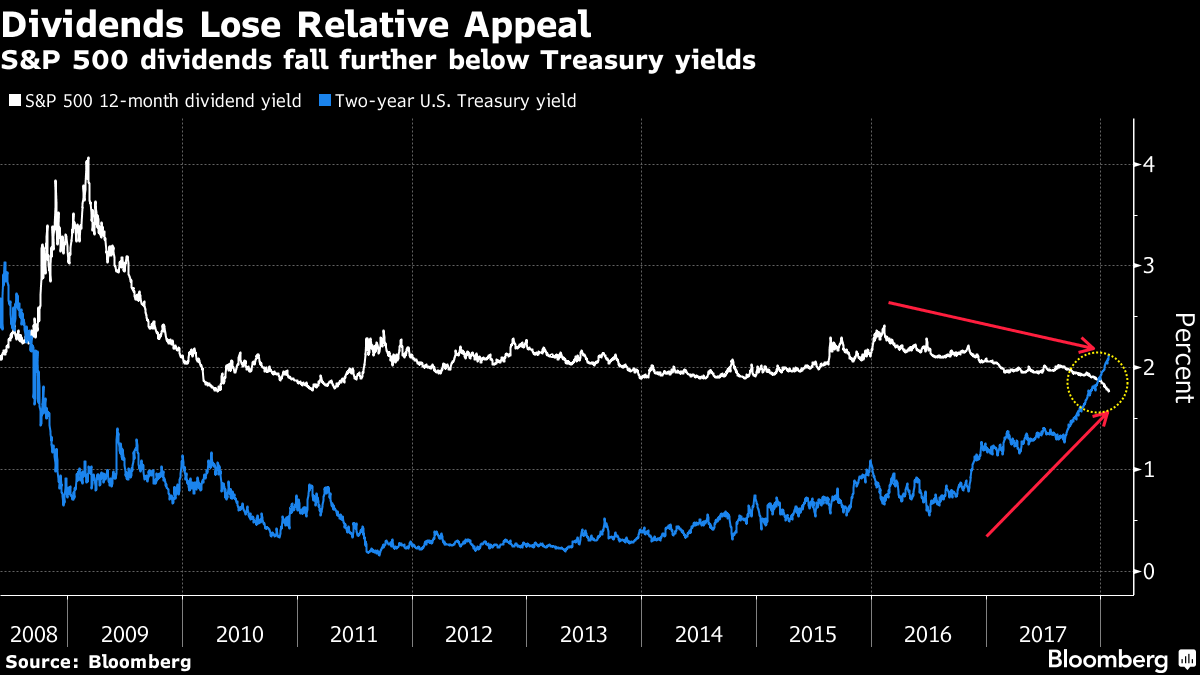
The 10 year treasury yield has recently strongly overtaken the S&P 500 dividend yield. That aggressive shift is guaranteed to end such a bubbly bull market run.

https://assets.bwbx.io/images/users/iqjWHBFdfxIU/i9Zchv.nY_N...

The treasury move since September is one of the most aggressive of the last five years.

What happened is simply an inflection point. Markets operate heavily by trigger points. Those are getting taken out, sparking reactions (selling, asset allocation adjustments). The Dow went up three thousand points in two months, after the market was already at bubble price levels on multiples.

Shiller PE:

http://www.multpl.com/shiller-pe/

These valuation levels are batshit crazy. It doesn't take much to crash something that over-extended.

Let's be realistic here. Where was this market going from there? Dow 36,000 by 2019? A 45 PE for the S&P 500? It'll already take ten years of 3% US GDP expansion and higher global growth to bring the S&P's earnings multiple back to being close to reasonable.

Re: Interpreting a market plunge

#34

Earlier quoted context omitted.

You see, the problem that I have with these kind of "explanations", is that those facts have been around for a long time. Why is it that precisely today (well, yesterday) was the day that everyone decided "right guys, we're selling equities"? The things you describe explain why people keep their finger hovering over the "sell" button, they don't explain why precisely today they decided to press it.

The 10 year treasury yield has recently strongly overtaken the S&P 500 dividend yield. That aggressive shift is guaranteed to end such a bubbly bull market run. https://assets.bwbx.io/images/users/iqjWHBFdfxIU/i9Zchv.nY_N... The treasury move since September is one of the most aggressive of the last five years. What happened is simply an inflection point. Markets operate heavily by trigger points. Those are getting t…

I hear you. So are you saying that the 10-year yield compared to the S&P dividend yield is one of these trigger points?

Re: Interpreting a market plunge

#35

Earlier quoted context omitted.

Why today(and Friday)? People track government data to form opinions. and first Friday of the month is very important because of a data point called Non-Farm Payroll or NFP. It is known to cause a lot of movement in the markets. Lot of brokers will tell you not trade during the announcement. You can see a lot of opinions on what was expected to happen on Monday by googling for NFP. Case in point: https://www.cnbc.com…

> Second, it seems you think these decisions are binary - to be or not to be or rather sell or not sell. It's not that simple. Lower markets doesn't mean everyone has sold off all their shares. They just reduce probabilities of their losses by reducing exposure. No. Obviously when I say "everyone decided to sell" I'm speaking figuratively. In any case, thanks a lot for that link. Cool stuff, I didn't know about the N…

Tiny bit of data? I can only say this - check out some older NFP releases and see what happens when there is a huge difference between the expected and actual data. During Greenspan's era there was another data point which was monitored a lot. I forgot the exact data point name.

In the current NFP consensus on this one was 181k while the report was 200k which is nearly 10% variation from the expected value.

As for treasuries, the upward movement is expected. It is considered to be a safe asset in the sense that there is a fixed return. Equities on the other hand are considered risky assets. So, for the most part they are negatively correlated. Markets are down, then bonds should go up.

That said, markets and crowd wisdom are not perfect and don't always reflect all the information correctly all the time.

Re: Interpreting a market plunge

#36
post #8

The bigger concern is on the interest rate hikes. Low rates were expected to help kickstart the economy and prices and wages to increase. What has happened instead is that all the cheap money has caused asset inflation. US companies now have record amount of debt. Too fast increase in interest rates will cause their debt obligations to balloon and lower profitability. Though this will take couple of quarters to fully…

This was always going to happen. Instead of trickle down we should be practicing filter up economics. Give the money to the people that need it so they can service their debts rather than turning the debts into derivatives and isolating them from the real economy.

Re: Interpreting a market plunge

#37

HODL, right! I am, anyway. The standard advice ("Buy low-cost index funds with dividends reinvested, keep buying on a regular basis, let it ride and don't worry about the plunges and the peaks") told us this would happen, and here we are. How to interpret it? I'd go so far as to ask should we interpret it? They get paid for coming up with reasons why things happened (after the fact, I note, although the Economist has…

Had to Google HODL and learned it means 'hold', in the context of crypto currencies losing value.

Can't comment on that, but for stocks, definitely yes. Historically, the market has always recovered from slumps. I know this does not mean it always will, but lots of people dropped out of the stock market after the crashes in 2001 or 2008 - for them, it would have been wiser to hodl.

Re: Interpreting a market plunge

#38
post #8

The bigger concern is on the interest rate hikes. Low rates were expected to help kickstart the economy and prices and wages to increase. What has happened instead is that all the cheap money has caused asset inflation. US companies now have record amount of debt. Too fast increase in interest rates will cause their debt obligations to balloon and lower profitability. Though this will take couple of quarters to fully…

>Low rates were expected to help kickstart the economy and prices and wages to increase.

You're confusing the sales pitch used to justify low interest rates with what they were expected to do. They were expected to bail out insolvent banks and save them from the consequences of their collective bad decisions. Not raise wages. Not kickstart the economy. Fiscal stimulus is how you do that and they knew that.

Had politicians instead gone to unions and asked "what the fuck should we do now?" the answer likely would have been "let those fuckers go under, fire/lock up all management that had fraud going on underneath them, nationalise the systemically important institutions and counteract the economic contraction brought on by a wave of banrkuptices with fiscal stimulus."

That's no good though because reliable political donors like Jamie Dimon would be in an orange jumpsuit and wages might actually go up (bad for profits). So we got the band aid that was zero interest rates that kept the current lot on Wall Street who blew up the economy and encouraged fraud in a position where they still get to direct it.

Re: Interpreting a market plunge

#39

HODL, right! I am, anyway. The standard advice ("Buy low-cost index funds with dividends reinvested, keep buying on a regular basis, let it ride and don't worry about the plunges and the peaks") told us this would happen, and here we are. How to interpret it? I'd go so far as to ask should we interpret it? They get paid for coming up with reasons why things happened (after the fact, I note, although the Economist has…

Had to Google HODL and learned it means 'hold', in the context of crypto currencies losing value. Can't comment on that, but for stocks, definitely yes. Historically, the market has always recovered from slumps. I know this does not mean it always will, but lots of people dropped out of the stock market after the crashes in 2001 or 2008 - for them, it would have been wiser to hodl.

FYI, the origin of HODL: https://bitcointalk.org/index.php?topic=375643.0

Re: Interpreting a market plunge

#40

Earlier quoted context omitted.

> Second, it seems you think these decisions are binary - to be or not to be or rather sell or not sell. It's not that simple. Lower markets doesn't mean everyone has sold off all their shares. They just reduce probabilities of their losses by reducing exposure. No. Obviously when I say "everyone decided to sell" I'm speaking figuratively. In any case, thanks a lot for that link. Cool stuff, I didn't know about the N…

Tiny bit of data? I can only say this - check out some older NFP releases and see what happens when there is a huge difference between the expected and actual data. During Greenspan's era there was another data point which was monitored a lot. I forgot the exact data point name. In the current NFP consensus on this one was 181k while the report was 200k which is nearly 10% variation from the expected value. As for tr…

I hear you, but it's still interesting to think that high inflation expectations means both bonds and stocks down, but much higher inflation expectations means stocks crash and therefore bonds is safe so they go up :-) Put differently, I could also argue that bonds up is irrational given higher inflation expectations and this move up will be short lived. Time to short bonds ;-)

Will check out older NFP, thanks.

> Tiny bit of data?

I phrased it all wrong. What I wanted to convey is a lot of data points slightly pointing in one direction, none of which move anything individually, but at some point people realize that everything in pointing in a downwards direction, and get scared.

Anyway, thanks for the chat.

Post reply on HN