Earlier quoted context omitted.
He’d been innovating extensively. He’d been having trouble with students who had nothing to say. At first he thought it was laziness but later it became apparent that it wasn’t. They just couldn’t think of anything to say. One of them, a girl with strong-lensed glasses, wanted to write a five-hundred-word essay about the United States. He was used to the sinking feeling that comes from statements like this, and sugge…
Err, Bozeman doesn't have an opera house. Certainly not one with a burger stand across Main Street. Just sayin' ;)
Reality has a surprising amount of detail (2017)
91–100 of 304 posts
Re: Reality has a surprising amount of detail (2017)
#92I've always thought the whole idea of virtual reality is strange. Why would I want to experience the world through VR when I can experience reality instead? I suppose there are exceptions where it makes sense. Maybe if someone is physically incapable of having an experience, or the risk is too high, but for the most part I derive more joy from actually going outside and doing stuff than playing a video game equivalen…
Re: Reality has a surprising amount of detail (2017)
#93>Do you remember the insights that were crucial in learning to ride a bike or drive? The author mentioned bicycles and inadvertently missed an opportunity to show another "unknown reality" that beautifully illustrates his point. Consider typical adults (not physicists) with 20+ years of bicycle riding. If you ask them, "how does a bicycle turn?" , they'd respond that "you just lean into the direction of the turn and…
Have you actually tried turning a bicycle without countersteering? I have, the last time the topic was discussed on HN. I found I was able to turn without any perceptible countersteer. It's technically possible that I do have to countersteer for a small number of miliseconds over a small number of milimeters, but my experience leads me to doubt it.
Re: Reality has a surprising amount of detail (2017)
#94Earlier quoted context omitted.
The problem isn't people not admitting ignorance online. The problem is that the internet might be the cause of people not admitting ignorance in real life.
As a person who basically made it through college without internet, I can tell you that I had just as much trouble admitting I was wrong when I didn't have access to the internet, perhaps more because I was younger and more hotheaded.
Re: Reality has a surprising amount of detail (2017)
#95And it's also why I think he paperclip maximizer and gray goo scenarios are silly. Maybe it's theoretically possible to create something that would eat the world, but in order to do so, it would have to overcome every obstacle the world throws at it. Again, easy to imagine, extremely hard to realize. All those details get in the way.
Re: Reality has a surprising amount of detail (2017)
#96>Do you remember the insights that were crucial in learning to ride a bike or drive? The author mentioned bicycles and inadvertently missed an opportunity to show another "unknown reality" that beautifully illustrates his point. Consider typical adults (not physicists) with 20+ years of bicycle riding. If you ask them, "how does a bicycle turn?" , they'd respond that "you just lean into the direction of the turn and…
Have you actually tried turning a bicycle without countersteering? I have, the last time the topic was discussed on HN. I found I was able to turn without any perceptible countersteer. It's technically possible that I do have to countersteer for a small number of miliseconds over a small number of milimeters, but my experience leads me to doubt it.
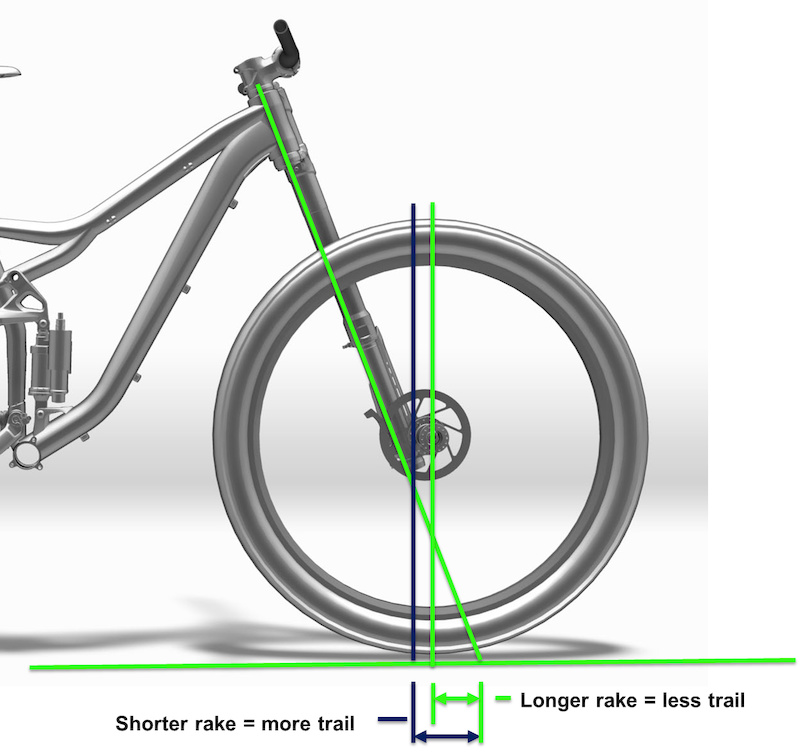
When the wheel is forward of the axis of steering, you don't need to countersteer for small turns. When you turn the bars, the contact point on the wheel moves forward and to the side, dropping the front of the bike down and tilting it into the direction of the turn for you. That mimics the effect of countersteer. It's also one of the factors that makes some bikes, like mopeds, easier or harder to control.
During harder turns, the amount of lean created by the rake angle is less than required and you do need to countersteer. It's very hard to notice even when you're actively looking for it though.
Re: Reality has a surprising amount of detail (2017)
#97Earlier quoted context omitted.
Have you actually tried turning a bicycle without countersteering? I have, the last time the topic was discussed on HN. I found I was able to turn without any perceptible countersteer. It's technically possible that I do have to countersteer for a small number of miliseconds over a small number of milimeters, but my experience leads me to doubt it.
A moped (and I assume a motorcycle) is a lot harder to turn without countersteering. I’m not sure if that’s because it’s more massive or what. Anyway, learning to ride a moped was when I first consciously discovered countersteering. It made things a lot easier after that point.
Re: Reality has a surprising amount of detail (2017)
#98The way he does it, with the angle brackets? That's the easiest way, and by far the weakest. The strongest way is to notch out 2x12's (ideally at least 3, with one in the middle). Oh, and no step can be more than 1/8" difference in rise vs any other stair. This much harder, though.
Combine this with the math to know how many steps you need, and what angle the stairs need to lean overall (this one he touches on), and it's a real pain. Fail, and people get hurt. Your body is pretty sensitive to stairs being perfect.
Re: Reality has a surprising amount of detail (2017)
#99>Do you remember the insights that were crucial in learning to ride a bike or drive? The author mentioned bicycles and inadvertently missed an opportunity to show another "unknown reality" that beautifully illustrates his point. Consider typical adults (not physicists) with 20+ years of bicycle riding. If you ask them, "how does a bicycle turn?" , they'd respond that "you just lean into the direction of the turn and…
See also: https://www.youtube.com/watch?v=MFzDaBzBlL0 YouTube channel Smarter Every Day tries to ride a bike that has been hacked to reverse which way the wheel goes when the handlebars are turned, which also reveals how much bike riding skill is implicit. (I also experience the "clicking" he refers to around 6:10 when I switch between QWERTY and Dvorak layouts. It takes about 15-30 seconds to switch, even after all…
Re: Reality has a surprising amount of detail (2017)
#100And this is the reason I'm somewhat skeptical of predictions of future superhuman AI. The world is complicated and full of all kinds of details we overlook. Creating a general purpose AI that's able to bootstrap itself to being better than all humans at everything seems like ignoring all the difficulties it will run into. It's easy to imagine when not taking everything into account, but extremely hard to realize. And…
An AI is an "unlocked" brain. It can see all the things that it does and then see how it does them. If it learns to ride a bike -and if it's a humanlike AI, it will be able to- it'll be able to see exactly what it does and build a model from that. We would be able to do the exact same except we can't see inside our own brains and we have to study slow motion video and notice every little thing. The AI just sees oh, I turn the other direction slightly before initiating a turn. Voila, countersteering is discovered.