Earlier quoted context omitted.
I believe America had it's own similar human liquidation program leading up to industrialization as well.
I presume you're referring to the ab original inhabitants? Sadly, quite effective.
Poverty-Fighting Startups
71–80 of 147 posts
Re: Poverty-Fighting Startups
#72Earlier quoted context omitted.
eh, You can have a very strong welfare state that provides minimal food, shelter, medical care and clothing to everyone who needs it without having a planned economy. They really are different issues. there's a big difference between a welfare state and full out socialism; the difference is largely about power... Socialisim is about giving the workers control over the means of production. The welfare state is merely…
I like your reasoning, and I agree that we need more effort toward social programs that provide basic needs for the population. One argument against such programs is that they could allow people to have a lifestyle where they choose to never work, yet live a comfortable life and have lots of children. It seems like this could cause extreme population growth, but in a very bad way. Am I missing something, or is there…
The corollary to "if X has what they need to live they won't work" is "the only reason X works is to not die".
While on a high level it can feel that way, especially at the lower rungs of society (where people get the worst kind of jobs). But ultimately humans have a lot of motivations for doing things.
Unfortunately many people cannot act on these motivations because they are too busy trying not to starve/get evicted/die from illness. A world where no one has to worry about these is something we could all work towards.
Re: Poverty-Fighting Startups
#73Fighting poverty is a social and political problem. It is simply a question of will. We have enough wealth on earth to provide food, clothing, and housing to every single human being. Why don't we do it? That's a political question. The technology is trivial. >“One of my ambitions is to help our users put more food on the table,” says Jimmy Chen, the founder of Propel. His company makes a mobile app called FreshEBT t…
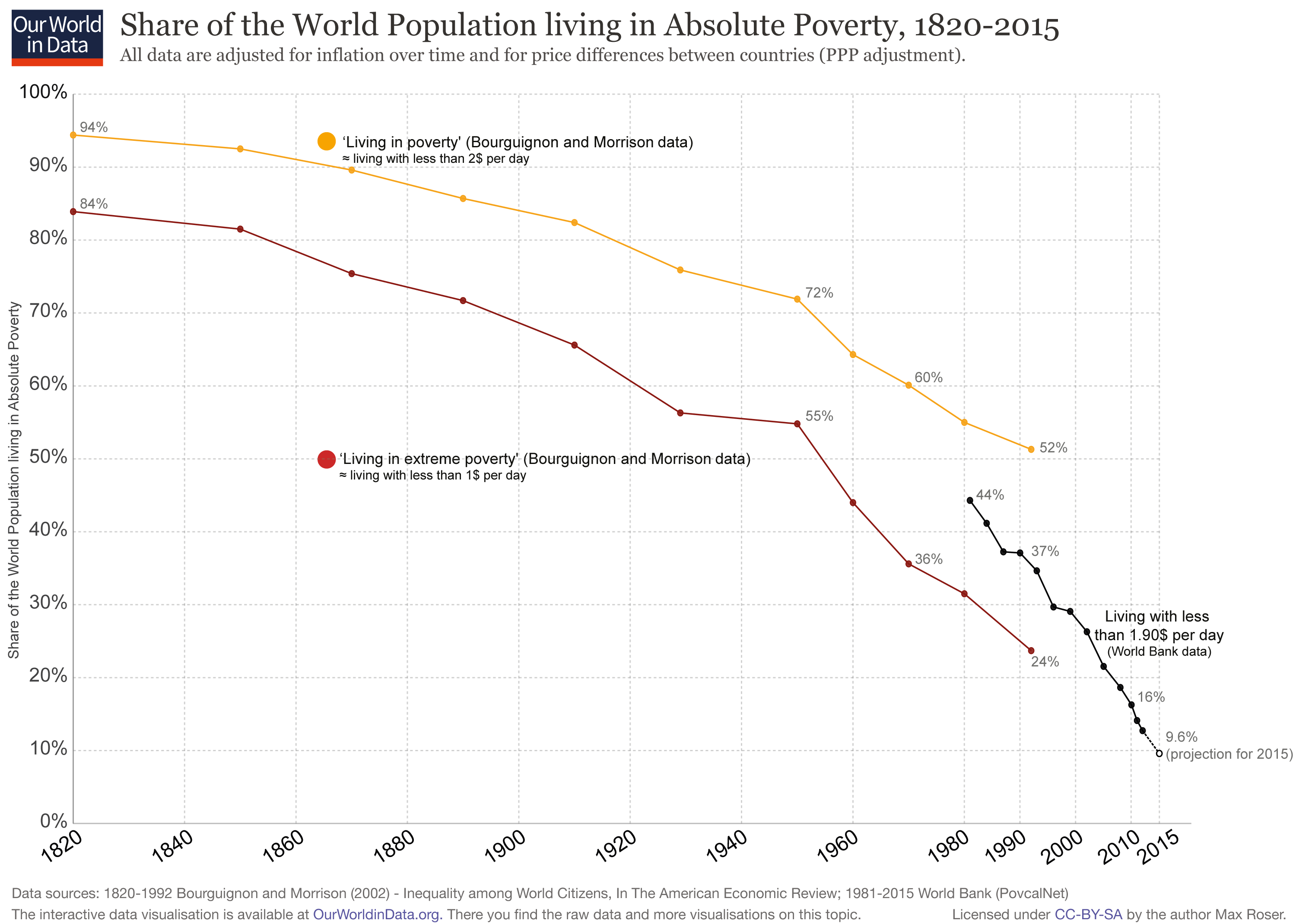
Define "we". World-wide, "we" are doing an absolutely amazing job of eliminating poverty.
https://ourworldindata.org/wp-content/uploads/2013/05/World-...
https://ourworldindata.org/extreme-poverty
Also, most industrialized economies don't really have absolute poverty: anyone who is poor has the right to social benefits to alleviate it, to provide the basics of food, clothing and housing (as well as other basics such as education).
So for example, in Germany, we talk about poverty being on the increase. But that is relative poverty, meaning a certain percentage of the average. So we can "increase" poverty by simply improving GDP w/o raising the bottom as much as the increase in GDP.
Re: Poverty-Fighting Startups
#74Earlier quoted context omitted.
The economy crashed after the revolution The loss of the war with Japan didn't help, either.
Source? I can’t find any evidence that there was any economic significance to that war aside from loss of the fleet and human life. Bruised imperial egos for sure and likely contributing to an image of a week government, but I’m hard pressed to see how it could have had any impact on the industrial output of the country.
Well-known events like the Potemkin mutiny may be dismissed as not impacting industrial output, but there was a large-scale general strike which actually lead to "1905 revolution" [0]. The loss to Japan was of course only a partial factor, with bigger contributor being the overall economic downturn of early 1900's.
There were some direct impacts from this revolution. There was large-scale unrest in Kingdom of Poland (the Russian-held part of partitioned Poland). Finland (then a Grand Duchy in the Russian empire) abolished Diet of Finland in favour of a new Parliament of Finland, with universal suffrage for both men and women. And in mainland Russia, the absolute monarchy was abolished in favour of a parliamentary monarchy.
However, this was too late for the Russian empire to recover.
Re: Poverty-Fighting Startups
#75Fighting poverty is a social and political problem. It is simply a question of will. We have enough wealth on earth to provide food, clothing, and housing to every single human being. Why don't we do it? That's a political question. The technology is trivial. >“One of my ambitions is to help our users put more food on the table,” says Jimmy Chen, the founder of Propel. His company makes a mobile app called FreshEBT t…
basically how to unplug yourself from the economy to restore foundations to survive better when you're on the border of the system
Re: Poverty-Fighting Startups
#76When I visited CalWorks (local government assistance program) to see if they could help my project financially, they were really excited and agreed to refer students (who are on the poverty line) and also pay the students so I don't have to. Before we joined, the only kinds of job training they were able to offer were the likes of Amazon warehouse packaging and hotel cleaning. I hope to empower more low-income earners to have the ability to simplify complex problems and problem solve.
Re: Poverty-Fighting Startups
#77Its important to know that you don't need millions of dollars to help people and do good. My salary was 145k with it I started a non profit that pays low-income earners minimum wage while they learn how to code. These people could really benefit from learning how to problem solve but they don't have the luxury to quit and join a bootcamp. With my salary, I was able to help 3 people at first but now (after getting a n…
Re: Poverty-Fighting Startups
#78Fighting poverty is a social and political problem. It is simply a question of will. We have enough wealth on earth to provide food, clothing, and housing to every single human being. Why don't we do it? That's a political question. The technology is trivial. >“One of my ambitions is to help our users put more food on the table,” says Jimmy Chen, the founder of Propel. His company makes a mobile app called FreshEBT t…
That's like saying nobody should ever be without water because of rain. There's more wealth than what's needed to provide necessities but it isn't located everywhere its needed and getting it there is often virtually impossible.
Re: Poverty-Fighting Startups
#79I'm not from Silicon Valley, so the only sampling I have of SV culture comes from this site[0]. From what I see, the article has a refrain that being anti-libertarian goes against the SV gain, but I see political opinions from across the political spectrum here, and my leftist opinions are often upvoted. So, while I can see investors being skeptical, would the tech community as a whole be anti-welfare? I don't necess…
I think SV culture tends to be politically extremist, or to be more accurate fundamentalist, in whatever ideology it pursues. I see more hard-line libertarians, but also more hard-line socialists, than in other subcultures. There's a long tradition of political extremism among engineers in cultures around the world; something to do with seeing society as a system simple enough that a single human being can understand…
There are several computational paradigms that we attribute to minds (and people) that more often than not backfire, finite state machines being the most obvious one. Sometimes it works, and we discover a great mental model to live by. Sometimes it goes really wrong and it all goes the modernist way (Mies van der Rohe and co).
This leads to another nasty effect: being incapable to commiserate with the people around us. If the mind is a deterministic black box and I'm not an alcoholic because I refrain myself from drinking, how come there are alcoholics. The answer must be: they do not try hard enough. Same with poor people, obese people. If things have not happened to me, the fact that happen to other people must mean that they've brought it upon themselves.
Re: Poverty-Fighting Startups
#80Earlier quoted context omitted.
>Actually if you look at where they started and where they got, they did a pretty good job in raising the very poorest our of poverty, electrifying the country, and really eliminating a lot of the abject poverty that was most of the country at the time of the revolution. That's the funny part about it. USSR was basically an engineered society with eliminated "overhead" of debating, negotiating, marketing, private ris…
If you make the argument the USSR removed that overhead, it might be good to keep in mind, the tsars and the kosacks where busy removing it long before.