Earlier quoted context omitted.
High housing prices are also very nice for banks and benks control nations. Essentially all mortgage money is created as dept. Banks can simply say: Here you go ma'am/sir, here is your money, created out of thin air. Now, please sign here to pay for your house twice, 1 time to the original owner and 1 time to us, because we created this money for you out of thin air.
Yes and no: The bank wants 2% as interests, but inflation is 3% --> The Bank effectively loses money
The Shock of Sweden's Housing Market Is Hitting the Country's Currency
351–360 of 456 posts
Re: The Shock of Sweden's Housing Market Is Hitting the Country's Currency
#352Earlier quoted context omitted.
I think the core contention here is that, at the end of the day, you are better off because of rising housing prices. You're complaining about transnational prices on your massive amount of equity while brushing aside the fact that you have such a massive amount of equity because of the real estate market.
I don't deny that. But right now I'm worse off relative to my goals at the moment than I would be if house prices were more stable. I'm not saying that rising prices are not good for some home owners, only that they are not good for all home owners in all circumstances.
Do you really feel like you'd be better off if your house sold for exactly what you bought it for?
Re: The Shock of Sweden's Housing Market Is Hitting the Country's Currency
#353Earlier quoted context omitted.
Let's say the house didn't go up in value.. where would that leave you? Would you be any more capable to sell? (Serious question, not a rhetorical or sarcastic one.. just seems to me you'd still be in a hole, just a different hole)
> Would you be any more capable to sell? Quite possibly, yes. Let's plug in some plausible numbers. Say someone buys a 3-bedroom house for $300k (they have kids). At the same time, 1-bedroom houses sell for $200k. Time passes, the kids grow up and move out. Say house prices didn't change at all. You sell for $300k, buy for $200k, pay some agent fees, have $85k or so left over. Now say prices went up and the 3-bedroom…
Re: The Shock of Sweden's Housing Market Is Hitting the Country's Currency
#354Earlier quoted context omitted.
That doesn’t make sense at all except for with housing. If I want to go vacation I will, if I need a new washing machine I will get it, if I want a cappuccino every morning now I can afford it no matter who I am!
If you want to go on vacation, but you can go on a little bit of a nicer vacation if you wait until next spring... If your old washing machine still mostly works, the new one will be cheaper if you can get the old one to limp along for a while longer... People don't completely stop buying things; life must go on. But people would start to drag out purchases where ever they can. Have you ever put off buying a computer…
I don't even think people have a grasp of the effects on inflation/deflation in practice anyway, let alone suddenly make strategic decisions upon it.
Re: The Shock of Sweden's Housing Market Is Hitting the Country's Currency
#355When will we learn that a "strong" housing market is not necessarily a good thing? High housing prices are great for those who already owned houses but terrible for everyone else (e.g. the entire generations born after prices became inflated). Not to mention people are greedy and will over leverage themselves when interest rates are good. No country should let the "landed gentry" hold them hostage over interest rates…
The plenty and cheapness of good land, it has already been observed, are the principal causes of the rapid prosperity of new colonies. The engrossing of land, in effect, destroys this plenty and cheapness. The engrossing of uncultivated land, besides, is the greatest obstruction to its improvement. But the labour that is employed in the improvement and cultivation of land affords the greatest and most valuable produce to the society.
https://en.m.wikisource.org/wiki/The_Wealth_of_Nations/Book_...
It helps greatly to know that "engross" in this context means "to purchase or control large quantities".
Another realisation I've had is that the incentive amongst those who hold valuable assets is to see their value increased. This includes land, money, financial holdings, commodities, licences (think of taxi medallions or professional licenses), education, and the like.
And the means of increasing price generally involves restricting the supply, or throwing constraints on the production of more of a thing.
Where the underlying asset is itself directly productive or essential, this tends to be tremdously disruptive.
https://www.reddit.com/r/dredmorbius/comments/608w97/asset_p...
Re: The Shock of Sweden's Housing Market Is Hitting the Country's Currency
#356Earlier quoted context omitted.
>What is infinitely more toxic than 'complaining' about first world problems That's just like, your opinion man. >Complaining about the ergonomics Look, complaining about work is a typical first world problem, sure. And of course we're all lucky to do the work we do and not live in [wherever.] Complaining about 20% taxes on $200k of a ~$700k windfall is truly more like a .00001% issue and is pretty obtuse by any meas…
> You wouldn't raise an eyebrow, or have any negative reaction to someone making $400k / year bitterly complaining that they have to pay taxes on it? I don't know anyone who wouldn't think that was obnoxious. Where are these bitter complaints? He commented to say that rising housing prices weren't good for him. He explained why. That isn't a complaint. He didn't say "I deserve this money from my rising house price!".…
First, he withheld the amount of capital gains, so everyone who initially responded naturally assumed it was under $500k, which is true of 99.9% of transactions. That was very misleading information to omit.
Secondly, he complained about broker fees, but it isn't required to sell a house using a broker by any stretch. Just do FSBO if you think the 3% cut (probably less) isn't worth it. And 3% isn't much at all when your already expensive house just went up over 100% in value. Facile and disingenuous.
>Where are these bitter complaints?
Pretending that he and his wife are "trapped" in his house and "can't afford to sell" makes it sound like a horrific and dire situation. Which is completely misleading, he and his wife are quite wealthy and could do anything they wanted. They are pretty much the opposite of "trapped."
>we can't afford to move!
Lies. They could easily afford to move.
They bought their house for something like $600k and now it's probably worth $1.3M. They pay 20% taxes on the $200k, so $40k and they lose 3% if they use a broker. That's another $40k, so $80k total. Let's make it an even $100k. So they have $1.2M to throw around, subtract $500k to pay off the existing mortgage, that's $700k free and clear.
$700k is a hell of a down-payment, even in the ritziest areas of Marin. Buy whatever you want.
I own a restaurant in norcal and have an employee whose room share / rental house burned in the recent fires. He goes to SRJC, doesn't have any family in the area, had no rental insurance, makes $12 an hour and no savings.
THAT's a dire situation, and considering I know people in situations like that, OP's framing of his (extremely cushy) situation as "I can't afford X!" is pretty disgusting to me.
Re: The Shock of Sweden's Housing Market Is Hitting the Country's Currency
#357Earlier quoted context omitted.
Do you mean “win” compared to the counterfactual where the house has appreciated and you don’t move to a similar one, or compared to the counterfactual where the house didn’t appreciate and you move to another one at the original price? If there had been no appreciation, your final wealth (cash + home equity) would be lower than in the case where the houses are more expensive, even after paying taxes, so it’s hard to…
> Do you mean “win” compared to the counterfactual where the house has appreciated and you don’t move to a similar one, or compared to the counterfactual where the house didn’t appreciate and you move to another one at the original price? Either one. We put a certain intrinsic value on a local lateral move. If the cost of moving is less than that intrinsic value, and we find a house we like, we'll move. If the cost o…
In your case, you can a) stay where you are or b) sell the house, pay the tax, and buy a similar house (or a cheaper one elsewhere).
An alternative you that didn't buy that house at that time, and got lower after-tax returns on that money, doesn't have option a) and has less capital available for option b).
Everyone else is in an strictly worse position than owners.
You have an unrealized capital gain and an unrealized tax liablity. Selling the house you'll realize both. You "feel" that you are not realizing the capital gain if you buy a similar house with that money. It's understandable, nobody likes paying taxes. But if you were to sell the new house in the future (maybe to downsize) the transaction would be tax free if prices don't change.
And as I said already, if you think prices may go down it's rational that you avoid realizing the capital gain and the tax liability at the current level if the utility gain from moving to a "similar" house is not larger than the expected savings of realizing (maybe) a lower capital gain in the future and paying less taxes.
Re: The Shock of Sweden's Housing Market Is Hitting the Country's Currency
#358Earlier quoted context omitted.
productive deployment of capital Right, and the economists argue a deflationary market makes capital scarce High housing costs are an incredibly unproductive use of capital Right; it seems desirable for housing costs to keep even pace with the rest of the market, and ideally stay close to depreciated replacement cost And even when computers were improving significantly every year and prices went down people on averag…
> Right; it seems desirable for housing costs to keep even pace with the rest of the market, and ideally stay close to depreciated replacement cost In markets where there is enough housing supply, do we see people change housing ownership more often? E.g. buy a bigger apartment when they get kids or downsize when they are empty nesters. In markets with enough housing supply, do we see higher expectations for housing…
If there is enough housing supply, prices are reasonable and moving to a different house isn't a $2M transaction, it's $100k. Aside from other things this makes the finances easier- if the down payment is $200k, you must line up the purchase & sale. If the down payment is $10k, you can front that, and the purchase isn't 100% contingent on the sale. (purchase/sale contingencies sink a lot of home sales) Additionally shopping for a house is not a dog-eat-dog fight.
If there is enough supply, you don't have to spend every dime of your income in a bidding cage match with other buyers, which leaves you with capital available for real repairs & renovations. Builders and private developers can buy the really crappy old houses for very low prices and knock the whole thing down and build new. Plus, in a market where appreciation is the prime determinant of value, and it's a major seller's market, why bother doing much renovation? It'll sell no matter how bad it is.
My local market certainly shows all these things compared to California- but, who can say exactly how much of the state of the California housing market is due to Prop 13?
P.S. Yeah, it's ironic how the Bay Area is this wealthy progressive metro, and yet so much of the housing stock is ancient, way behind code, and terribly energy inefficient.
Re: The Shock of Sweden's Housing Market Is Hitting the Country's Currency
#359Earlier quoted context omitted.
It's less about printing money and more about falling long-term interest rates (and thus, discount rates). Fundamentally, a house is worth the net present value of its use value. Lower discount rates means that more of that value gets pulled forward into its present valuation. An equivalent way of thinking of it is that house prices are fixed by mortgages to rents - when mortgage payments are lower than rents, people…
In Sweden though, pretty much no one rents a house. This may or may not be relevant to the above observation. It's also generally not allowed to buy flats to rent them out which limits speculation in that market.
Re: The Shock of Sweden's Housing Market Is Hitting the Country's Currency
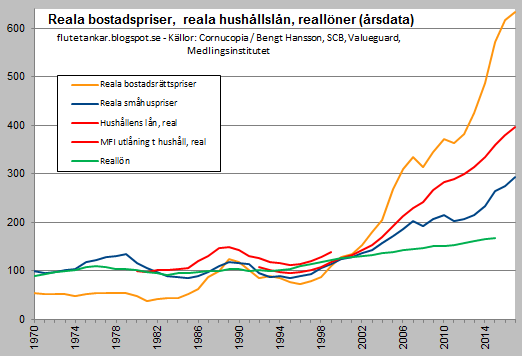
#360https://2.bp.blogspot.com/-tonEuOE0IXE/WfpBpIzy8rI/AAAAAAAAF...
The interesting lines are apartment prices (yellow/orange) and salary (green). Note that the small bump in the early 90s was the last economic crisis...