Live data from Hacker News

Almost everything on computers is perceptually slower than it was in 1983

tttthreads.com

141–150 of 349 posts

Re: Almost everything on computers is perceptually slower than it was in 1983

#141
post #120

This could be a copy-paste of rants I have written. I think marketing has ruined pretty much everything. Everything has a subscription now, and it's in the cloud . My experience is that everything is slower than when I first started using computers as a child in the 90's, and it does it worse. You don't own anything anymore, upgrades routinely take away features, and nothing interfaces with anything else. There are a…

You do, in fact, have a choice, you always did, everyone does. There are decent, completely offline solutions (Libreoffice vs GDocs), you can self-host a lot of things and do a private "cloud" on a Raspberry Pi or an old laptop ( https://yunohost.org/#/ ; https://cloudron.io/ ; etc). The tradeoff is compatibility and not being trendy. However, that has always been a problem both the 80s and the 90s. Mac vs PC? Amiga…

> There are decent, completely offline solutions (Libreoffice vs GDocs)

LibreOffice is slow. On a ~2010 business-class Dell laptop that still is in perfectly good physical condition, running Debian 9, with a handful of tabs in Firefox and a mosh running:

    adamantoise:~ geofft$ time libreoffice --terminate_after_init
    
    real    0m8.103s
    user    0m1.696s
    sys     0m0.520s
The rant here isn't about cloud vs. local, it's about performance and functionality. We had the cloud in the late 1980s, it was called dialing up to a mainframe, and it worked fine because software was designed to be fast in the presence of slow (by today's standards) connections. One of the examples of that -- library card catalogs running on amber-screen terminal -- was explicitly brought up in the rant.

Re: Almost everything on computers is perceptually slower than it was in 1983

#142
post #141
post #120

Earlier quoted context omitted.

You do, in fact, have a choice, you always did, everyone does. There are decent, completely offline solutions (Libreoffice vs GDocs), you can self-host a lot of things and do a private "cloud" on a Raspberry Pi or an old laptop ( https://yunohost.org/#/ ; https://cloudron.io/ ; etc). The tradeoff is compatibility and not being trendy. However, that has always been a problem both the 80s and the 90s. Mac vs PC? Amiga…

> There are decent, completely offline solutions (Libreoffice vs GDocs) LibreOffice is slow . On a ~2010 business-class Dell laptop that still is in perfectly good physical condition, running Debian 9, with a handful of tabs in Firefox and a mosh running: adamantoise:~ geofft$ time libreoffice --terminate_after_init real 0m8.103s user 0m1.696s sys 0m0.520s The rant here isn't about cloud vs. local, it's about perform…

re 1: Slow - compared to google docs? Are you serious?

EDIT: not startup time, who cares about startup time? When you load a few hundred pages doc, or a massive excel.

re 2: I only wanted to give examples, but you're right, my wording is off.

I wanted to say there are fast and good interfaces: there's vim for the terminal, there's Rainloop for webmail, miniflux for RSS reading - these are all keyboard-oriented ones, all working decently and as fast as they can. In case of web-connected ones, the speed of going back and forth is certainly an issue.

Local - as in not making connections on the network - in my opinion, will always have a speed advantage though.

Re: Almost everything on computers is perceptually slower than it was in 1983

#143
post #74

Earlier quoted context omitted.

I’m constantly stunned by the fact that chrome basically allocated a gig of men to each open tab... Can anyone eli5 why this is? I typically have thirty tabs open at any given time.

Are you counting shared memory multiple times? Try hitting shift-esc in Chrome and checking the memory usage there. My heaviest tab (Gmail) is only around 250M. Edit: I mean most computers don't even have 30 GB of RAM, but if you do there's an easy way to check. Open a bunch of tabs and note your system's total RAM usage. Then close Chrome and see how much gets freed up. If it's 30GB then you have a problem :)

OK checked.

htop report that system idle with nothing running consumes 996MB mem -- one tab open in chrome jumps to 1.77GB (out of 16GB)

now I have 6 open tabs... cnn, HN, reddit, reddit, reddit, netflix - and just to display these tabs its allocated 2.5 gigs... I just cant understand how displaying 6 websites requires 2.5GB of ram?

Ill admit to being stupid on this topic - but I can maths, and that just doesnt appear to be logical - and I am not complaining, im trying to understand. So can anyone ELI5 why displaying the default pages of some of the fastest sites on the internet, reddit and hn, would consume the resources they do? im literally curious.

http://i.imgur.com/Lm3iexB.jpg

WHY being the operable term here.. I just want to know WHY a browser is so mem intensive for displaying fucking text. The whole point was that in 1983, we had a VT100 or somesuch and they were fast as heck... but now I have to pre-load a shit-ton of ads or something that consume my local resources and ruin my experience? Do we need to punch a designer in the face?

http://media.fakeposters.com/results/2009/07/16/z22e8wsvrf.j...

Re: Almost everything on computers is perceptually slower than it was in 1983

#144

Earlier quoted context omitted.

I disagree with that. Even spinning HDDs are several orders of magnitude faster than even the main RAM of computers from 20 years ago.

Not in latency, by a very long stretch (500ns 30 years ago).

Not in latency but definitely in throughput. I remember being amazed 20 years ago at 3MiB/sec throughput when copying some files around. Today, even a spinning disc can sustain 160MiB/s and peak at 240MiB/s (personal anecdotal evidence) before looking at RAID or hybrid SSD options.

Sure, latency is still pretty bad. But a well-designed application is going to minimize individual seeks required, and therefore minimize the total aggregate latency cost.

It's the same way across the internet; a well designed application is going to minimize the latency cost across a socket by minimizing the amount of synchronization (seeking) required to continue work. TCP connection, TLS handshake, HTTP processing and routing, application processing to disk/database, multiple queries/seeks to handle the request... it all adds up.

Re: Almost everything on computers is perceptually slower than it was in 1983

#145
post #118
post #96

Earlier quoted context omitted.

Only 250M. ONLY 250M. Gives up and dies I don't mean to be dramatic but this is a huge part of the problem. How is it that the exact same application (email) ran perfectly well on systems with 1M of RAM (and no virtual memory!) and now it takes two-hundred-and-fifty-fucking-megs?

Because... it's not at all the same application? Email used to keep everything on disk and load up one message at a time. Now everything is on the server and has images embedded, so it all gets cached into RAM. If I switch to the "HTML version" of Gmail, the tab takes only 3MB to list my emails. There's also inflation of the content itself. That same HTML view uses over 100MB to render one email with a lot of picture…

Wow - I was going to make a counterargument about how alpine is perfectly capable of keeping everything on disk (and how I usually don't care about images), but my alpine process, which has been running for a bit over a month and is connected via IMAP to a remote server with about 220,000 messages in the inbox, is using 250 MB virtual and 100 MB resident if I'm reading ps right.

So maybe Gmail is actually pretty efficient!?

Re: Almost everything on computers is perceptually slower than it was in 1983

#146

In the name of usability, we have practically neutered these computing machines. I think optimizing for user experience is partly to blame for this. You don't want users to have a confusing experience the first time they use the application, and you want the application to look good and be inviting. But that may be at cross purposes with making applications that allow open-ended exploration. Exploration implies that…

> I think pretty much everything in computing is like this. But then there's Dwarf Fortress, Blender, Vim, Emacs, ... Accounting for Sturgeon's Law, things aren't quite so bleak.

Did we forget how Emacs used to mean "Eight Megabytes And Constantly Swapping?"

Saying that as an Emacs User for almost 20 years now. Even today there are things that can bring Emacs crawling to its knees. The moment you start adding auto-complete to a big project, or if you have your files hosted in some NFS server, you're SOL.

Re: Almost everything on computers is perceptually slower than it was in 1983

#147
post #142
post #141

Earlier quoted context omitted.

> There are decent, completely offline solutions (Libreoffice vs GDocs) LibreOffice is slow . On a ~2010 business-class Dell laptop that still is in perfectly good physical condition, running Debian 9, with a handful of tabs in Firefox and a mosh running: adamantoise:~ geofft$ time libreoffice --terminate_after_init real 0m8.103s user 0m1.696s sys 0m0.520s The rant here isn't about cloud vs. local, it's about perform…
re 1: Slow - compared to google docs? Are you serious? EDIT: not startup time, who cares about startup time? When you load a few hundred pages doc, or a massive excel. re 2: I only wanted to give examples, but you're right, my wording is off. I wanted to say there are fast and good interfaces: there's vim for the terminal, there's Rainloop for webmail, miniflux for RSS reading - these are all keyboard-oriented ones,…

re 1: Slow - compared to google docs? Are you serious?

I can't speak for the poster above yours, but I would be serious. In my experience, on the startup time, google docs way out performs open office. It's open in single digit seconds, open office is 10s+

I still prefer offline software, but the bloat can be awful. At least web tech is designed with web browsing latency expectation. I find most desktop software these days has a much larger start and use latency by far.

Re: Almost everything on computers is perceptually slower than it was in 1983

#148
post #142
post #141

Earlier quoted context omitted.

> There are decent, completely offline solutions (Libreoffice vs GDocs) LibreOffice is slow . On a ~2010 business-class Dell laptop that still is in perfectly good physical condition, running Debian 9, with a handful of tabs in Firefox and a mosh running: adamantoise:~ geofft$ time libreoffice --terminate_after_init real 0m8.103s user 0m1.696s sys 0m0.520s The rant here isn't about cloud vs. local, it's about perform…

re 1: Slow - compared to google docs? Are you serious? EDIT: not startup time, who cares about startup time? When you load a few hundred pages doc, or a massive excel. re 2: I only wanted to give examples, but you're right, my wording is off. I wanted to say there are fast and good interfaces: there's vim for the terminal, there's Rainloop for webmail, miniflux for RSS reading - these are all keyboard-oriented ones,…

> re 1: Slow - compared to google docs? Are you serious?

Slow compared to decent standards of what a word processor needs. For reference, WordPad perceptually opens instantly for me, and has felt like it opened instantly since Windows 95, I'm pretty sure. I am saying that both LibreOffice and Google Docs are examples of software that take way too long to do simple things because they're busy doing complicated things that I don't actually care for. (And arguably this isn't really their fault per se, they're both designed to compete with / follow the expectations set by Microsoft Office of what an office suite is, and those expectations are that all the complicated things are available).

> Local - as in not making connections on the network - in my opinion, will always have a speed advantage though.

Depends what you're doing with the network. I do just about all of my work in the terminal with a mosh connection to a cheap server a couple hundred miles away, and I never feel perceptual slowness from my machine not being local, unless I am literally in the subway or in an elevator. And I actually gain a lot of perceptual speed because I can close my laptop and switch to my phone instantly and see the exact screen where I was.

If you're streaming binaries from the network or trying to pump animations on a 2048-by-1536 true-color retina display, yes, remote is going to be slow. Half the tweetstorm's point is that you shouldn't be designing software to need that in the first place.

Re: Almost everything on computers is perceptually slower than it was in 1983

#149
post #145
post #118

Earlier quoted context omitted.

Because... it's not at all the same application? Email used to keep everything on disk and load up one message at a time. Now everything is on the server and has images embedded, so it all gets cached into RAM. If I switch to the "HTML version" of Gmail, the tab takes only 3MB to list my emails. There's also inflation of the content itself. That same HTML view uses over 100MB to render one email with a lot of picture…

Wow - I was going to make a counterargument about how alpine is perfectly capable of keeping everything on disk (and how I usually don't care about images), but my alpine process, which has been running for a bit over a month and is connected via IMAP to a remote server with about 220,000 messages in the inbox, is using 250 MB virtual and 100 MB resident if I'm reading ps right. So maybe Gmail is actually pretty effi…

I'm sure the Gmail Android app is nice and light. I'm guessing the RAM bloat in the browser is from the JIT keeping lots of profiling data and cached compiled code, which looks good in benchmarks but does get a little "heavy".

Re: Almost everything on computers is perceptually slower than it was in 1983

#150
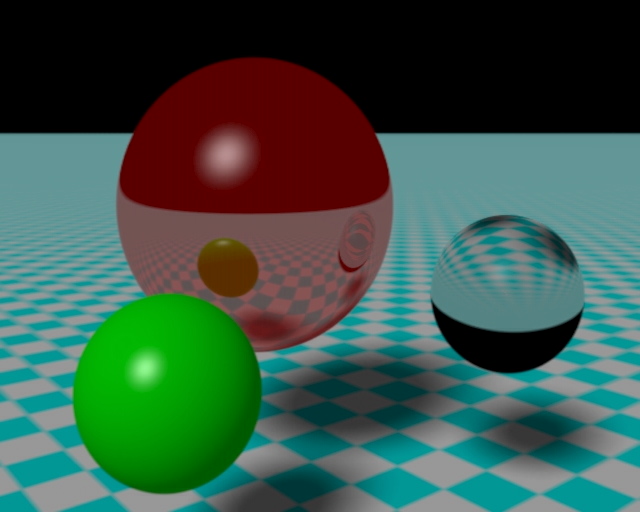
Back in the mid eighties rendering very simple three dimensional scenes using ray tracing took a great deal of time.

"...images generated using some of the above improvements to ray tracing. They all took approximately 50 minutes each to compute on a VAX 780." - From http://www.cs.yorku.ca/~amana/research/cones.pdf

Example image found here: http://www.cs.yorku.ca/~amana/research/images/spheres.jpg

A DEC VAX 780 cost over a hundred thousand dollars - http://www.computerhistory.org/revolution/mainframe-computer...

Post reply on HN