So where are the stars in our night sky? Are they even further away than Uranus, Neptune.., but so bright we see them anyway?
EDIT: Thanks, all! Makes sense.
81–90 of 104 posts
So where are the stars in our night sky? Are they even further away than Uranus, Neptune.., but so bright we see them anyway?
EDIT: Thanks, all! Makes sense.
Off topic but can someone answer this for me? Are the stars in our night sky part of our galaxy or no? It seems such a stupid question to ask, but when I look online it says we have one star, our Sun, whereas other galaxies have one or multiple - for instance a galaxy with two stars would be called a Binary System. So where are the stars in our night sky? Are they even further away than Uranus, Neptune.., but so brig…
Yes.
Off topic but can someone answer this for me? Are the stars in our night sky part of our galaxy or no? It seems such a stupid question to ask, but when I look online it says we have one star, our Sun, whereas other galaxies have one or multiple - for instance a galaxy with two stars would be called a Binary System. So where are the stars in our night sky? Are they even further away than Uranus, Neptune.., but so brig…
Every star you see in the night sky with the naked eye is part of our galaxy.
>for instance a galaxy with two stars would be called a Binary System.
A galaxy usually has billions or trillion of stars. Our solar system has one star, which is our sun ( a sun is a star with planets around it). Our solar system is inside of a galaxy, which is made up of billions and billions of stars.
>So where are the stars in our night sky? Are they even further away than Uranus, Neptune.., but so bright we see them anyway?
All stars are outside of our solar system by definition. They are light-years away ( the time it takes to get there at the speed of light is years), but most planets are light-minutes away.
Off topic but can someone answer this for me? Are the stars in our night sky part of our galaxy or no? It seems such a stupid question to ask, but when I look online it says we have one star, our Sun, whereas other galaxies have one or multiple - for instance a galaxy with two stars would be called a Binary System. So where are the stars in our night sky? Are they even further away than Uranus, Neptune.., but so brig…
Yes, they are outside of our solar system. They are ridiculously far away.
Take a peek here: https://imagine.gsfc.nasa.gov/features/cosmic/farthest_info....
Off topic but can someone answer this for me? Are the stars in our night sky part of our galaxy or no? It seems such a stupid question to ask, but when I look online it says we have one star, our Sun, whereas other galaxies have one or multiple - for instance a galaxy with two stars would be called a Binary System. So where are the stars in our night sky? Are they even further away than Uranus, Neptune.., but so brig…
There's Earth, it's a planet orbiting our star, Sol AKA the Sun, in our solar system. A star has plenty of bodies orbiting around it, dust, asteroids, planets, so the whole group is called a solar system.
There's other stars "next" to us, which in turn have dust, asteroids and planets orbiting around them. So they also are solar systems, since all stars have stuff orbiting around them.
Stars (/solar systems) tend to cluster together in a galaxy. A galaxy is composed of billions of stars.
Earth/our Solar system is in the Milky Way galaxy, so most of the stuff we see in the sky are stars that are not very far from us and/or part of the Milky Way galaxy.
The closest galaxy from ours is Andromeda, which is in turn composed of billions of stars, and countless planets.
So, the order is planet (Earth) -> star (Sun) -> (grouped into a) solar system -> galaxy (Milky Way)
Binary systems are solar systems which do not have a single star, but they have TWO! and these stars orbit each other. A galaxy has millions of binary systems (not sure how rare they are)
Uranus, Neptune, etc. are part of our solar system, so yeah, the stars you see are farther beyond.
EDIT: apparently I'm a bit confused as well, as star/planet groups are called planetary systems, and only ours is called the Solar System (from Sol/the Sun). The more you know.
Does this help and answer your question?
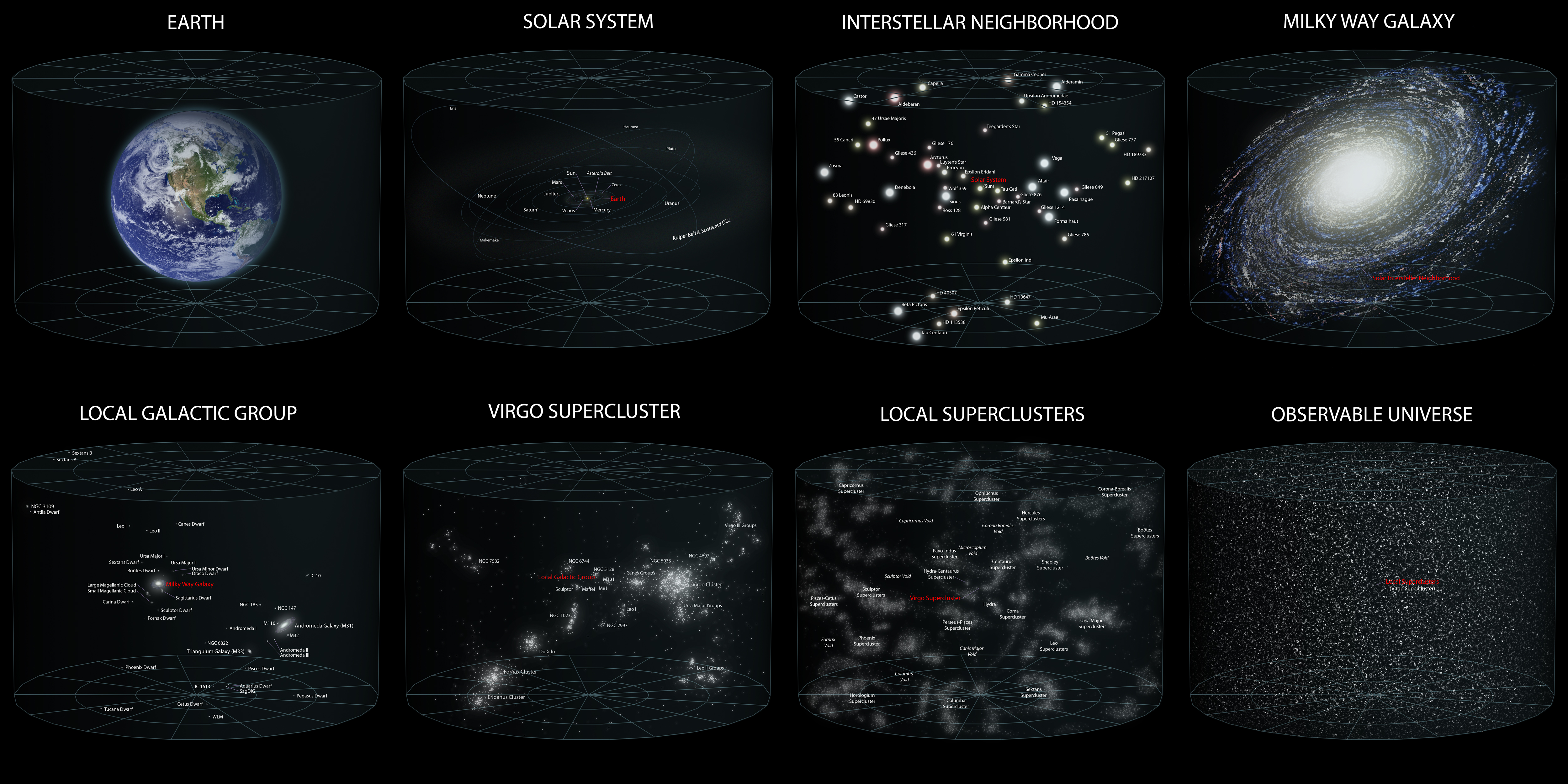
Off topic but can someone answer this for me? Are the stars in our night sky part of our galaxy or no? It seems such a stupid question to ask, but when I look online it says we have one star, our Sun, whereas other galaxies have one or multiple - for instance a galaxy with two stars would be called a Binary System. So where are the stars in our night sky? Are they even further away than Uranus, Neptune.., but so brig…
https://upload.wikimedia.org/wikipedia/commons/0/0f/Earth%27...
View full screen and at 100% to be able to read the text.