Live data from Hacker News

The web at maximum FPS: How WebRender gets rid of jank

hacks.mozilla.org

191–200 of 212 posts

Re: The web at maximum FPS: How WebRender gets rid of jank

#191

Just tried it with the Nightly by setting gfx.webrender.enabled to true in about:config. Wow, that thing flies. It's seriously amazing. And so far no bugs or visual inconsistencies I could detect. Firefox is really making great progress on this front!

Yeah I'm pretty stunned at the speed improvements. I was getting a little worried there after Australis.

Re: The web at maximum FPS: How WebRender gets rid of jank

#192
post #146

Earlier quoted context omitted.

Actually, virtually every device the average grade consumer uses, has a GPU. For instance, even Atom processors have GPUs. Granted, they don't have as much cores as a full-fledged nVidia GPU, nor as much dedicated memory, but they are still GPU with several tens of cores and specialized APIs that were designed specifically for the tasks at hand. Plus, they offload (ish) the CPU.

Something without a GPU: VirtualBox. Last time I tried a Servo nightly in VirtualBox (to be fair, a few months ago), it immediately crashed/aborted with a GPU-related error. I think there's a good argument for preventing security-critical apps from raw GPU access, because graphics cards and drivers are a huge amount of attack surface. I still think WebRender is the way forward, but I hope they get it working with som…

While I understand the concern about security, I think it is beside the point. The surface attack is effectively the GPU and its driver, not the web renderer. The technique that are put in place by the web renderer are and were used by game engines.

If anything it'll push the GPU makers to have better drivers support.

EDIT: As for the no-GPU case, it is an edge-case, in which we could for example switch to the classical renderer. If you're running FF from a VM as your daily driver, there's something not right somewhere I think. (I'm thinking of C&C servers for satellites still running on WinXP and stuff)

Re: The web at maximum FPS: How WebRender gets rid of jank

#193
post #88
post #73

Earlier quoted context omitted.

I'll admit I'm certainly not an expert on browser rendering pipelines, but that's not the impression the article gave. Rather, it suggested that current browser engines may, in fact, be more efficient in terms of the absolute number of computations done. When discussing existing browsers: > But often the things on these layers didn’t change from frame to frame. For example, think of a traditional animation. The backg…

There's some interesting discussion about this very topic happening on /r/rust right now: https://www.reddit.com/r/rust/comments/75hzk5/the_whole_web_... A particularly relevant bit: > For the case where the CPU would have painted a single pixel, WR will certainly use a bit more power than CPU rendering with a compositor. For the case where a large portion of the screen changes, CPU renderers might miss their frame b…

Hmm that sounds like outside of missed frames or otherwise busy sites consistently using more than 25% of the frame budget more power will be required by the new approach. Isn’t that going to be the most common case?

Re: The web at maximum FPS: How WebRender gets rid of jank

#194

Earlier quoted context omitted.

Speaking of batching, I look at this demo [1] on my mobile phone, and I can get ~3500 sprites without dropping below 60FPS. A web page may not be able to reuse as much image data, I know. But smart game engines frequently look for ways to better batch sprites. And technically speaking, if you're using a Z-buffer, you don't need to sort opaque layers at all . You can draw the layers in back and then draw more layers i…

As far as I understand this, that demo will have no benefit whatsoever from the changes described in the article. Since it uses with WebGL, it has always done all its rendering on the GPU in a videogame style way – in any version of any browser.

Correct. But the idea is that WebRender uses the same (general) techniques that a game-engine like this would use to make web page renders happen faster.

Re: The web at maximum FPS: How WebRender gets rid of jank

#195
post #189

This is great! I'm really impressed by the technical achievement, and hope everyone takes lessons from it to put performance and FPS at the forefront of their concerns when developing applications. Sadly, seeing the state of the industry, people will just use this as an excuse to continue write more and more sloppy code that would perform terrible even on the newest and faster WebRender version. In other words, this…

No, not "crash the browser" (coz browsers are not supposed to crash no matter the site's content), but that "this site might drain your battery quickly" or something along those lines.

Re: The web at maximum FPS: How WebRender gets rid of jank

#196

Just tried it with the Nightly by setting gfx.webrender.enabled to true in about:config. Wow, that thing flies. It's seriously amazing. And so far no bugs or visual inconsistencies I could detect. Firefox is really making great progress on this front!

I really want to use Firefox full time, but I miss Safari's multi-touch gesture integration.

Re: The web at maximum FPS: How WebRender gets rid of jank

#197

Just tried it with the Nightly by setting gfx.webrender.enabled to true in about:config. Wow, that thing flies. It's seriously amazing. And so far no bugs or visual inconsistencies I could detect. Firefox is really making great progress on this front!

I really want to use Firefox full time, but I miss Safari's multi-touch gesture integration.

You can try out Better Touch Tool to add a ton of custom gestures to whatever mapping you want.

For example, I use a four finger swipe down to hit CMD-W, which closes the window in focus for most apps.

https://www.boastr.net/

Re: The web at maximum FPS: How WebRender gets rid of jank

#198

Earlier quoted context omitted.

Let's clarify, WebRender doesn't do anything at all if nothing changed. If the content of the window is static then webrender won't wake your gpu up until it really needs to. There seem to be a confusion about video games needing to render at constant frame rate, but that is only the case in games where there is always something changing on screen. It isn't that uncommon for other types of games with more static grap…

What about if a tiny thing changes? Perhaps animated avatars totaling 1% of the page. Is that a scenario where the new method might use more power, because it redraws too much?

A compositor is already repainting the whole window on the GPU. WR doesn't change anything here.

Re: The web at maximum FPS: How WebRender gets rid of jank

#199
post #60

Humourously enough, when I worked on a team that was writing a graphical web browser for mobile in the late 90's [1], they used a display list for rendering. The reasoning was somewhat different, web pages were essentially static (we didn't do "DHTML"), if the page rendering process could generate an efficient display list, then the page source could be discarded, and only the display list needed to be held in memory…

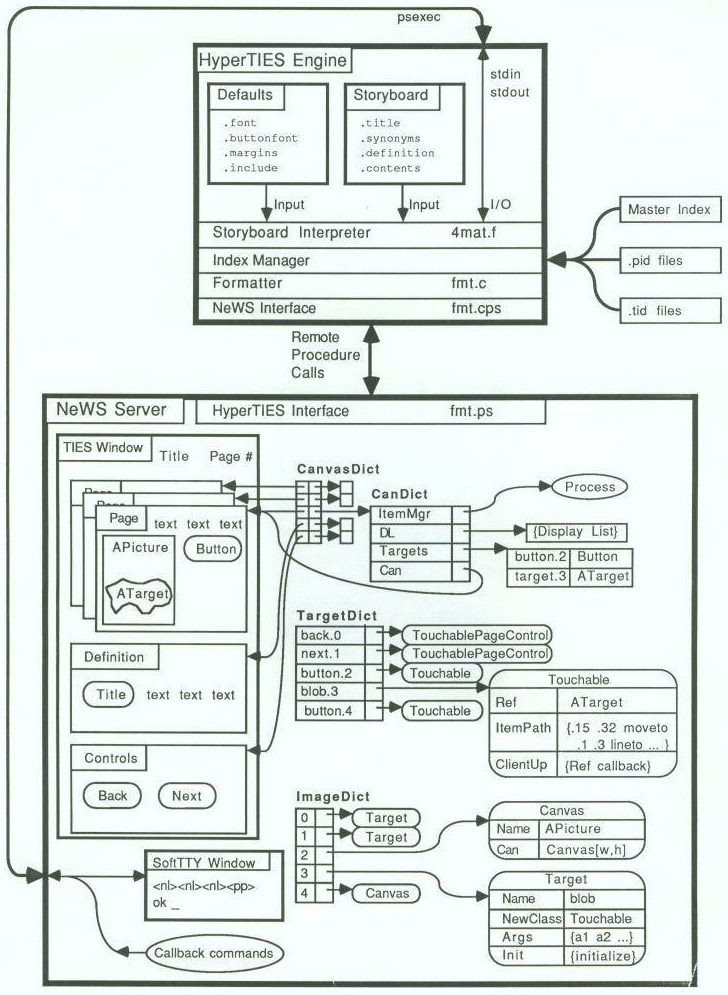
I developed a hypermedia browser called HyperTIES for NeWS that was scriptable in FORTH, and whose formatter could output FORTH code to layout and paginate an article for a particular screen size, which could be saved out in a binary FORTH image that you could restart quickly.

The FORTH code then downloaded PostScript code into the NeWS server, where it would be executed in the server to draw the page.

It even had an Emacs interface written in Mocklisp!

http://www.donhopkins.com/home/archive/HyperTIES/ties.doc.tx...

http://www.donhopkins.com/home/images/HyperTIESDiagram.jpg http://www.donhopkins.com/home/images/HyperTIESAuthoring.jpg

http://www.donhopkins.com/drupal/node/101 http://www.donhopkins.com/drupal/node/102

http://www.donhopkins.com/home/ties/ http://www.donhopkins.com/home/ties/fmt.f http://www.donhopkins.com/home/ties/fmt.c http://www.donhopkins.com/home/ties/fmt.cps http://www.donhopkins.com/home/ties/fmt.ps http://www.donhopkins.com/home/ties/ties-2.ml

Re: The web at maximum FPS: How WebRender gets rid of jank

#200

Earlier quoted context omitted.

What about if a tiny thing changes? Perhaps animated avatars totaling 1% of the page. Is that a scenario where the new method might use more power, because it redraws too much?

A compositor is already repainting the whole window on the GPU. WR doesn't change anything here.

In this use case the "painting" a compositor does from layers is copying one big rectangle. That takes next to zero time. That's not at all similar to "painting" where you actually re-render the entire visible portion of the page.
Post reply on HN