Live data from Hacker News

The Last Invention of Man

nautil.us

41–50 of 122 posts

Re: The Last Invention of Man

#41

I think it’s a little absurd that we would make the leap to machine super-intelligence without going through the step of machine low or medium intelligence. If I could write, I’d write a companion story to this called “Omega-1, the artificial super intelligence that wasn’t really that good at things”. They try to have it write mini-AIs to solve MT problems, but it’s slow and inaccurate. They have it write and produce…

Perhaps we will find that when we give it control of weapons, despite its inadequacies in other areas, it will excel at killing.

Re: The Last Invention of Man

#42

I think it’s a little absurd that we would make the leap to machine super-intelligence without going through the step of machine low or medium intelligence. If I could write, I’d write a companion story to this called “Omega-1, the artificial super intelligence that wasn’t really that good at things”. They try to have it write mini-AIs to solve MT problems, but it’s slow and inaccurate. They have it write and produce…

[deleted]

Re: The Last Invention of Man

#44

I think it’s a little absurd that we would make the leap to machine super-intelligence without going through the step of machine low or medium intelligence. If I could write, I’d write a companion story to this called “Omega-1, the artificial super intelligence that wasn’t really that good at things”. They try to have it write mini-AIs to solve MT problems, but it’s slow and inaccurate. They have it write and produce…

Yeah. Maciej wrote a pretty good piece rebutting AI alarmism and kind of alludes to that as one of several points. http://idlewords.com/talks/superintelligence.htm > With no way to define intelligence (except just pointing to ourselves), we don't even know if it's a quantity that can be maximized. For all we know, human-level intelligence could be a tradeoff. Maybe any entity significantly smarter than a human being…

Similarly, I wonder if it's something where adding to it doesn't actually do much, like all the variations you see done on Turing Machines (adding more tapes or 2d tapes etc.) which seem like they would increase its capacity somehow, but it turns out they have the same power as the original Turing Machine. Or like the arithmetic of infinite numbers, e.g. aleph-0 + aleph-0 = aleph-0.

Re: The Last Invention of Man

#45
post #34
post #18

Earlier quoted context omitted.

>We probably would have found remnants of their society. Not sure if that's true. Especially if technological civilizations tend to be short lived. The Jurassic was a very^very long time ago. What's the state of the paleocryptoxenocheology field any good over view papers?

If organic matter can survive (bones and even sometimes tissues), we can be very assured that hardened structures would. Furthermore, there's nothing in the fossil record suggesting humans were around very^very long ago, so it'd have to have been a different intelligent species.

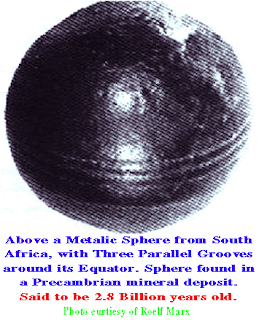
That's a bold statement. Read Forbidden Archeology, and you'll see quite a few oddities in the archeological realm. Such as metal spheres with odd, precise features, that are very very old ( http://4.bp.blogspot.com/-oiiiI75kDic/TdRv4ZsspWI/AAAAAAAAAC... )

(Yes, you can now give me the defaults: "if this was true we would have heard of it" "if he says something that is unconventional, he's probably a retard/arbitrarily biased" etc. etc. yes, go ahead)

Re: The Last Invention of Man

#46
post #20

A couple of weeks ago I went to see Max Tegmark (the author of this piece) speak about his new book "Life 3.0: being human in the age of artificial intelligence" in San Francisco and saw the same speculative AI intelligence explosion crap we're seeing all over the place. I was disappointed because I'm a fan of Max's work as a scientist, his "Our Mathematical Universe: My Quest for the Ultimate Nature of Reality" book…

His book is still great though and raises a number of interesting points, either you're fan of future AI speculations or not.

Re: The Last Invention of Man

#47
When they shifted their focus toward products that they could develop and sell, computer games first seemed the obvious top choice. Prometheus could rapidly become extremely skilled at designing appealing games, easily handling the coding, graphic design, ray tracing of images, and all other tasks needed to produce a final ready-to-ship product. Moreover, after digesting all the web’s data on people’s preferences, it would know exactly what each category of gamer liked, and could develop a superhuman ability to optimize a game for sales revenue.

I'll bet $20 this is the stage that brings down human civilization. We don't need full AGI to realize a dystopia, we just need something optimized to indefinitely hold our attention.

Re: The Last Invention of Man

#48

I think it’s a little absurd that we would make the leap to machine super-intelligence without going through the step of machine low or medium intelligence. If I could write, I’d write a companion story to this called “Omega-1, the artificial super intelligence that wasn’t really that good at things”. They try to have it write mini-AIs to solve MT problems, but it’s slow and inaccurate. They have it write and produce…

The first intelligent AIs will be weak and have limited influence on real world human affairs. The worst we have now is poorly supervised automatic trading systems that can shift massive amounts of money through electronic markets. However, once AIs can design and implement their own successors all bets are off. I would also be concerned about the development of non-theraputic neural implants and the ability of an AI…

In the absolutely epic space opera "Hyperion" (and its sequel "Endymion") the author Dan Simmons theorizes -- through the plot, not through a monologue! -- that AI creatures would offer us tech that we could never invent -- impossibly minituarized personal computers (the size of a discrete and thin silver bracelet, an earring or even smaller implants under the skin, and which are basic AI by themselves), and real-time worm-holes through which humanity finally achieves inter-stellar civilization status.

However, the author is very realistic (pessimistic?) about such an AI community -- actually there's billions of them living in a place humanity can't ever reach or even guess where it is, with internal politics as foreign for the people as our societal dynamics are a mystery to the bacteria around us. Anyhow -- the tech they give to humanity is heavily backdoored and this becomes very apparent and dangerous as the plot progresses.

I'd recommend those books to anybody with a heart and some curiosity about a seemingly optimistic future (which is actually pretty dark).

Be warned though: if you decide to read them, the first ~120 pages of the first book are DARK AND HEAVY. However, enduring it was the best sacrifice of several hours of patience I've ever done in my life. I just couldn't stop reading before I finished all 4 books.
Re: The Last Invention of Man

#49

I think it’s a little absurd that we would make the leap to machine super-intelligence without going through the step of machine low or medium intelligence. If I could write, I’d write a companion story to this called “Omega-1, the artificial super intelligence that wasn’t really that good at things”. They try to have it write mini-AIs to solve MT problems, but it’s slow and inaccurate. They have it write and produce…

Yeah. Maciej wrote a pretty good piece rebutting AI alarmism and kind of alludes to that as one of several points. http://idlewords.com/talks/superintelligence.htm > With no way to define intelligence (except just pointing to ourselves), we don't even know if it's a quantity that can be maximized. For all we know, human-level intelligence could be a tradeoff. Maybe any entity significantly smarter than a human being…

> With no way to define intelligence (except just pointing to ourselves..

..and anything else considered to be alive)

Not to make an attempt at arguing whether or not machines can be intelligent but machines are not submerged in an environment that effects them, giving them no merit to be intelligent about anything; and even if they were they still have no ability to influence the environment. (Sensors for example)

It seems many that speak on AI have completely disregarded coming up with a reasonable implementation of intelligence in favor of pondering its potential uses. (Typically in ideals central to humans)

Re: The Last Invention of Man

#50

I think it’s a little absurd that we would make the leap to machine super-intelligence without going through the step of machine low or medium intelligence. If I could write, I’d write a companion story to this called “Omega-1, the artificial super intelligence that wasn’t really that good at things”. They try to have it write mini-AIs to solve MT problems, but it’s slow and inaccurate. They have it write and produce…

But this part isn't science fiction, we already have AIs that do this. See AIVA for pretty good musical composition[0], new sites are using AI to write and compress news stories[1], and screeplays are being written via machine learning[2].

Obviously these are still in their infancy, but doesn't this perfectly encapsulate your point? There's not really an interesting story or thought piece there, because people are working on these in all sorts of fields all over the world, today.

If we can build AIs that create "good" art, is it much of a stretch to teach a super AI what "better" means? By default a super intelligence doesn't have to start out as super intelligence, just have the capability to improve.

[0] https://www.youtube.com/watch?v=Ebnd03x137A

[1] https://www.wired.com/2017/02/robots-wrote-this-story/

[2] https://www.youtube.com/watch?v=LY7x2Ihqjmc

Post reply on HN