Live data from Hacker News

Ken Thompson quotes

en.wikiquote.org

11–20 of 76 posts

Re: Ken Thompson quotes

#11
post #10

Some gems: > "I've seen [visual] editors like that, but I don't feel a need for them. I don't want to see the state of the file when I'm editing." -Thompson on the superiority of ed to editors such as today's vi or emacs, as summarized by Peter Salus in A Quarter Century of UNIX (Addison-Wesley, 1994). > The X server has to be the biggest program I've ever seen that doesn't do anything for you. and I'm glad linux has…

That first one you quoted is pretty incredible. It's hard for me to even imagine writing many thousands of lines of code in ed today.

Re: Ken Thompson quotes

#12

> I think the open software movement (and Linux in particular) is laudable.

He didn't say "proprietary code is evil" or "property is theft", dude's not Richard Stallman. Also, Google does plenty of open source stuff, including Go, which Thompson works on.

Re: Ken Thompson quotes

#13
"You can't trust code that you did not totally create yourself. (Especially code from companies that employ people like me.) No amount of source-level verification or scrutiny will protect you from using untrusted code." -Ken Thompson

Reminds me of Theo de Raadt's quote about ESR's "many eyes" argument:

"My favorite part of the "many eyes" argument is how few bugs were found by the two eyes of Eric (the originator of the statement). All the many eyes are apparently attached to a lot of hands that type lots of words about many eyes, and never actually audit code."

Re: Ken Thompson quotes

#14
On his quote about educational value of UNIX and being so small you can go through it line by line to lean what it does. Can someone recommend a version appropriate for doing this?

Re: Ken Thompson quotes

#15
post #11
post #10

Some gems: > "I've seen [visual] editors like that, but I don't feel a need for them. I don't want to see the state of the file when I'm editing." -Thompson on the superiority of ed to editors such as today's vi or emacs, as summarized by Peter Salus in A Quarter Century of UNIX (Addison-Wesley, 1994). > The X server has to be the biggest program I've ever seen that doesn't do anything for you. and I'm glad linux has…

That first one you quoted is pretty incredible. It's hard for me to even imagine writing many thousands of lines of code in ed today.

I have no idea but perhaps in those days (60s & 70s), they wrote code on paper first before feeding it into the computer? If so, then ed was probably tolerable. It's nigh unthinkable these days of course.

Re: Ken Thompson quotes

#17

"You can't trust code that you did not totally create yourself. (Especially code from companies that employ people like me.) No amount of source-level verification or scrutiny will protect you from using untrusted code." -Ken Thompson Reminds me of Theo de Raadt's quote about ESR's "many eyes" argument: "My favorite part of the "many eyes" argument is how few bugs were found by the two eyes of Eric (the originator of…

Given enough eyeballs, all bugs are shallow. - Linus Torvalds

Re: Ken Thompson quotes

#20

> I must say the Linux community is a lot nicer than the Unix community. A negative comment on Unix would warrent death threats. With Linux, it is like stirring up a nest of butterflies. Interesting comment on the Linux, UNIX communities.

Death threats for negative comments on Unix??! Pththththt!

The Unix Haters Handbook [1] was dedicated to Ken and Dennis, and Dennis [2] wrote the anti-forward [3].

[1] http://simson.net/ref/ugh.pdf

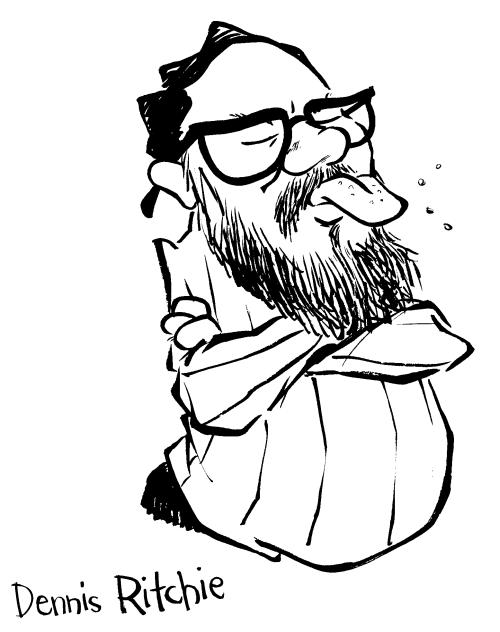
[2] http://www.donhopkins.com/home/images/DennisRitchiePthththth...

[3] https://news.ycombinator.com/item?id=3106271

    From: dmr@plan9.research.att.com
    Date: Tue, 15 Mar 1994 00:38:07 EST
    Subject: anti-foreword

    To the contributers to this book:

    I have succumbed to the temptation you offered in your preface: I do
    write you off as envious malcontents and romantic keepers of memories.
    The systems you remember so fondly (TOPS-20, ITS, Multics,
    Lisp Machine, Cedar/Mesa, the Dorado) are not just out to pasture,
    they are fertilizing it from below.

    Your judgments are not keen, they are intoxicated by metaphor. In
    the Preface you suffer first from heat, lice, and malnourishment, then
    become prisoners in a Gulag. In Chapter 1 you are in turn infected by
    a virus, racked by drug addiction, and addled by puffiness of the
    genome.

    Yet your prison without coherent design continues to imprison you.
    How can this be, if it has no strong places? The rational prisoner
    exploits the weak places, creates order from chaos: instead, collectives
    like the FSF vindicate their jailers by building cells almost com-
    patible with the existing ones, albeit with more features. The
    journalist with three undergraduate degrees from MIT, the researcher
    at Microsoft, and the senior scientist at Apple might volunteer a few
    words about the regulations of the prisons to which they have been
    transferred.

    Your sense of the possible is in no sense pure: sometimes you want
    the same thing you have, but wish you had done it yourselves; other
    times you want something different, but can't seem to get people to
    use it; sometimes one wonders why you just don't shut up and tell
    people to buy a PC with Windows or a Mac. No Gulag or lice, just a
    future whose intellectual tone and interaction style is set by Sonic the
    Hedgehog. You claim to seek progress, but you succeed mainly in
    whining.

    Here is my metaphor: your book is a pudding stuffed with apposite
    observations, many well-conceived. Like excrement, it contains
    enough undigested nuggets of nutrition to sustain life for some. But
    it is not a tasty pie: it reeks too much of contempt and of envy.
    Bon appetit!
Post reply on HN