Live data from Hacker News

What happens after a defendant is found not guilty by reason of insanity?

nytimes.com

41–50 of 143 posts

Re: What happens after a defendant is found not guilty by reason of insanity?

#41
post #32
post #9

Earlier quoted context omitted.

Isn't that the case everywhere? But the catch is that you aren't set free until you are considered cured and/or safe to set free. For many, this means never.

Unfortunate reality is some mental disease can't be effectively treated, if you can't clear the barrier of "not a danger to self or others" then it's best for society to keep a patient isolated from it. Still, our history with mental health facilities shows that we have a less than stellar reputation of actually treating individuals - wouldn't surprise me if to this day there are still people locked up in these place…

Right. It's even very commonly the case that disorders are not treatable. Which is why many that are found insane and dangerous are never released from care.

I think a problem in the US (at least by appearance) is that the regular prison system for those found same offers too little rehabilitation and care fit minor psychological disorders such as hyperactivity disorders etc. Locking half as many people up for half as long as they are currently would quadruple resources available to rehabilitate those who need it.
Re: What happens after a defendant is found not guilty by reason of insanity?

#42

Earlier quoted context omitted.

> But he did cut a guy's head off. Would you want to live next to the guy who did that while not in control of himself? Well, if he is considered sane by trustworthy professionals, then why not? I can't see how it's different to live next to someone who is cured after 10 years of treatment, as opposed to say someone who was in prison for 10 years for the same crime (Where I live this would likely be considered more s…

>Well, if he is considered sane by trustworthy professionals, then why not? Psychology as a science is remarkable in its inability to make accurate predictions. I'd ask those professionals be criminally liable if their assessment proves inaccurate.

   I'd ask those professionals be criminally liable if their assessment proves inaccurate.
You mean like we do for DA's, parole boards, expert (court) testimony, etc. ?

Re: What happens after a defendant is found not guilty by reason of insanity?

#43
post #36

Tom, name made up, is a friend of mine. Sort of... I knew Tom for only a short while but I still write him letters and send him a few dollars every couple of weeks. When Tom was just 18, he had finished school and was headed off to a large university on a sports scholarship. Not having any money, and coming from a poor family, he looked forward to this. It was going to be his big break. But, Tom needed a wardrobe fit…

Amerika, Amerika, the beautiful.

Re: What happens after a defendant is found not guilty by reason of insanity?

#44
post #26

Earlier quoted context omitted.

Slightly off-topic, but > After the incident, People for the Ethical Treatment of Animals attempted to run an ad in the Portage Daily Graphic comparing the killing of McLean to the consumption of animals WTF peta?

yes, that is the intended response http://slatestarcodex.com/2014/12/17/the-toxoplasma-of-rage/

peta is the donald trump of 'rights organizations'

Re: What happens after a defendant is found not guilty by reason of insanity?

#45
post #7

There was a very high profile case in Ontario over a decade ago. Basically, the man went into an absolute psychotic state on the travelling bus and cut the head off a stranger while everyone else on the bus ran for their lives. A decade later, he's been released- under a lot of conditions and on a lot of medication, but people are very upset that he'd ever be free at all. In interviews, he's a very interesting person…

> Would you want to live next to the guy who did that while not in control of himself?

I would prefer to not live next to anyone who if they got the wrong medical condition, the wrong combination of drugs or medical procedure, or wrong parasite, could go on a rampage and kill someone. The question is if that is possible, or if its just part of human biology that medical with the wrong set of circumstances there will be a fringe possibility that people do things which they otherwise would not.

Re: What happens after a defendant is found not guilty by reason of insanity?

#46

Earlier quoted context omitted.

I believe violent versus non-violent crimes should be treated distinctly in terms of evaluating (a) rehabilitation and (b) future offense odds. For non-violent crime, I think rehabilitation is the answer. For violent crime, I'm more comfortable with a model that involves sequestration, i.e. keeping the offender separate from society until their risk of re-offending falls suitably low.

I'm not sure prison is likely to lower anyone's risk of re-offending, alas.

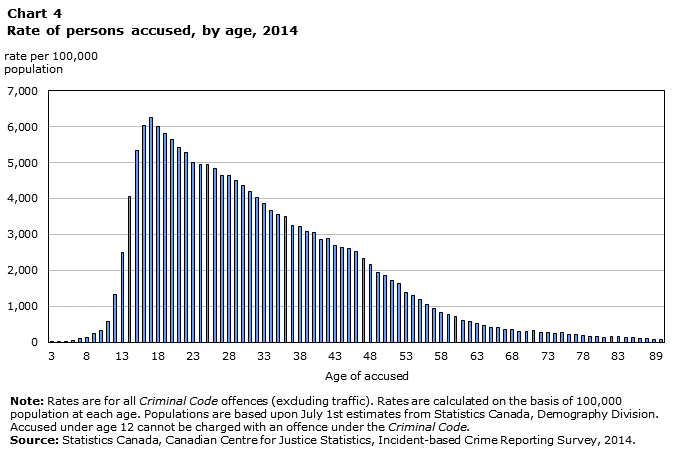
It may lower everyone's risk of re-offending by making them older when they get out: https://www.statcan.gc.ca/pub/85-002-x/2016001/article/14309... (via https://www.statcan.gc.ca/pub/85-002-x/2016001/article/14309... )

Although I guess it would make more sense to be looking at a chart of 2nd offences.

Re: What happens after a defendant is found not guilty by reason of insanity?

#47
post #7

There was a very high profile case in Ontario over a decade ago. Basically, the man went into an absolute psychotic state on the travelling bus and cut the head off a stranger while everyone else on the bus ran for their lives. A decade later, he's been released- under a lot of conditions and on a lot of medication, but people are very upset that he'd ever be free at all. In interviews, he's a very interesting person…

Where is the difference between 'I choose to do it' and 'I couldn't choose not to do it'? A lot of perceived differences between these I've seen others mention is based on free will, which is something science isn't sure even exists.

Re: What happens after a defendant is found not guilty by reason of insanity?

#48

Earlier quoted context omitted.

> But he did cut a guy's head off. Would you want to live next to the guy who did that while not in control of himself? Well, if he is considered sane by trustworthy professionals, then why not? I can't see how it's different to live next to someone who is cured after 10 years of treatment, as opposed to say someone who was in prison for 10 years for the same crime (Where I live this would likely be considered more s…

>Well, if he is considered sane by trustworthy professionals, then why not? Psychology as a science is remarkable in its inability to make accurate predictions. I'd ask those professionals be criminally liable if their assessment proves inaccurate.

Someone decided the person was insane to begin with. If we could trust them to lock them up we need to trust them to release them too.

Now, this is a nearly non existent problem isn't it? For major crimes, being locked up in psychiatric care is a longer, or indefinite sentence, than would be served in prison (this varies between countries of course).

Re: What happens after a defendant is found not guilty by reason of insanity?

#49
post #42

Earlier quoted context omitted.

>Well, if he is considered sane by trustworthy professionals, then why not? Psychology as a science is remarkable in its inability to make accurate predictions. I'd ask those professionals be criminally liable if their assessment proves inaccurate.

I'd ask those professionals be criminally liable if their assessment proves inaccurate. You mean like we do for DA's, parole boards, expert (court) testimony, etc. ?

Parole boards don't claim that empirically speaking the person to be released will never re-offend only that they have met the legal standards previously outlined for parole.

Similarly a DA only attempts to prove to a jury that a defendant is guilty and it us their job to argue as much.

If an expert witness claims something that is untrue he would be subject to perjury.

Re: What happens after a defendant is found not guilty by reason of insanity?

#50

Earlier quoted context omitted.

>Well, if he is considered sane by trustworthy professionals, then why not? Psychology as a science is remarkable in its inability to make accurate predictions. I'd ask those professionals be criminally liable if their assessment proves inaccurate.

Someone decided the person was insane to begin with. If we could trust them to lock them up we need to trust them to release them too. Now, this is a nearly non existent problem isn't it? For major crimes, being locked up in psychiatric care is a longer, or indefinite sentence, than would be served in prison (this varies between countries of course).

> If we could trust them to lock them up we need to trust them to release them too.

This guy was getting locked up no matter what. The only question was, was he getting locked up in a prison or in a psych ward? So do we trust psychiatry enough to say "lock him up here rather than there"? Sure.

Do we trust them enough to say "It's safe to release him now"? That's a harder question.

Post reply on HN