Live data from Hacker News

Cost of iPhone X in 1957

bradford-delong.com

111–120 of 173 posts

Re: Cost of iPhone X in 1957

#111
This flies directly into the face of mainstream economists who claim that deflation is killing an economy and therefore requires positive inflation because otherwise "people would stop spending".

Here's the thing: Deflation got people spending money on an iPhone.

Re: Cost of iPhone X in 1957

#112
For the punchline, the author should have followed up:

>taken up 100 billion square meters of floor space that is (with a three-meter ceiling height per floor): a hundred-story square building 300 meters high, and 3 kilometers long and wide

by saying,

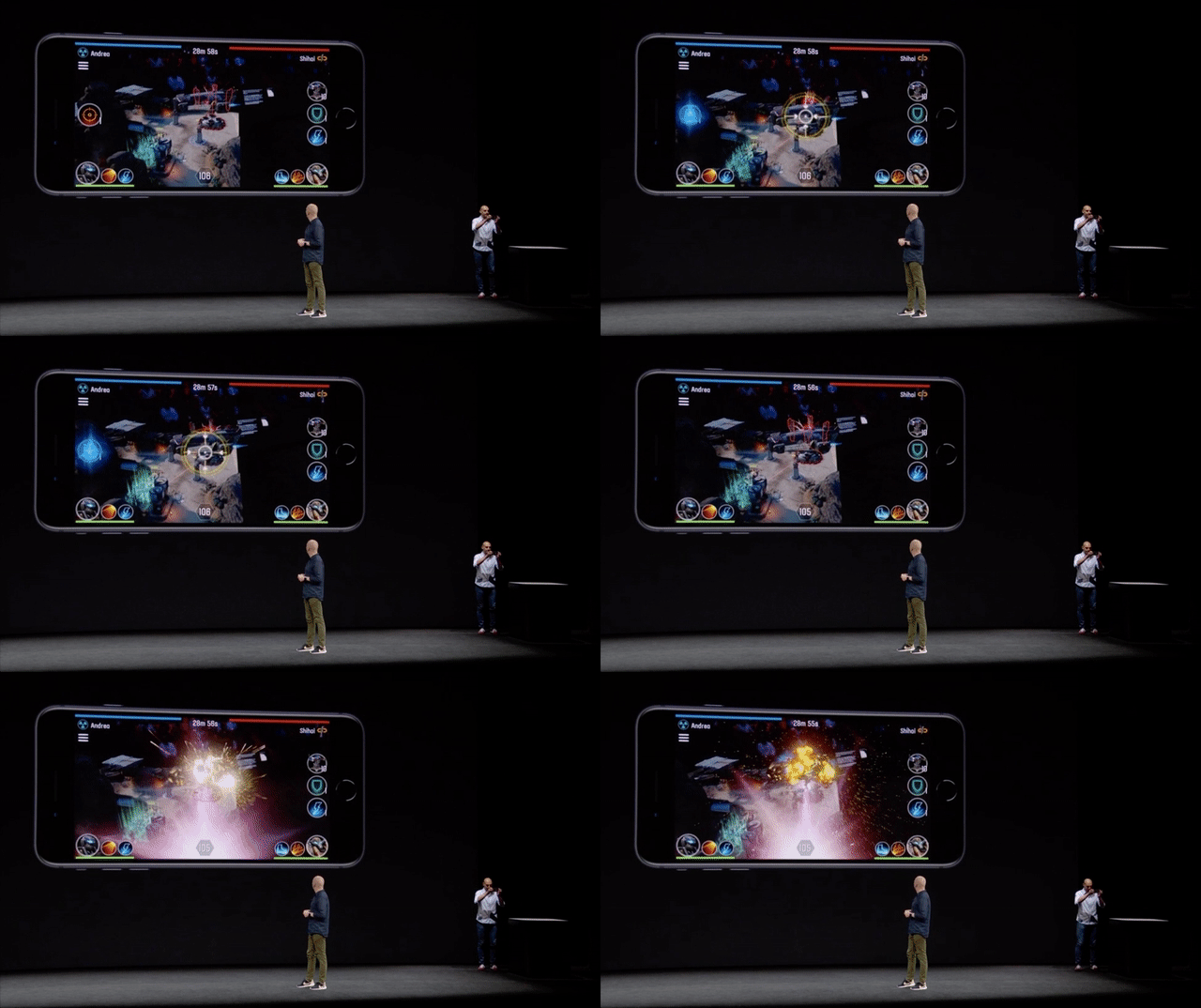
"Oh and by the way this device has an edge to edge display that is so real you can hold it up seamlessly against a background while it invents a made-up image and draws it on, pretending it's part of reality.[1] It knows its position and can adjust to your movements. It also includes a photography studio that makes billboard-size full-color photos. It fits in your pocket and needs to have its battery recharged once per day. Also it's an entire telephone including video which it has a camera facing the front for. And you can talk to it, it has a built-in assistant. Basically, magic."

[1] https://images.adsttc.com/media/images/59b8/247c/b22e/38e2/0...

Re: Cost of iPhone X in 1957

#113

Earlier quoted context omitted.

What I think is also important to consider is median income and net worth of US citizens at that time. In the early 50s, much pf Europe and Asia was still rebuilding from war, and the US held an effective monopoly on multiple industries. From the data I could find for 1952 in the US, a house was 5 years of income and a new car was half a year's income. For many people in the US today, a new car (post tax dollars) is…

I don't earn insane SV money but I could buy an iPhone X tomorrow, I save approx 50% of my salary every month but then I don't drive, own a house or have any debts. My total owed to everyone is I grew up poor though so my attitude to money is different to most people my age. If I don't have a minimum of 6mths income in savings I feel vulnerable. FWIW I won't be buying the iPhone X, my Moto G5 Plus is an ideal phone f…

Thank you for writing :)

I suppose I have two points to make from your comments:

1) You are similar to most Americans in that you already have a phone that is ideal for your needs, and that phone isn't an iPhone X

2) You are different, statistically, from hundreds of millions of Americans, in that you have any money saved at all, and don't have large financial responsibilities (house, debts)

Re: Cost of iPhone X in 1957

#114

Earlier quoted context omitted.

The name X (10) kinda reinforces this. As in, "Don't expect next year's standard priced iPhone (nominally the 9) to be as good as this."

You misunderstand. The iPhone X is the new flagship line. Next year there's most likely to be an iPhone 9 and an iPhone X2, though considering Apple's naming strategy it'll probably be called something like 'the new iPhone X'.

They pronounce it "ten" so you expect them to say "ten-two", or "the new iPhone ten" year after year?

Re: Cost of iPhone X in 1957

#115

Earlier quoted context omitted.

I don't earn insane SV money but I could buy an iPhone X tomorrow, I save approx 50% of my salary every month but then I don't drive, own a house or have any debts. My total owed to everyone is I grew up poor though so my attitude to money is different to most people my age. If I don't have a minimum of 6mths income in savings I feel vulnerable. FWIW I won't be buying the iPhone X, my Moto G5 Plus is an ideal phone f…

Thank you for writing :) I suppose I have two points to make from your comments: 1) You are similar to most Americans in that you already have a phone that is ideal for your needs, and that phone isn't an iPhone X 2) You are different, statistically, from hundreds of millions of Americans, in that you have any money saved at all, and don't have large financial responsibilities (house, debts)

I'm also different from most Americans because I'm British but yes both of those hold true for the UK.

I have considered an iPhone down the line though because Apple focuses more on privacy and that is something I do care about.

Re: Cost of iPhone X in 1957

#116
post #12

this article is just made to justify the phone's price.

In a way I love that this comment is greyed out. It's the only one that has merit. Think of it: how often do you see articles of this kind on HN, that could be written in the thousands easily, all of which you could call "amusing" or "interesting" with just as much merit? For me personally the answer is "not that I can remember", so yeah, it's kind of obvious.

HN, do you want to be a meeting point for minds, or a marketing tentacle connection node?

Re: Cost of iPhone X in 1957

#117
post #17

Comparisons like that always assume the that price is constant with increased demand even when world GDP is spent on something. What would likely happen is first the price would go up and later down as the world manufacturing would shift to vacuum tubes production.

Yes if a government started buying trillions of vacuum tubes, companies would quickly get much more efficient at producing then and there would be a huge investment into researching alternatives. But that brings up the question, what tech could we be subsidizing today so we can get it faster?

Construction. The industry has low margins ,is risk averse and slow to change.

Mobile wireless - we already have theoretical innovations that can fully solve and make it practically free

Cargo transport. Hybrid airships come mind.

On-demand ride-sharing(multiple people in a minibuses). It won't even take money, just a law demanding all transport requests will be done through a single app and than share the data and create a market.

Nuclear for sure.

Microcontroller based products -so much complexity is added to the field by the games(limited ram,flash,peripherals when they cost nothing) mcu makers play to increase profit.

Industries that may look like there's planned obsolescence occuring.so we could get cars that last a million miles(Toyota had that but fixed that problem), more reliabile appliances, etc.
Re: Cost of iPhone X in 1957

#118

Earlier quoted context omitted.

You misunderstand. The iPhone X is the new flagship line. Next year there's most likely to be an iPhone 9 and an iPhone X2, though considering Apple's naming strategy it'll probably be called something like 'the new iPhone X'.

They pronounce it "ten" so you expect them to say "ten-two", or "the new iPhone ten" year after year?

My point wasn't about the name but about the new product line. iPhone X is a new product line. Apple have made fundamental changes to the user interface. The iPhone 9 would be the successor to the iPhone 8. Whatever name Apple comes up with for iPhone X's successor, it's almost certain to keep the new 'all screen' interface.

Re: Cost of iPhone X in 1957

#119
post #89

Earlier quoted context omitted.

My family were not nearly millionaires when we bought a $1500 equivalent computer in 1982, but this phone costs less than that. And a iPhone X isn't a phone, it's a computer. I agree you do need to be in an upper tier economically to afford one, but only speaking globally. People bought plenty of laptops when they averaged well over $1000. The way phones are financed makes them much more attainable, also. The way peo…

I like to note that a smartphone is indeed a computer with one huge difference: the phone does break more often. It's no fun dropping a $1000 phone in the toilet or down the stairs. A lot of people forget this.

Also it is a hard thing to share so you're not just buying one for a family.

Re: Cost of iPhone X in 1957

#120

This comparison seems fairly fantastical and irrelevant. Something from within the history of consumer electronics would be more useful to consider, in my opinion. For example, in 1982, the wildly popular low-end home entertainment computer, the Commodore 64, was released at $595, or about $1500 after inflation adjustment. On release in 1977, the Apple II was $1298, or over $5000 in today's terms. You could pay $400…

What I think is also important to consider is median income and net worth of US citizens at that time. In the early 50s, much pf Europe and Asia was still rebuilding from war, and the US held an effective monopoly on multiple industries. From the data I could find for 1952 in the US, a house was 5 years of income and a new car was half a year's income. For many people in the US today, a new car (post tax dollars) is…

$1000 USD is 1.8 weeks full time of the minimum wage in my country (Australia).

It might be dumb for a minimum wage earner to spend 1.8 weeks of their income on a mobile phone, but I absolutely believe a certain subset of working-class Australians will, with some difficulty, manage to scrape together enough to buy one.

Or, more realistically, they'll finance one on a $100/month phone plan, which I also think is a bit ridiculous and unwise, but not so far fetched as to be impossible for many lower-income people who really want to do it.

Now, if you're middle class... let's just say that as someone who earns a salary that's within the same ballpark as the national median, I could go out and buy several iPhone Xs tomorrow if I had to...

Post reply on HN