Earlier quoted context omitted.
>>> It's more mainstream than the $NEW-AWESOME-JAVASCRIPT-FRAMEWORK. This sentence doesn't make any sense. "Mainstream" means used alot - widespread acceptance. Lisp is #33 on Tiobe after Cobol, Foxpro, Fortran and Ada. How you can compare that to the takeup of the latest JS nframeworks I don't really understand. https://www.tiobe.com/tiobe-index/ 21 SAS 1.372% 22 Dart 1.306% 23 D 1.103% 24 Transact-SQL 1.075% 25 ABA…
I was just looking at that same list. I'm surprised Lua is that low considering how many applications embed it.
Lisp Machine Manual (1984)
51–60 of 165 posts
Re: Lisp Machine Manual (1984)
#52The classic joke in here is that if you look up "fascism" in the index, it goes to the section about logging in. User authentication wasn't part of the dream, so having been forced to build it, they embedded a dig on it right in the manual. https://hanshuebner.github.io/lmman/files.xml#fascism I think there are a few other jokes in the index but I don't recall what they are.
Re: Lisp Machine Manual (1984)
#53Earlier quoted context omitted.
Lisp workstations were quite expensive with proprietary source code, while UNIX workstation were built on source code available almost for free (AT&T could not sell it so they licensed it for a symbolic price), which made them cheaper to sell. Also the companies involved in selling Lisp machines did quite a few management errors.
Ask anyone who owned a Symbolics 3600, a single-user machine the size of a refrigerator. Overpriced hardware. Poor maintenance service and low hardware reliability. A level of company arrogance seldom seen in a small company. (They thought they were going to rule AI. Didn't happen.) And, originally, 45-minute garbage collections. (Virtual memory plus slow disk plus naive garbage collection.) What really killed them w…
> a small company
At max they had 1000 employees.
> And, originally, 45-minute garbage collections
Then they invented and commercialized better GCs.
Re: Lisp Machine Manual (1984)
#54Earlier quoted context omitted.
Lisp had a 10 year head start on expensive academic machines that were low on industry uses. C had a head start on high-end mainframes for actual work. Then the main contenders on the nascent PC were assembly, C and Pascal. P-code based compilers arrived quickly and were faster to develop with, but the resulting code was inefficient—and early PCs were sufficiently resource-constrained that inefficient code was very n…
> C had a head start on high-end mainframes for actual work. No. C started on low-end minicomputers, not high-end mainframes. And why didn't Lisp take over the low-end minicomputers? Because Lisp was too resource-hungry, and those low-end minicomputers didn't have the muscle to run Lisp well. They ran C just fine, though.
Re: Lisp Machine Manual (1984)
#55My friend Nick made a run of custom silkscreened orange LISP CHINE NUAL t-shirts (most places won't print around the side like that).
https://www.facebook.com/photo.php?fbid=74206161754&l=54ec4e...
I was wearing mine in Amsterdam at Dappermarkt on Queen's Day (when everyone's supposed to wear orange, so I didn't stand out), and some random hacker (who turned out to be a university grad student) came up to me at random and said he recognized my t-shirt!
http://www.textfiles.com/hacking/hakdic.txt
CHINE NUAL (sheen'yu-:l) noun.
The reference manual for the Lisp Machine, a computer designed at MIT especially for running the LISP language. It is called this because the title, LISP MACHINE MANUAL, appears in big block letters -- wrapped around the cover in such a way that you have to open the cover out flat to see the whole thing. If you look at just the front cover, you see only part of the title, and it reads "LISP CHINE NUAL"
Re: Lisp Machine Manual (1984)
#56Earlier quoted context omitted.
>>> It's more mainstream than the $NEW-AWESOME-JAVASCRIPT-FRAMEWORK. This sentence doesn't make any sense. "Mainstream" means used alot - widespread acceptance. Lisp is #33 on Tiobe after Cobol, Foxpro, Fortran and Ada. How you can compare that to the takeup of the latest JS nframeworks I don't really understand. https://www.tiobe.com/tiobe-index/ 21 SAS 1.372% 22 Dart 1.306% 23 D 1.103% 24 Transact-SQL 1.075% 25 ABA…
I was just looking at that same list. I'm surprised Lua is that low considering how many applications embed it.
The reason those rankings are (mostly) useless is that it's based on search engine hits. An active, effective community that for whatever reason doesn't generate a million and one blog entries a month will not perform as well on the index. This makes it very useful for indicating fads in programming, but not reality.
Re: Lisp Machine Manual (1984)
#57There seems to be plenty of people who think Lisp is awesome. If so, then why hasn't it become "mainstream"?
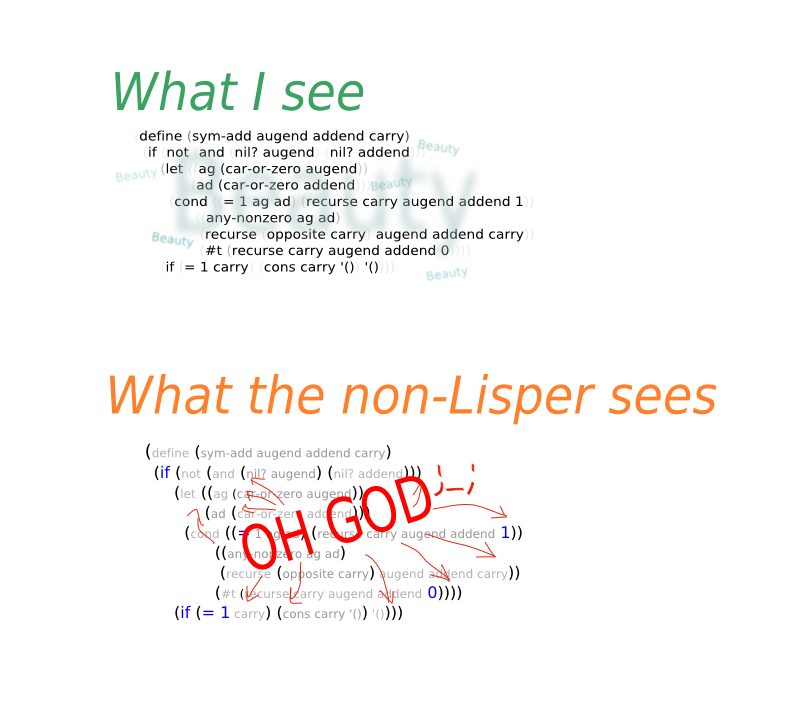
Asbestos suit on. There are many positive things you can say about Lisp. However, many day-to-day developers, and their managers, believe that Lisp's syntax creates nigh-unreadable programs. For example, there's no built-in infix syntax, as opposed to practically all other programming languages, and many modern programmers today expect infix as minimum table stakes for a language. Lisp syntax is extremely simple , bu…
Re: Lisp Machine Manual (1984)
#58There seems to be plenty of people who think Lisp is awesome. If so, then why hasn't it become "mainstream"?
Asbestos suit on. There are many positive things you can say about Lisp. However, many day-to-day developers, and their managers, believe that Lisp's syntax creates nigh-unreadable programs. For example, there's no built-in infix syntax, as opposed to practically all other programming languages, and many modern programmers today expect infix as minimum table stakes for a language. Lisp syntax is extremely simple , bu…
I'm forced to use other languages and rarely have the time to do something in Lisp for fun, but when I do, it is the most readable and least eye-straining language that I know.
Python is far more eye-straining in its monotony.
I understand other arguments: I'd like batteries included outside Lispworks/Allegro, larger repositories of examples that reflect best practices, perhaps even an improved Common Lisp.
But readability? I just don't get it.
Re: Lisp Machine Manual (1984)
#59There seems to be plenty of people who think Lisp is awesome. If so, then why hasn't it become "mainstream"?
Asbestos suit on. There are many positive things you can say about Lisp. However, many day-to-day developers, and their managers, believe that Lisp's syntax creates nigh-unreadable programs. For example, there's no built-in infix syntax, as opposed to practically all other programming languages, and many modern programmers today expect infix as minimum table stakes for a language. Lisp syntax is extremely simple , bu…
But I don't think syntax alone is enough to explain Lisp's apparent languishing (though only apparent since it seems to be on the rise again), because we have Clojure. Clojure has the same syntax issues as Lisp (ok a bit fewer because of no reader macros and there's an argument that bracket variety is more pleasant to read) yet it's very popular all things considered. And because Clojure has a BDFL, if lacking infix OOTB was really an issue (I don't think it's come up in any of the annual surveys), RH could just include one of the libraries for it out of the box. SBCL could do that for Lisp, but it would be non-standard.
To me there are several stronger drivers for language adoption than anything the language itself offers. Here are three: having a BDFL (Python, Perl, PHP, Clojure... not Lisp), having big corporate backing (Swift, Objective C, C#, Go, arguably Java but driven by more than 1 megacorp... not Lisp), being the lingua franca of a very widespread platform (Javascript (web), PHP (shared web hosts), Bash, C/C++ (unix, windows), Java (android)... not Lisp, maybe if the Lisp Machine had won but it didn't).
Re: Lisp Machine Manual (1984)
#60Earlier quoted context omitted.
Because Brendan Eich's management lied to him about allowing him to do Scheme in the browser: https://brendaneich.com/2008/04/popularity/ When I think of what web programming could have been like, it makes me want to weep.
I also dream of what it would be like if lisp in the browser had become mainstream, but it's possible that if he had implemented it like he wanted to, it wouldn't have received such wide spread adoption like javascript did.