Live data from Hacker News

When the Rich Said No to Getting Richer

nytimes.com

31–40 of 229 posts

Re: When the Rich Said No to Getting Richer

#31

I wrote this a few years ago in response to a similar piece: The problem is that the rich have the ability to take their income in alot of different ways. Tax income more, they'll take it as dividends. Tax dividends more, they'll take it as capital gains. Tax capital gains, they won't realize their capital gains until they can offset them with realized losses or they'll just get bank loans again't their stock holding…

You could tax holdings in the US or by US citizens instead of earnings, then. Make it expensive to hold capital. Capital in motion and at a high velocity is generally good for everyone. Capital at rest serves very few and is very harmful to everyone else.

> Capital in motion and at a high velocity is generally good for everyone. Capital at rest serves very few and is very harmful to everyone else.

This is dangerously wrong. No economist would tell you that a high velocity of money is an inherent good, or even that increasing the velocity of money is an unfettered good.

Public infrastructure, mortgages, venture capital, small business loans - all of these are investments, and making it more expensive to hold capital will dry up access to money for these sorts of projects.
Re: When the Rich Said No to Getting Richer

#32
post #10

Earlier quoted context omitted.

"The problem is that no tax code can close all loop holes because you just can't foresee the creative ways people will out maneuver the tax code." I disagree. I simple flat tax rate where everything is taxed at a single rate would close every single one of the loopholes above, if only by making it moot. The fact that the rich can maneuver themselves into a much lower tax rate than the average person presents a signif…

How would a flat tax rate avoid the unfortunate reality of burdening the poor with relatively high taxes? Tax brackets, in theory, mitigate this by reducing or eliminating taxes for low income individuals and families. A flat tax rate would surely simplify things, but I'm not convinced it would be the best solution.

A flat tax (eg. land tax + sales taxes, which are harder to manipulate than income tax) can be used to fund a universal basic income, which automatically gives you a smooth progressive tax system with no weird breakpoints setting up inefficient incentives.

Re: When the Rich Said No to Getting Richer

#33

I wrote this a few years ago in response to a similar piece: The problem is that the rich have the ability to take their income in alot of different ways. Tax income more, they'll take it as dividends. Tax dividends more, they'll take it as capital gains. Tax capital gains, they won't realize their capital gains until they can offset them with realized losses or they'll just get bank loans again't their stock holding…

You could tax holdings in the US or by US citizens instead of earnings, then. Make it expensive to hold capital. Capital in motion and at a high velocity is generally good for everyone. Capital at rest serves very few and is very harmful to everyone else.

Define "hold capital". Most capital held in banks ends up helping the velocity of money because it's used for loans. If we tax the hell out of money stored in banks, banks will have less reserve, which reduces the fraction of which they can lend, which means your average joe has less access to loans for their cars, maybe their first house, a small business, etc.

Past that, if it's expensive to hold money in America, they'll stop holding money in America, which means capital flight, which is its own very large problem worth avoiding.

Re: When the Rich Said No to Getting Richer

#34
post #10

Earlier quoted context omitted.

"The problem is that no tax code can close all loop holes because you just can't foresee the creative ways people will out maneuver the tax code." I disagree. I simple flat tax rate where everything is taxed at a single rate would close every single one of the loopholes above, if only by making it moot. The fact that the rich can maneuver themselves into a much lower tax rate than the average person presents a signif…

What would the flat tax actually tax though, income? Wouldn't they just dodge that then by not having income? Sure, for you and me it would make it easier -- my W2 says I made exactly 100k, here's exactly 50k of it, period. For people who have a flexible income, why report any amount that would make you pay in?

Don't have income tax at all, tax every transaction 20%, like a flat rate VAT except that you can't claim it back on your business expenses. Simplify the entire tax system without having loads of brackets, exemptions and special cases - if you sell goods or services, 20% of that is paid as tax, end of story.

I mean, I am not an economist, I have no idea if that would work or not(probably not)

Re: When the Rich Said No to Getting Richer

#35

I don't understand the obsession with financially successful people. If you have ambitions for financial success, learn a skill that is in high demand or find another way to create value for society. If you have no ambitions for financial success, you have no right to go around complaining about the success of others. Stop fetishizing successful people who deprecate their success. Some, like Warren Buffet, are dising…

Quite often in the pursuit of more wealth, they trample on the little guys, leaving them to struggle more.

Re: When the Rich Said No to Getting Richer

#36
post #10

I wrote this a few years ago in response to a similar piece: The problem is that the rich have the ability to take their income in alot of different ways. Tax income more, they'll take it as dividends. Tax dividends more, they'll take it as capital gains. Tax capital gains, they won't realize their capital gains until they can offset them with realized losses or they'll just get bank loans again't their stock holding…

"The problem is that no tax code can close all loop holes because you just can't foresee the creative ways people will out maneuver the tax code." I disagree. I simple flat tax rate where everything is taxed at a single rate would close every single one of the loopholes above, if only by making it moot. The fact that the rich can maneuver themselves into a much lower tax rate than the average person presents a signif…

A flat tax rate is not a good idea whatsoever; if you tax e.g. 20% of earnings ,do you believe people who earn $30k a year are impacted the same way as people earning $200k or more? Sure, those who earn more pay more, but it hits them in "extra" earnings, while the poor are taxed on money they need to survive.

A (very) progressive tax rate with a few ways of reducing the tax based on social (e.g. number of children, etc) criteria would probably work better here.

Re: When the Rich Said No to Getting Richer

#37
> The theory behind all those high-end tax cuts — a theory that I once found persuasive, I admit — was that it would unleash entrepreneurial energy: The lure of great wealth would inspire business leaders to work harder and smarter, and the economy would flourish.

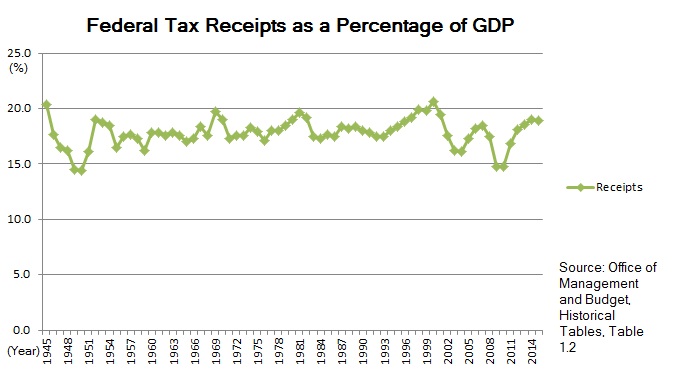
That's one reason I suppose but it's important to note that despite large differences in top marginal tax rates, the percentage of tax revenue as a percentage of GDP has stayed remarkably stable since the 40s. So perhaps something else is going on.

[0] https://upload.wikimedia.org/wikipedia/commons/7/75/U.S._Fed...

Re: When the Rich Said No to Getting Richer

#39
post #10

I wrote this a few years ago in response to a similar piece: The problem is that the rich have the ability to take their income in alot of different ways. Tax income more, they'll take it as dividends. Tax dividends more, they'll take it as capital gains. Tax capital gains, they won't realize their capital gains until they can offset them with realized losses or they'll just get bank loans again't their stock holding…

"The problem is that no tax code can close all loop holes because you just can't foresee the creative ways people will out maneuver the tax code." I disagree. I simple flat tax rate where everything is taxed at a single rate would close every single one of the loopholes above, if only by making it moot. The fact that the rich can maneuver themselves into a much lower tax rate than the average person presents a signif…

While I agree that a flat tax is drastically superior to our current convoluted tax scale, it would still have many unfortunate depressant effects. When you introduce friction at every trade, you hurt the market's ability to reach an optimum. This could never happen in the US (or any country that follows the Geneva convention, since it forbids revocation of citizenship), but it would be extremely interesting to have a small nation where the only tax was a constant head tax, like $X thousand/person/year. All of a sudden, many incentives that don't currently line up would start to.
Post reply on HN