Live data from Hacker News

24/192 Music Downloads Are Very Silly Indeed (2012)

xiph.org

171–180 of 445 posts

Re: 24/192 Music Downloads Are Very Silly Indeed (2012)

#171
post #132

Earlier quoted context omitted.

That makes for some genuinely interesting thought experiments. What if, this actually becomes possible, but we discover that because we previously couldn't hear these frequencies, our instruments and equipment are HORRIBLY mis-tuned and sound terrible? We may end up having to re-record tons of stuff. Something something premature optimization. And part of me is glad that the art of hand-making instruments is not yet…

Most instruments generate harmonics that are integer multiples of the fundamental frequency, and some go a lot higher than human hearing. As you go up the harmonic series, the harmonics get (logarithmically) closer together. Our brains interpret close-together notes as dissonant, so higher harmonics could be kind of obnoxious to hear together. They might be "in-tune", but just too close to be enjoyable. (Imagine an e…

Because of the power decrease as you go up the overtone series, I'd suspect that being able to hear higher frequencies wouldn't cause very much trouble. However, the ability to hear higher fundamental frequencies would surely change harmonic theory! This is assuming that our pitch perception of high fundamental frequencies increased accordingly.
Re: 24/192 Music Downloads Are Very Silly Indeed (2012)

#172
post #140

There's a very straightforward practical reason why you might want to keep downloading 24/192. The people who put those together are on average "audiophile" snobs so the rips tend to be perfect, often from high quality sources like SACDs, hdtracks, etc. The source of the recording is usually the best master known for that record (special remastered editions, etc.). If you download mp3/spotify chances are the copy you…

> The source of the recording is usually the best master known for that record (special remastered editions, etc.).

Usually what is happening here is you're getting a master that hasn't been compressed to death (see loudness wars). Vinyl is a shit source for 'quality', but most records aren't compressed to death so they can still sound better on a good set of speakers due to the dynamic range.

Re: 24/192 Music Downloads Are Very Silly Indeed (2012)

#173
post #45

Earlier quoted context omitted.

It's not that much different to think of than 480p vs 4K/2160p -- dramatically higher resolution, increasing the width and length of the 'grid' that sound is recorded into -- except that in the case of audio fidelity, quality after a certain point causes problems with playback systems, resulting in audible artifacts and distortion.

That analogy works if you modify it: - 480p vs 2160p is measuring the resolution of your cell phone propped up on a pillow at the other end of your living room - experimental evidence shows that your eyesight is not good enough to pick up on the increased resolution, you've maxed out your sensory perception - Your phone stutters trying to stream at 4k so the playback might actually be worse.

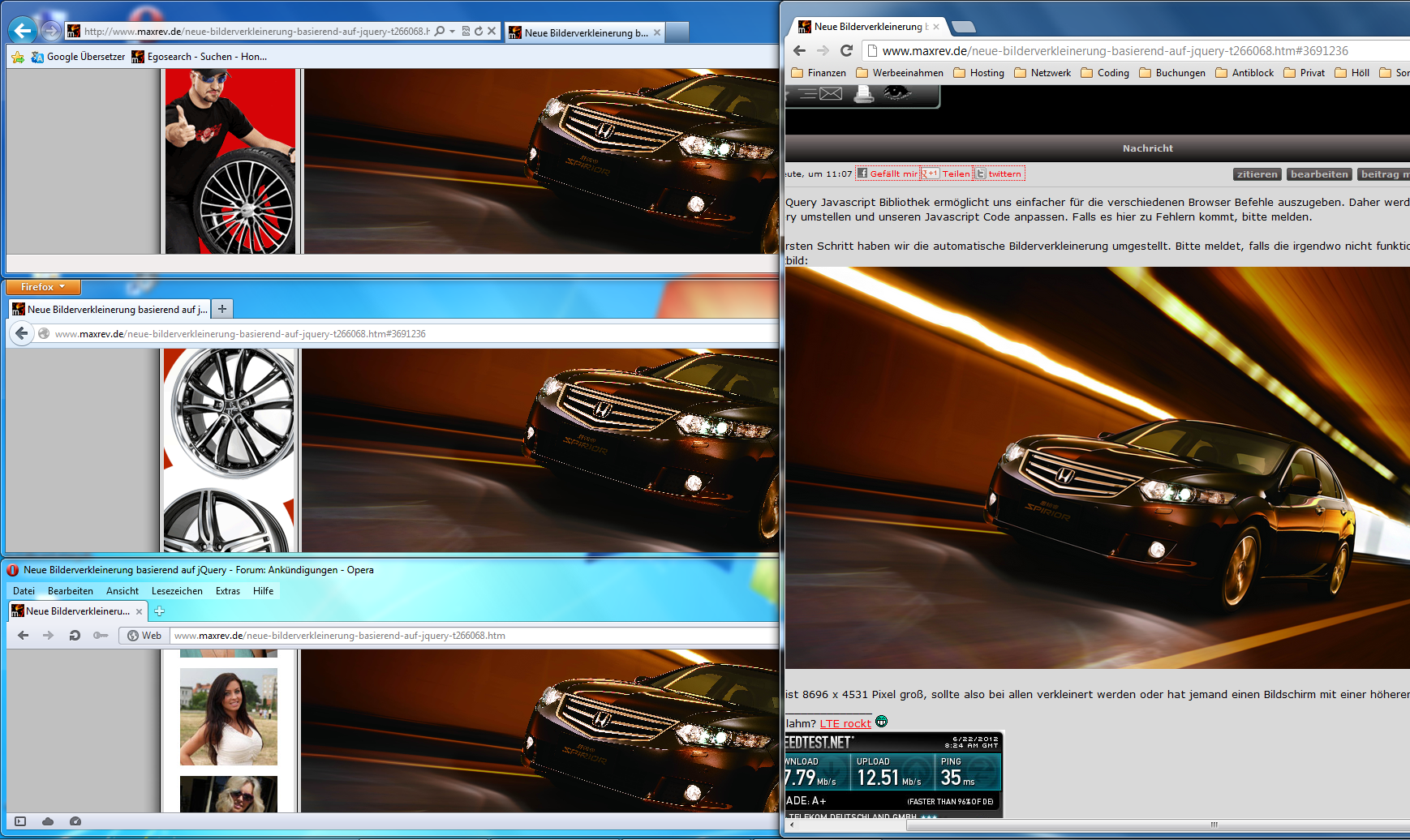
The analogy with images is demonstrated in this screenshot [1], which is referenced in a StackOverflow answer on the topic of image scaling in web browsers [2].

When the high resolution image is downscaled poorly, some high (spatial) frequencies are aliased down into lower (spatial) frequencies, manifesting as blocky/jagged lines. The images are 2D data in the spatial domain, while the audio is 1D data in the temporal domain, but the aliasing of high frequency signal to lower frequency artifact is similar.

Viewing a high resolution image on a panel that has enough pixels to display it without scaling is analogous to listening to 192 kHz audio on a fantastic speaker system that can reproduce those high frequencies accurately, instead of causing distortion by aliasing them to lower frequencies. On the other side, viewing a high resolution image which has been downscaled poorly is analogous to listening to that 192 kHz audio on a realistic speaker system that cannot reproduce high frequencies, which results in those signals aliasing down into the audible range.

And as you say, there is a point where, for the viewer/listener's sake, it doesn't make sense to push for higher frequencies because even if you can build a panel/speaker that will faithfully reproduce those frequencies without aliasing, the eye/ear will not be able to perceive the additional detail.

[1] http://www.maxrev.de/files/2012/08/screenshot_interpolation_...

[2] https://stackoverflow.com/a/11987735

Re: 24/192 Music Downloads Are Very Silly Indeed (2012)

#174
post #3

While the extra quality is lost on listeners, from experience I've found that super-HQ source material can change your results (for the better) when fed through distortion/compression/warming effects processors

I've heard (and it passes the smell test) that even if your ears can't resonate at frequencies higher than human hearing, the space you are in can, and your ears are sensitive to the differences in arrival time that are smaller than the pitches we can't hear. So at least in high sample rate music the imaging could potentially be cleaner. Assuming super great everything else.

Arrival time differences are essentially phase shifts and assuming infinite quantization you can encode phase shifts with infinite accuracy on a band limited sampled system.

So no.

Re: 24/192 Music Downloads Are Very Silly Indeed (2012)

#175

If the only thing you do with your music is listen, then yes, 24/192 delivers questionable value compared to the more popular 16/44.1 or 16/48 formats. However, all musicians I know use these high-rez formats internally. The reason for that, when you apply audio effects, especially complex VST ones, these discretization artifacts noticeably decrease the result quality. Maybe, the musicians who distribute their music…

To truly support downstream remixing, musicians would need to distribute the original, separate tracks. Occasionally an independent musician will do this, but it's not at all common AFAIK.

Re: 24/192 Music Downloads Are Very Silly Indeed (2012)

#176
post #131

Earlier quoted context omitted.

Unfortunately this video doesn't work on iOS. I'll try to remember to watch this next time I'm at a computer.

It's available on YouTube[1] as well, which should work just about everywhere. [1]: https://www.youtube.com/watch?v=cIQ9IXSUzuM

Thanks!

Re: 24/192 Music Downloads Are Very Silly Indeed (2012)

#177
post #18

I've said it before, this video demo is one of the very best I've ever seen. https://xiph.org/video/vid2.shtml So well prepared, so well presented, so little that could be removed without ruining it. I aspire to do such good demos but always fall so short.

Thanks, I appreciate it. I have probably forwarded the article to 20 or so people since it first came out. Didn't know about this video.

Re: 24/192 Music Downloads Are Very Silly Indeed (2012)

#178

If the only thing you do with your music is listen, then yes, 24/192 delivers questionable value compared to the more popular 16/44.1 or 16/48 formats. However, all musicians I know use these high-rez formats internally. The reason for that, when you apply audio effects, especially complex VST ones, these discretization artifacts noticeably decrease the result quality. Maybe, the musicians who distribute their music…

I do not believe it. 24 bits is definitely needed for processing (better yet, use floating-point). Not 192 kHz; no friggin' way. Repeated processing through multiple blocks at a given sample rate does not produce cumulative discretization problems in the time domain; it's just not how the math works.

> Not 192 kHz; no friggin' way.

That's an anthropocentric statement.

I want to leave it at that for now just to see if I get dinged for low effort.

Re: 24/192 Music Downloads Are Very Silly Indeed (2012)

#179
post #140

There's a very straightforward practical reason why you might want to keep downloading 24/192. The people who put those together are on average "audiophile" snobs so the rips tend to be perfect, often from high quality sources like SACDs, hdtracks, etc. The source of the recording is usually the best master known for that record (special remastered editions, etc.). If you download mp3/spotify chances are the copy you…

so like, signaling?[1]

[1] https://en.wikipedia.org/wiki/Signalling_(economics)

Re: 24/192 Music Downloads Are Very Silly Indeed (2012)

#180

If the only thing you do with your music is listen, then yes, 24/192 delivers questionable value compared to the more popular 16/44.1 or 16/48 formats. However, all musicians I know use these high-rez formats internally. The reason for that, when you apply audio effects, especially complex VST ones, these discretization artifacts noticeably decrease the result quality. Maybe, the musicians who distribute their music…

To truly support downstream remixing, musicians would need to distribute the original, separate tracks. Occasionally an independent musician will do this, but it's not at all common AFAIK.

For software, you have a source code, you compile it with a standard-complying compiler, and you’ll more or less reproduce the result.

Music is different. If you have the original multi-track composition, you can’t reproduce the result unless you also have the original DAW software (of the specific version), and all the original VST plugins (again, of the specific version each).

All that software is non-free, and typically it’s quite expensive (esp. VSTi). Some software/plugins are only available on Windows or Mac. There’s little to no compatibility even across different versions of the same software.

Musicians don’t support nor maintain their music. Therefore, DAW software vendors don’t care about open formats, interoperability, or standardization.

Post reply on HN