Debian reproducibility statistics
tests.reproducible-builds.org
Debian reproducibility statistics
1–10 of 72 posts
Re: Debian reproducibility statistics
#2Can someone shed some light on what exactly "reproducible" means in this context?
Re: Debian reproducibility statistics
#3Can someone shed some light on what exactly "reproducible" means in this context?
It's a term for binaries (usually ELF) being byte-to-byte equal in two
different runs of a compiler. This way you can build a binary package from
source package and if its content is the same, you know what source code was
used to build the package, and then you can e.g. inspect the code for
backdoors or build debug symbols without planning for that beforehand.
Re: Debian reproducibility statistics
#4Can someone shed some light on what exactly "reproducible" means in this context?
It's a term for binaries (usually ELF) being byte-to-byte equal in two different runs of a compiler. This way you can build a binary package from source package and if its content is the same, you know what source code was used to build the package, and then you can e.g. inspect the code for backdoors or build debug symbols without planning for that beforehand. https://en.wikipedia.org/wiki/Reproducible_build
And why Debian is not reproducible?
Re: Debian reproducibility statistics
#5Earlier quoted context omitted.
It's a term for binaries (usually ELF) being byte-to-byte equal in two different runs of a compiler. This way you can build a binary package from source package and if its content is the same, you know what source code was used to build the package, and then you can e.g. inspect the code for backdoors or build debug symbols without planning for that beforehand. https://en.wikipedia.org/wiki/Reproducible_build
And why Debian is not reproducible?
because during the compilation, some package use date-dependent stuff, for example (I dunno the exact details though)
Re: Debian reproducibility statistics
#6Can someone shed some light on what exactly "reproducible" means in this context?
More details at https://reproducible-builds.org/ which is linked to at the bottom of OP's page.
Re: Debian reproducibility statistics
#7Earlier quoted context omitted.
It's a term for binaries (usually ELF) being byte-to-byte equal in two different runs of a compiler. This way you can build a binary package from source package and if its content is the same, you know what source code was used to build the package, and then you can e.g. inspect the code for backdoors or build debug symbols without planning for that beforehand. https://en.wikipedia.org/wiki/Reproducible_build
And why Debian is not reproducible?
Often, package is built using a certain library version (from a different package), that library is then updated - and the new package cannot build using the new library.
Or... deeper parts of the compiler toolchain change, and the application doesn't re-build without changes.
Re: Debian reproducibility statistics
#8Earlier quoted context omitted.
It's a term for binaries (usually ELF) being byte-to-byte equal in two different runs of a compiler. This way you can build a binary package from source package and if its content is the same, you know what source code was used to build the package, and then you can e.g. inspect the code for backdoors or build debug symbols without planning for that beforehand. https://en.wikipedia.org/wiki/Reproducible_build
And why Debian is not reproducible?
https://wiki.debian.org/ReproducibleBuilds
"With this we can detect problems related to timestamps, file ordering, CPU usage, (pseudo-)randomness and other things"
https://tests.reproducible-builds.org/debian/index_variation...
Re: Debian reproducibility statistics
#9What a nice progression https://tests.reproducible-builds.org/debian/stats_issues.pn...
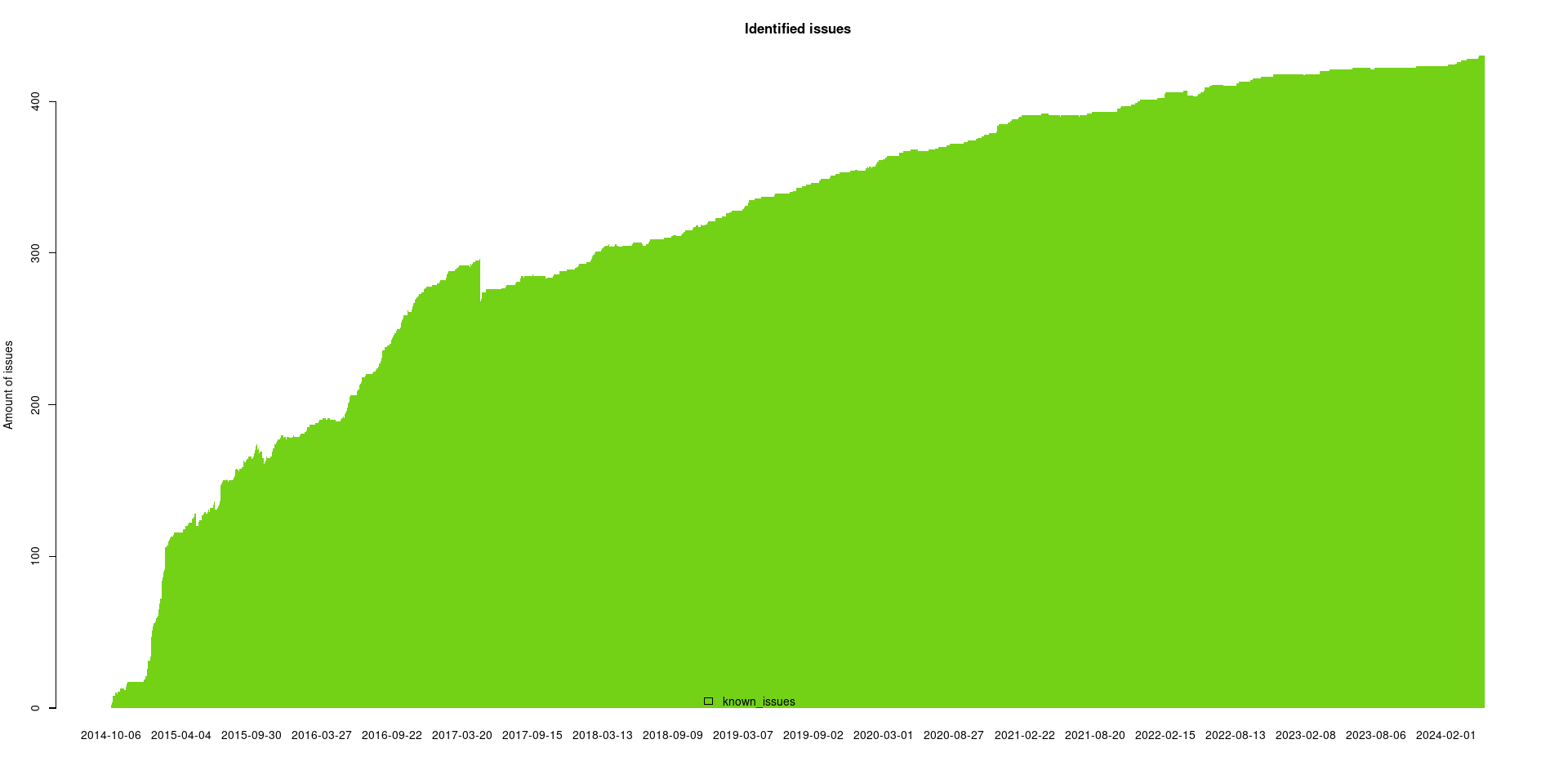
Project started in 2014 it seems.
Re: Debian reproducibility statistics
#10Maybe im missing something but it seems the justification behind this is based on a situation in which source wasnt open. Debian is open so why is reproducibility a priority?