Live data from Hacker News

Inside Waymo's Secret World for Training Self-Driving Cars

theatlantic.com

61–70 of 146 posts

Re: Inside Waymo's Secret World for Training Self-Driving Cars

#61

Earlier quoted context omitted.

Agreed. As a Google engineer, I think a lot of our AI efforts are "safe" (as in we'll keep investing in them for a long time) because they're already providing substantial business value. For example, - TTS and speech synthesis have lots of uses in Android (phones, Wear, Auto, etc.) - Object recognition is very useful for photo search - Face recognition is also useful for photo search (if you tag people in Google Pho…

I doubt Google will cut back any time soon, but as a former Google engineer, I find this an entertaining definition of business value ;) How much money does Google Photos make? Last time I used it, there were no ads in it. Isn't speech recognition nearly at human levels of comprehension, at least for US English and outside of highly technical jargon? Speech patterns change slowly, so would Android continue to make mo…

> How much money does Google Photos make? Last time I used it, there were no ads in it.

Google Photos is, in a sense, a big ad with prominent calls to action for selling storage space.

> Isn't speech recognition nearly at human levels of comprehension, at least for US English and outside of highly technical jargon?

Recognition, maybe (though I think no). Applying recognized text to get the desired outcome, not even close.

> Does Google Translate make money in some specific, measurable way?

It powers a paid API, so, yes, it makes money in a specific, direct, measurable way.
Re: Inside Waymo's Secret World for Training Self-Driving Cars

#62

Earlier quoted context omitted.

I occassionally come across construction that is marked in an unusual way - at 65 miles an hour when the speed limit is 75. Also, when they are changing freeways and restriping them (leaving the original old faded lanes and before new lines go up) sometimes it's confusing to me and the traffic is flowing at 80 miles an hour, IIRC this was happening on 880 for a while about 10 years back. If the AI is confused by a ro…

Both of those situations are one where policy could be changed to solve the problem with relative ease. Transportation construction crews would actively put up markers and other signs to make routes clear to self driving vehicles. A side effect would be that it would probably be more clear to human drivers as well.

Basically, I'd expect an AI system to be able to go into swarm mode without clear markings.

How else do they ever want to work in egypt, or around the arc de trioumpe(sp?) in paris?

Re: Inside Waymo's Secret World for Training Self-Driving Cars

#63

Earlier quoted context omitted.

I doubt Google will cut back any time soon, but as a former Google engineer, I find this an entertaining definition of business value ;) How much money does Google Photos make? Last time I used it, there were no ads in it. Isn't speech recognition nearly at human levels of comprehension, at least for US English and outside of highly technical jargon? Speech patterns change slowly, so would Android continue to make mo…

> How much money does Google Photos make? Last time I used it, there were no ads in it. Google Photos is, in a sense, a big ad with prominent calls to action for selling storage space. > Isn't speech recognition nearly at human levels of comprehension, at least for US English and outside of highly technical jargon? Recognition, maybe (though I think no). Applying recognized text to get the desired outcome, not even c…

But selling disk storage is a very marginal business and few people take huge numbers of photos they value enough to pay for storage of (vs sticking them on Facebook or Instagram which compresses the hell out of them but does it for free). I really doubt this is a significant business for Google.

Re: Inside Waymo's Secret World for Training Self-Driving Cars

#64

> But Peng also presented the position of the traditional automakers. He said that they are trying to do something fundamentally different. Instead of aiming for the full autonomy moon shot, they are trying to add driver-assistance technologies, “make a little money,” and then step forward toward full autonomy. It’s not fair to compare Waymo, which has the resources and corporate freedom to put a $70,000 laser range…

Who's going to buy a car that might tell them they can't drive?

Re: Inside Waymo's Secret World for Training Self-Driving Cars

#65
Recently, Waymo and Lyft launched a self-driving vehicle partnership [0]. With Trump nomination of Derek Kan (Lyft General Manager in Southern California) to serve as Under Secretary of Transportation for Policy [1], would it ease Waymo path towards autonomous car supremacy?

[0] https://www.reuters.com/article/us-lyft-waymo-collaboration-...

[1] https://www.whitehouse.gov/the-press-office/2017/04/06/presi...

Re: Inside Waymo's Secret World for Training Self-Driving Cars

#66
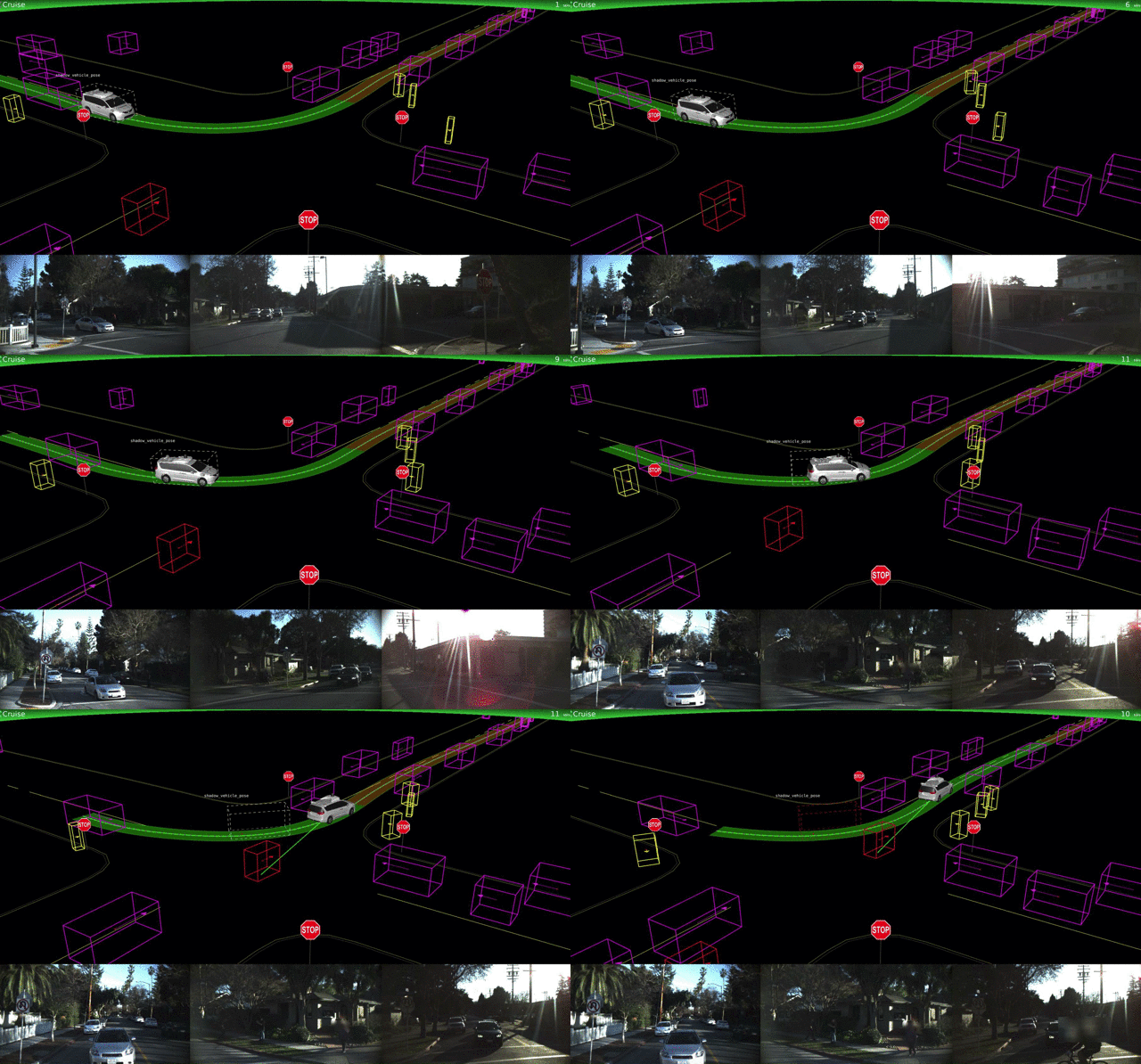
Unless I didn't understand correctly, on the animated image of the car turning, which included a wireframe representation of the scene, as well as the cameras: https://cdn.theatlantic.com/assets/media/img/posts/2017/08/W...

The generated geometry doesn't seem to include the Bike that quickly passes behind the car at the intersection ...

Re: Inside Waymo's Secret World for Training Self-Driving Cars

#67
post #62

Earlier quoted context omitted.

Both of those situations are one where policy could be changed to solve the problem with relative ease. Transportation construction crews would actively put up markers and other signs to make routes clear to self driving vehicles. A side effect would be that it would probably be more clear to human drivers as well.

Basically, I'd expect an AI system to be able to go into swarm mode without clear markings. How else do they ever want to work in egypt, or around the arc de trioumpe(sp?) in paris?

Swarm mode can still happen with clear markings. I assume the vehicles don't have a dedicated swarm mode, more like they try to do lane keeping but the distance and road keeping algorithms override that. If not, a "great" practical joke would be to paint lane markings that run off the side of the road. It's just like any piece of software, you cannot trust any external input, not even road markings.

Re: Inside Waymo's Secret World for Training Self-Driving Cars

#69
post #51
post #27

Earlier quoted context omitted.

Do they have anything that works in rain/snow?

Snow is challenging because the lane markers are obscured by the snow -- human drivers guess at where the lanes should be, or remember where the lanes were yesterday. Tesla being able to record sensor/map data from human drivers driving through snow will help them mitigate this. On the other hand, electric batteries have less range in cold whether, so I imagine that in the near term electric cars will be less popular…

While I take the point cold weather affects range. Norway, Sweden, Finland and many other cold climates have very high electric car usage. Mostly due to the subsidies, but it appears range isn't a major concern there.

https://cleantechnica.com/2017/06/23/tesla-electric-cars-con...

Re: Inside Waymo's Secret World for Training Self-Driving Cars

#70
post #16

> for an average of once every 890 miles, or 0.80 disengagements per 1,000 miles. Isn’t that 1.12~ per 1000mi?

Wow, and I must think we're looking to squeeze ~3 more orders of magnitude or more of the reliability before going full driverless ~(1m miles/disengagement)

I wonder how many disengagements per unit of distance your average human has...
Post reply on HN