Forgive my ignorance, but why wouldnt we expect to see exponential growth in wealth, and as a result a greater discepency between the top 1% and everyone else?
The rich are hoarding economic growth
21–30 of 157 posts
Re: The rich are hoarding economic growth
#22So what caused the change in 1973?
Financialization of the economy. The fall of Bretton-Woods. The fall of the gold standard. The repeal of Glass-Steagall.
Re: The rich are hoarding economic growth
#23This is why I appreciate the $15 an hour minimum wage movement. Paying people more is better then taxing the rich more. The super-rich own congress but at the city and State level there is depending upon the state some room to grow wages. Higher wages equals fewer people on public subsidies which is good for cities and states.
Minimum wage costs are mostly passed on as increased prices paid by the middle class. The profits to the .01% class are barely affected.
Re: The rich are hoarding economic growth
#24Earlier quoted context omitted.
What labor has value below the required amount to exist as a human? I think the reasoning is - if it's worth being done, it's worth paying someone a meager living wage to have it done.
While I agree in principle, the counter-argument is that you're just going to end up with that job going overseas or getting automated. Basically, if you need something done and it's only worth $10/hour to you to have it done, but no one near you will do it for less than $15/hour, either 1) it won't get done and that $10/hour economic input is lost, or 2) you'll find a way to get it done for $10/hour or less via mean…
And when outsourcing happens, you tax the fuck out of that business transaction, and with the proceeds pay your unemployed laborers a livable minimum income. You think Chinese labor is cheap for no reason? There are tons of gov't subsidies, from straight up handouts to nonexistant labor laws (which are a form of subsidy to big business at the expense of workers, a reverse tax).
The same should apply to automation. The inordinate inequality of wealth which is bound to happen with automation should be alleviated through heavy taxation. Or if tax is too dirty a word, ownership of such dual capital/labor should be partly socialized--i.e. newly created AI/robot companies must put up a % of their shares to the public who receive equal amounts.
Re: The rich are hoarding economic growth
#25The title and the tone of the OP are a bit inflammatory for my taste, but the data and graphs from the research paper are eye-opening: most economic growth in the US over the past three decades has indeed gone to the top 1%, and particularly to the top 0.01%, leaving everyone else behind.[1]
Here's the money shot: https://cdn.vox-cdn.com/uploads/chorus_asset/file/9013427/Sc...
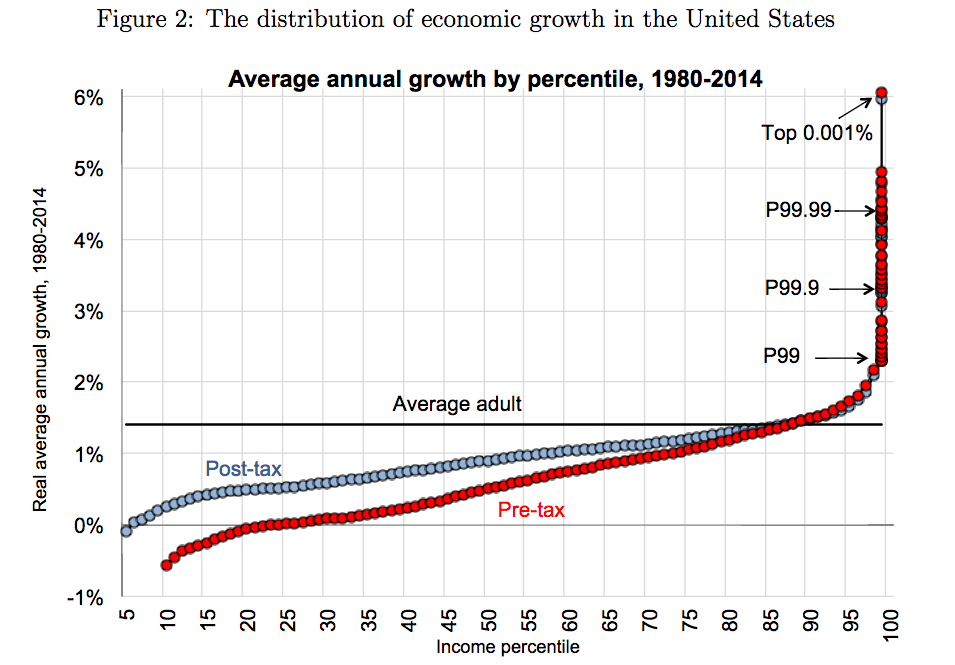
However, rather than debate the causes of this divergence, or accuse "the rich" of anything, we should instead be coming up with WORKABLE SOLUTIONS for increasing the income -- and therefore the spending power -- of the masses in a sustainable manner.
I imagine a tremendous amount of pent-up consumer demand would be unleashed, because THE MORE THE MASSES EARN, THE MORE THEY SPEND ON PRODUCTS AND SERVICES, including those created by entrepreneurs.
[1] Here's the paper: http://gabriel-zucman.eu/files/PSZ2017.pdf
Re: The rich are hoarding economic growth
#26Forgive my ignorance, but why wouldnt we expect to see exponential growth in wealth, and as a result a greater discepency between the top 1% and everyone else?
Technically we would, but not at the cost of such discrepancy, as it usually had a violent ending in the past. Costing lives and entire countries social stabilities.
Re: The rich are hoarding economic growth
#27Earlier quoted context omitted.
We need to just peg the minimum wage to inflation so we don't have to do this every decade or two.
Minimum wage++ == Inflation++
Except that they've tracked that, and it doesn't. There was a nice recent natural experiment in Seattle, and the effect was negligible.
Do you have any empirical evidence otherwise?
Re: The rich are hoarding economic growth
#28This is why I appreciate the $15 an hour minimum wage movement. Paying people more is better then taxing the rich more. The super-rich own congress but at the city and State level there is depending upon the state some room to grow wages. Higher wages equals fewer people on public subsidies which is good for cities and states.
Why stop there? Just make it 100$ and hour and everyone will be rich!
Oh wait, arbitrary wage increases don't really work out in real life.
https://fivethirtyeight.com/features/seattles-minimum-wage-h...
Seattle's socialist member of the city council fired the Unversity of Washington team after the results came out and hired an anti-capitalist professor from berkeley to ensure the study finds the right results.
http://www.foxnews.com/politics/2017/06/29/seattle-commissio...
Re: The rich are hoarding economic growth
#29This is why I appreciate the $15 an hour minimum wage movement. Paying people more is better then taxing the rich more. The super-rich own congress but at the city and State level there is depending upon the state some room to grow wages. Higher wages equals fewer people on public subsidies which is good for cities and states.
[deleted]
Re: The rich are hoarding economic growth
#30This is why I appreciate the $15 an hour minimum wage movement. Paying people more is better then taxing the rich more. The super-rich own congress but at the city and State level there is depending upon the state some room to grow wages. Higher wages equals fewer people on public subsidies which is good for cities and states.
The problem is that if you set a minimum wage that is higher than the real value of the work performed, it means those jobs just simply won't exist anymore.
The real value of a lot of products and services is more adjustable than your statement would lead someone to believe. Reality is absolutely not an efficient marketplace that immediately culls jobs and workers the moment a certain price of labor threshold is reached.