Live data from Hacker News

Machine Learning Crash Course: The Bias-Variance Dilemma

ml.berkeley.edu

51–60 of 63 posts

Re: Machine Learning Crash Course: The Bias-Variance Dilemma

#51
post #36
post #14

Earlier quoted context omitted.

That's is a great and pithy characterization. To expand on that a little: If there existed an underlying model with a finite number of parameters, then you could potentially find it will a finite number of measurements. But if there is no underlying model, the only viable approach is using non-parametric estimation. If you try to truncate a non-parametric model to a finite/fixed dimensional model, you are introducing…

Yes, interestingly the idea of preference for simplicity is a medieval invention - not a universal truth. It served the rational program well for eight hundred years, but now we have infernal engines we can abandon it. I think that the late enlightenment test of theories that generate a clutch of non trivial testable predictions is going to prove more useful in the future.

There are many reasons to prefer simplicity, not just that prior to ubiquitous computing complicated models were intractable. Off the top of my head:

A simple model can be "robust" to errors because the errors tend to cancel out. More complex models are typically more sensitive to slight changes in the input (and therefore noise), so even if your model is exactly correct, small errors in the input can be amplified yielding large errors in the predictions.

Or it can be preferable because it tends to fail in certain characteristic ways. For example, Newtonian mechanics breaks down at both the high and low mass/energy scales, but it's usually possible to determine whether you'll have to employ GR or QM (and perhaps despair if both are required simultaneously).

Also, it's much easier to test simple models (and typically also to train them if we're talking ML)[0]. Furthermore, if your first approximation is well-understood, then you can complicate it to address new data.

Simplicity has many virtues; just because we can employ more complicated methods now doesn't mean that we should, or that the sole reason previous generations of scholars opted for simple models is because they couldn't perform the calculations needed by more complex ones. In general we can't expect to know the underlying truth with certainty, but maybe a question is so important and so well investigated that it merits a seriously convoluted answer. For less well-studied or relatively unimportant problems, a model that is obviously wrong but easy to use is usually preferable. It's called the bias-variance trade-off for a reason (although you should still try to get a good deal, which in this case means minimizing error or perhaps risk).

------

0. This point can be particularly subtle-- we generally have more computing power available than (quality) data. I can try millions of variations on a given hypothesis for a small data set relatively quickly and find a handful of results with publishable p-values. This is how you get replication crises. Even if one of my hypotheses is invalidated, I can generate many more that are still consistent with the data. Take string theory for example-- a naive approach to testing the various parameterizations/permutations of the basic idea would run out of time before the heat death of the universe, so absent theoretical work constraining the possibility space, it would be effectively unfalsifiable.
Re: Machine Learning Crash Course: The Bias-Variance Dilemma

#52
post #5

Wow, the discussion on the Fukushima civil engineering decision was pretty interesting. However, I find it surprising that the engineers simply overlooked the linearity of the law and used a nonlinear model. I wonder if there were any economic / other incentives at play, and the model shown was just used to justify the decision? Regardless, that post was a great read.

Honestly, the nonlinear model looks far better to my eye than the linear model. The error term of the linear model seems obviously dependent on X, which contradicts the notion that the linear model was "correct". I think the article does a disservice to the reader by oversimplifying and calling the linear model "correct".

Re: Machine Learning Crash Course: The Bias-Variance Dilemma

#53
post #41
post #39

Earlier quoted context omitted.

I simply don't recognise that characterisation of ML. I think that "data driven AI" fits far better. ML emerged in a number of ways over the years, but a strong driver of the last iteration was the knowledge engineering bottleneck encountered in fifth generation computing and surrounding the demise of the last turing center. I invite you to read Chris Bishop's or Stephen Muggleton's books. Anyone who works with data…

data that "fell into your lap" is a euphemism for a process in which the data was not generated by a controlled experiment in which a hypothesis is created first, and then the data is gathered according to a procedure using the proper controls and testing. "fell into your lap" has nothing to do with how hard the work is, it's about the difference between a controlled experiment and an observational study. the bulk of…

Yes, it's observational data. But this is quite common in many sciences. Observations of stella events, measurements of ecosystems and weather events for example. These have lead to theories with explanatory power and machine learning tools can and do as well.

One big deal is applications to dynamic domains.

Re: Machine Learning Crash Course: The Bias-Variance Dilemma

#54
post #15

I've always liked this visualization of the Bias-Variance tradeoff: http://www.eggie5.com/110-bias-variance-tradeoff

That's OK as a visualisation of what bias and variance are, but it's a bad visualisation of the bias-variance tradeoff, because in that image there is no tradeoff - it shows a case where bias and variance are independent of one another. An illustration like this one genuinely confused me when I was first introduced to bias and variance: I couldn't understand why the lecturer was claiming there is a tradeoff while showing a picture of a case where there is no tradeoff. I eventually figured out what was going on, but I think I would have got it quicker if it had been explained more like the linked post, and less like that diagram.

Re: Machine Learning Crash Course: The Bias-Variance Dilemma

#55
post #9
post #7

Earlier quoted context omitted.

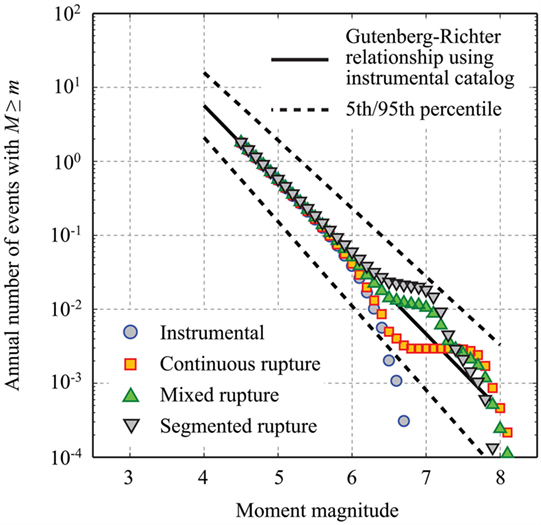
Most likely, since building a facility to survive a 2.5x stronger shake would surely be a lot more expensive. I was also curious about how the data in the past few years did not follow the same trend as before. Does anyone know if that is what geologists call to be 'overdue' to an earthquake? Like California is supposed to be for a while?

Well, the data wasn't showing that the past few years were anomalous; rather, there were fewer high-magnitude earthquakes than expected. I don't think this has anything to do with being overdue for an earthquake. Most likely this is just because with events of low frequency (e.g. these higher-magnitude earthquakes were predicted to occur once every ~100 years by the linear model), large percent deviations from the ex…

My point was that maybe for high mag quakes the power law is invalid... Or at least I dont think we have enough data at this end to be certain of what is going on.

Here's another plot, this time from UK seismic frequency, where again the frequency for high magnitude earthquakes seem 'under' the expected curve. Yet, again, these are 2 plots...

http://www.quakes.bgs.ac.uk/hazard/Hazard_UK.htm

Re: Machine Learning Crash Course: The Bias-Variance Dilemma

#56
post #5

Wow, the discussion on the Fukushima civil engineering decision was pretty interesting. However, I find it surprising that the engineers simply overlooked the linearity of the law and used a nonlinear model. I wonder if there were any economic / other incentives at play, and the model shown was just used to justify the decision? Regardless, that post was a great read.

Honestly, the nonlinear model looks far better to my eye than the linear model. The error term of the linear model seems obviously dependent on X, which contradicts the notion that the linear model was "correct". I think the article does a disservice to the reader by oversimplifying and calling the linear model "correct".

As therajiv pointed out, there were only a handful of data points supporting the kink in the curve, down at its end, versus lots and lots for the main line. Even in freshman physics labs you get told it's a terrible idea to extrapolate from a few points at the end of a curve, because those are typically the noisiest.

Re: Machine Learning Crash Course: The Bias-Variance Dilemma

#57

Earlier quoted context omitted.

Honestly, the nonlinear model looks far better to my eye than the linear model. The error term of the linear model seems obviously dependent on X, which contradicts the notion that the linear model was "correct". I think the article does a disservice to the reader by oversimplifying and calling the linear model "correct".

As therajiv pointed out, there were only a handful of data points supporting the kink in the curve, down at its end, versus lots and lots for the main line. Even in freshman physics labs you get told it's a terrible idea to extrapolate from a few points at the end of a curve, because those are typically the noisiest.

Certainly. But the issues of a linear model being "correct" and how to extrapolate forward are not the same.

Re: Machine Learning Crash Course: The Bias-Variance Dilemma

#58
post #45

Earlier quoted context omitted.

The other common example of the same phenomena is a test for a deadly genetic defect with a 1% false positive rate. If the incidence of the defect is .01% and you test positive, its actually more likely that you don't have the disease. (although this can be solved with bayesianism over frequentism).

This is a pernicious misunderstanding of "frequentism", often found among people who studied statistics mainly by reading comics. http://web.archive.org/web/20130117080920/http://andrewgelma...

That's incredibly unnecessary. My understanding of statistics is not derived from comics (and the first time I heard that example was in a statistics course), and the link you post doesn't actually address what I stated. It addresses an actual mistake in the comic, which is a mistake that I didn't make.

Here's Andrew, the author of that blog post:

> Yes, I think it makes a lot of sense to criticize particular frequentist or Bayesian methods rather than to criticize freq or Bayes statisticians.

Which is exactly what I did. There are times when frequentist methods are effective. I just wouldn't use them to tell me that I have a disease.

Re: Machine Learning Crash Course: The Bias-Variance Dilemma

#59
post #7
post #5

Wow, the discussion on the Fukushima civil engineering decision was pretty interesting. However, I find it surprising that the engineers simply overlooked the linearity of the law and used a nonlinear model. I wonder if there were any economic / other incentives at play, and the model shown was just used to justify the decision? Regardless, that post was a great read.

Most likely, since building a facility to survive a 2.5x stronger shake would surely be a lot more expensive. I was also curious about how the data in the past few years did not follow the same trend as before. Does anyone know if that is what geologists call to be 'overdue' to an earthquake? Like California is supposed to be for a while?

Actually it seems so. I'm no geologist but a quick google search for Gutenberg–Richter plots show that this 'kink' can have a very specific physical reason:

http://www.frontiersin.org/files/Articles/233038/fbuil-02-00...

Re: Machine Learning Crash Course: The Bias-Variance Dilemma

#60
Welch Labs has a great 15-part series, where they gradually build up a decision tree model that counts the number of fingers in an image. Part 9 in the series explains the bias-variance spectrum really well: https://youtu.be/yLwZEuybaqE?list=PLiaHhY2iBX9ihLasvE8BKnS2X...
Post reply on HN