The web has become bloated, where people use heavy JS frameworks like React to make their blog and then load 5MB of ad JS to load 10MB autoplaying videos. I dream of a day when static site generators like Hugo and Jekyll are the norm. Let's flex our muscles and make that happen and show the world that AMP is good but openness is better.
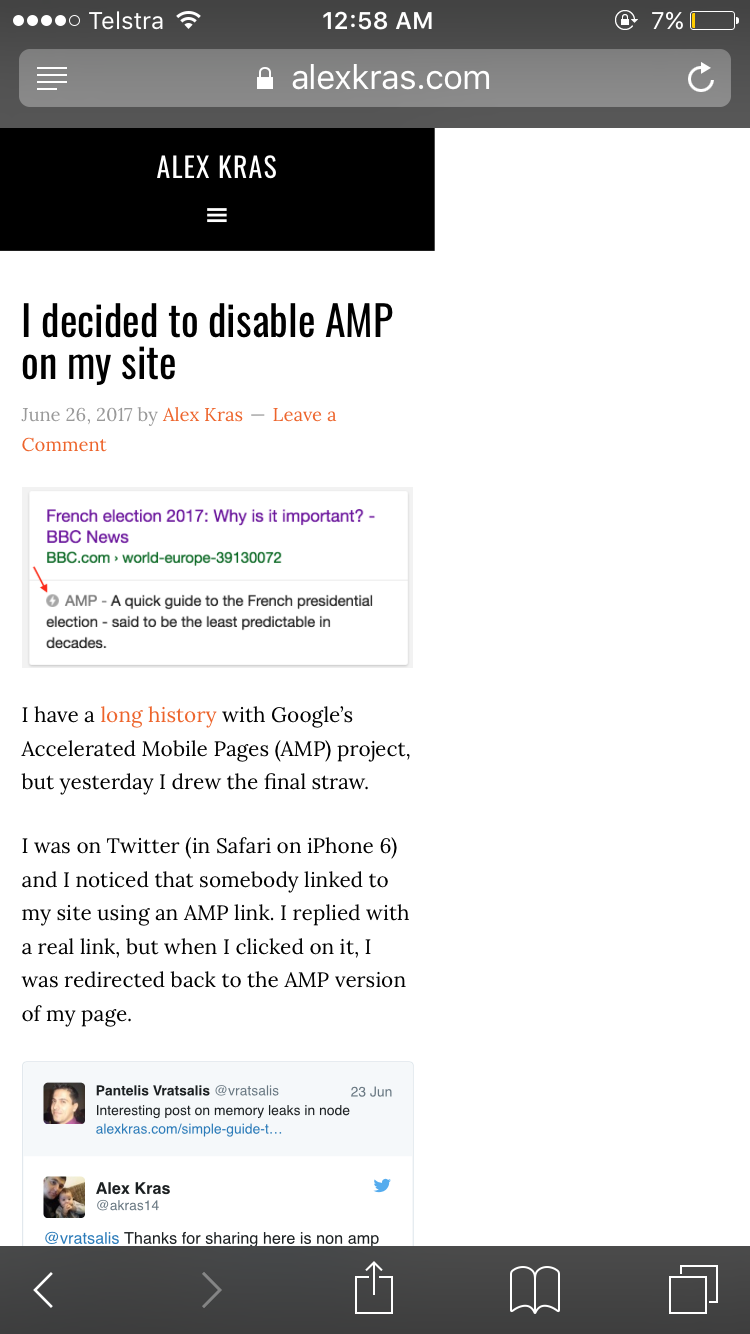
I decided to disable AMP on my site
201–210 of 360 posts
Re: I decided to disable AMP on my site
#202There's a lot of backlash against AMP on principle, which I agree with and support. However, as a non-principled web consumer, I think AMP pages are 10x better than the ad-filled, slow as molasses, jump-around-as-JavaSript-loads, video autoplaying, 'stories you might like' suggested bullshit, auto-loading 20MB heaps of steaming garbage that current news sites are. I think that AMP is a stepping stone that shows the u…
Re: I decided to disable AMP on my site
#203To me, AMP is the same wallet garden that Facebook is. Google and Facebook both say: "Give us your content. But without the crap. Just the content. Since we don't allow crap, users prefer the experience over here. So your content will have more readers then on your own domain.". And for some reason publishers are crazy enough to do that. Instead of removing the crap on their own domains in the first place.
BEGIN NITPICKY_JERK;
Just in case you've misheard the phrase, it's actually "walled garden" not "wallet garden".
END NITPICKY_JERK;
Re: I decided to disable AMP on my site
#204Earlier quoted context omitted.
The feature that defines a walled garden is the wall. AMP doesn't have that wall: it is perfectly usable by any other search engine/spider to replicate the experience. The website itself can link to the AMP version if that makes sense for users. Mobile browsers, or web servers, could check for and redirect to the AMP version. There's a slightly-higher wall for advertisers, I believe. But Google is rightfully afraid o…
Here's the wall: could any competitor to Google itself ever be on AMP? (E.g., a competitor to search, Gmail, YouTube, or adsense/adwords.) Or would it have to be something on the open web? And if only AMP pages get ranked well on Google in the future, how much harder would it be for such competitors to ever get noticed in the first place?
Currently, the only thing on Google results explicitly limited to AMP is the mobile news carousel. Presumably AMP pages also do well on the "loads fast" evaluation that affects normal rankings, but in theory it should be possible to do equally well without AMP. If this is changed, or turns out to not hold up in practice, then there is cause for concern, but I have not seen evidence of either.
News sites, of course, don't generally compete with Google's core services - unless you count Blogger, but in that case all news sites do). The one thing I can think of is that they might embed videos hosted on competitors to YouTube. When it comes to that, AMP is a mixed bag. Unlike on the open web, video players that use custom controls/iframes (like YouTube) need to be explicitly approved, since there's not much alternative without granting a blanket license to put arbitrary sites in iframes, which would (mostly) defeat the purpose. So Google acts as a gatekeeper. On the other hand, the spec [1] already lists like a dozen random video hosts you've never heard of; that's not evidence that Google wouldn't try to block a more serious competitor to YouTube, should one ever spring up, but there's certainly no evidence that they would.
[1] https://www.ampproject.org/docs/reference/components/amp-vid...
Re: I decided to disable AMP on my site
#205The author has some very valid points against AMP from a technical standpoint, but for me there is a single reason that is sufficient: the Web is, and should stay, free and open . Indeed, I'm having really hard time trying to understand how people can be fine with AMP while fighting for the net neutrality and so on.
I fail to see what, in AMP, makes the web less free or open. I am usually among the first on the stockade on invasive tech, but I have a hard time to understand the fuss around AMP. Yes, the cache is problematic, as it may allow Google, in a possible future, to filter some content, censor some other or not refresh often some pages. The thing is, if it does that, people will start using Google's caching, that's as sim…
Re: I decided to disable AMP on my site
#206The author has some very valid points against AMP from a technical standpoint, but for me there is a single reason that is sufficient: the Web is, and should stay, free and open . Indeed, I'm having really hard time trying to understand how people can be fine with AMP while fighting for the net neutrality and so on.
Why? Because the article doesn't display alright on my mobile (screenshot here: http://mickael.kerjean.free.fr/public/IMG_1720.PNG) From a user experience, it's not great.
The way I see it, AMP is just another alternative to Bootstrap. Sure, it's not perfect but when I need to quickly add a few things to create something simple, it does the job. Like any piece of techs, there's some downside, but at least you benefit from:
- less ui bugs in your website as it was likely test accross more devices that you could ever do on your own
- would load faster than you bootstrap equivalent
Re: I decided to disable AMP on my site
#207Earlier quoted context omitted.
You're saying that AMP doesn't help with slow connections, based on AMP not loading all resources on 2G. But you're missing the data point for non-AMP pages on 2G. Are you sure it's not even worse? It's hard to believe how bloated many modern websites are, before trying to load them over 2G. We're talking megabytes of data and tens of connections to display what should be a 20kB of text.
AMP puts 100KB of JavaScript in the initial render path, and a bunch of CSS. That doesn't mean that other sites cannot be worse but it means that there's no way to make an AMP page which doesn't require transferring at least that much data. I notice this fairly regularly in marginal network coverage (subway tunnels/platforms) where AMP pages load no faster than any well-optimized site unless the stars are aligned and…
Re: I decided to disable AMP on my site
#208Earlier quoted context omitted.
AMP puts 100KB of JavaScript in the initial render path, and a bunch of CSS. That doesn't mean that other sites cannot be worse but it means that there's no way to make an AMP page which doesn't require transferring at least that much data. I notice this fairly regularly in marginal network coverage (subway tunnels/platforms) where AMP pages load no faster than any well-optimized site unless the stars are aligned and…
Keep in mind that this AMP JS library is being loaded from the CDN only once for all AMP pages, then cached in the browser.
The general rule about inclining render-blocking resources matters here, too.
Re: I decided to disable AMP on my site
#209> It “traps” users on Google. If user were to click “x” in the screenshot above, they will be taken back to Google search results. A normal redirect would have landed users on actual BBC site, maximizing their chances of staying on that site. Instead, AMP makes it easier for users to return to Google. As a user, this is what I want. I don't care about the BBC's site, I care about what I searched for. If I want to see…
Last time this came up someone linked to a Google employee submitting a bug report to Apple about the scrolling. Their response was "that's how it's supposed to work - the rest of the system is wrong and we will fix that". So iPhone users might not have much choice anyway soon!
Kind of reminds me of how terrible mouse acceleration is on OSX, and how Apple gradually removed all the options for fixing it - now the only option is to install a completely different commercial mouse driver (SteerMouse).
Re: I decided to disable AMP on my site
#210To me, AMP is the same wallet garden that Facebook is. Google and Facebook both say: "Give us your content. But without the crap. Just the content. Since we don't allow crap, users prefer the experience over here. So your content will have more readers then on your own domain.". And for some reason publishers are crazy enough to do that. Instead of removing the crap on their own domains in the first place.
> same wallet garden BEGIN NITPICKY_JERK; Just in case you've misheard the phrase, it's actually "walled garden" not "wallet garden". END NITPICKY_JERK;