Live data from Hacker News

Horcrux: A Password Manager for Paranoids

arxiv.org

21–30 of 168 posts

Re: Horcrux: A Password Manager for Paranoids

#21
post #14

I think all password managers that store passwords are flawed. Storage is a burden. The store must be synced between devices, secured, backed-up, etc. and it can be stolen. I believe that passwords should be deterministically generated when needed, not retrieved from a store. I'm not sure why this approach is not seen more often. Edit: It seems people don't understand what I mean... I just put some code here to bette…

Because then you're out of luck when you need to update your password, say, due to a data breach at your target site. Or when the deterministically generated password doesn't meet the specific password requirements of the website. Or if somebody can capture your input "seed", they can generate all your passwords without needing to capture your password database like they would in another password manager.
Re: Horcrux: A Password Manager for Paranoids

#22
post #4

The trick of entering a dummy username and password, which is then modified in the post request sounds a whole lot better than playing clipboard roulette or messing with the DOM.

Are they using dummy parameters in the request so they can substitute correctly?

Re: Horcrux: A Password Manager for Paranoids

#23
post #14

I think all password managers that store passwords are flawed. Storage is a burden. The store must be synced between devices, secured, backed-up, etc. and it can be stolen. I believe that passwords should be deterministically generated when needed, not retrieved from a store. I'm not sure why this approach is not seen more often. Edit: It seems people don't understand what I mean... I just put some code here to bette…

How could you generate passwords that satisfy arbitrary password constraints? Say example.com has a 20 character limit, must contain a capital letter and symbol (but not certain symbols), and can't contain a dictionary word. It seems to me like your generator would have to have an option for each constraint to satisfy, and you'd have to remember them at the time of retrieval (unless you store the settings).

Is there a different solution?

Re: Horcrux: A Password Manager for Paranoids

#24
post #14

I think all password managers that store passwords are flawed. Storage is a burden. The store must be synced between devices, secured, backed-up, etc. and it can be stolen. I believe that passwords should be deterministically generated when needed, not retrieved from a store. I'm not sure why this approach is not seen more often. Edit: It seems people don't understand what I mean... I just put some code here to bette…

A very easy scheme could be:

    password = hmac(url++nonce, master_key)
You then store url and nonce. it's no problem that this info is public as far as I know, but perhaps you could again encrypt both the URL and the Nonce using symmetric encryption using the master key

Every time you need to change your password, (because it leaked), you simply generate a new nonce. You only store the nonce and the URL and this seems like a very secure scheme to me.

Cons: You can not change the master key after the fact, so make sure it's secure.

I'm not a cryptographer, so I'm probably missing something obvious

Edit:

We still need to solve the "password constraints" problem. I would say, we could add functions that given the password stored, deterministically creates a string from the password that adheres to some specific password scheme. For example, by using the password as a seed to a random number generator used to fuel traditional password generators like the one included in lastpass. The 'scheme' would also be stored next to the nonce and the url.

Re: Horcrux: A Password Manager for Paranoids

#25
post #14

I think all password managers that store passwords are flawed. Storage is a burden. The store must be synced between devices, secured, backed-up, etc. and it can be stolen. I believe that passwords should be deterministically generated when needed, not retrieved from a store. I'm not sure why this approach is not seen more often. Edit: It seems people don't understand what I mean... I just put some code here to bette…

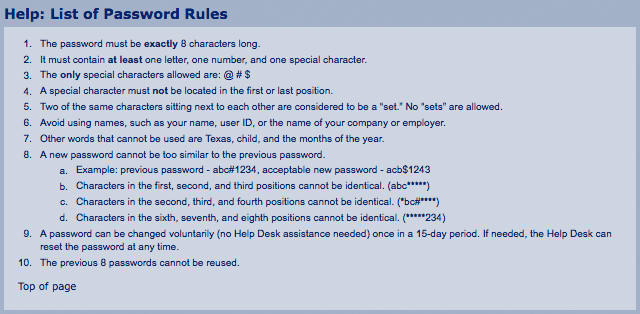
The fact that different websites have different password requirements/limitations is a big part of it

http://also.kottke.org/misc/images/password-req.gif

Re: Horcrux: A Password Manager for Paranoids

#26
post #14

I think all password managers that store passwords are flawed. Storage is a burden. The store must be synced between devices, secured, backed-up, etc. and it can be stolen. I believe that passwords should be deterministically generated when needed, not retrieved from a store. I'm not sure why this approach is not seen more often. Edit: It seems people don't understand what I mean... I just put some code here to bette…

It is because of differences in password requirements. It is likely impossible to design a strong deterministic algorithm that doesn't require any per-site tweaks. Once you have per-site tweaks, remembering the exact tweak for each site has similar drawbacks as remembering per-site passwords. You can instead write the tweaks down somewhere, but that has similar drawbacks to writing down the passwords themselves.

Re: Horcrux: A Password Manager for Paranoids

#27
post #14

I think all password managers that store passwords are flawed. Storage is a burden. The store must be synced between devices, secured, backed-up, etc. and it can be stolen. I believe that passwords should be deterministically generated when needed, not retrieved from a store. I'm not sure why this approach is not seen more often. Edit: It seems people don't understand what I mean... I just put some code here to bette…

A very easy scheme could be: password = hmac(url++nonce, master_key) You then store url and nonce. it's no problem that this info is public as far as I know, but perhaps you could again encrypt both the URL and the Nonce using symmetric encryption using the master key Every time you need to change your password, (because it leaked), you simply generate a new nonce. You only store the nonce and the URL and this seems…

I tried doing that a few years ago, random password constraints made it highly impractical.

And if you end up using a database for storing your nonces and hashing schemes you'll end up with the same limitations and attack vectors the parent was complaining about.

Re: Horcrux: A Password Manager for Paranoids

#28
post #16

If you are paranoid, then there is only one option, you are the password manager. Certainly not a piece of software you didn't author yourself. Else you are not truly paranoid.

Are you trying to tell me what my threat model should be? That makes me suspicious...

No, actually only stating truly paranoid people would not use a 3rd party password manager. Else you still have somewhat trust in third parties, making you not paranoid.

Your reply however... stamps paranoid label on it :)

Re: Horcrux: A Password Manager for Paranoids

#29
post #27

Earlier quoted context omitted.

A very easy scheme could be: password = hmac(url++nonce, master_key) You then store url and nonce. it's no problem that this info is public as far as I know, but perhaps you could again encrypt both the URL and the Nonce using symmetric encryption using the master key Every time you need to change your password, (because it leaked), you simply generate a new nonce. You only store the nonce and the URL and this seems…

I tried doing that a few years ago, random password constraints made it highly impractical. And if you end up using a database for storing your nonces and hashing schemes you'll end up with the same limitations and attack vectors the parent was complaining about.

nonces and hashing schemes are not very sensitive information though. The nonce does not make the HMAC more predictible in any way

Re: Horcrux: A Password Manager for Paranoids

#30
post #23
post #14

I think all password managers that store passwords are flawed. Storage is a burden. The store must be synced between devices, secured, backed-up, etc. and it can be stolen. I believe that passwords should be deterministically generated when needed, not retrieved from a store. I'm not sure why this approach is not seen more often. Edit: It seems people don't understand what I mean... I just put some code here to bette…

How could you generate passwords that satisfy arbitrary password constraints? Say example.com has a 20 character limit, must contain a capital letter and symbol (but not certain symbols), and can't contain a dictionary word. It seems to me like your generator would have to have an option for each constraint to satisfy, and you'd have to remember them at the time of retrieval (unless you store the settings). Is there…

I store the settings. It's either in the shell history or I just remember it. There are few services, notably online banking websites, that impose such requirements: ironically they are reducing the strength of my password scheme.

I use this tool to generate the passwords: http://hackage.haskell.org/package/scat

Post reply on HN