Live data from Hacker News

Why we’re betting against real-time team messaging

blog.doist.com

61–70 of 220 posts

Re: Why we’re betting against real-time team messaging

#61

TL;DR they made a modernised version of an nntp client and server ;-)

I agree with you.

I can't believe that they even wrote a new app when they could just have installed mailman, or any other mailing list server, or even a news server.

If I were to create a company I would create mailing lists for discussion and a wiki for consolidation of knowledge. In my humble opinion, there is no need for new fancy apps. The tools are there.

What does the new app they created provide that cannot be done with the tools I mentionned?

I feel old. I'm 36 years old and I see too many articles of people discovering stuff we discussed at length in the 90s. This IRC vs Usenet discussion is an old one.
Re: Why we’re betting against real-time team messaging

#62
All you need is a little self discipline, not a special app. Turn off notifications, check your messages when you're taking a break, do not attempt to chat real time.

The only actually useful feature of this app seems to be that it's thread oriented, but you can mitigate that with enough irc (okay, Slack these days) channels as well.

Re: Why we’re betting against real-time team messaging

#63
post #11

A small, but impactful design choice we made in creating Twist was to leave out the online presence indicator. I imagine you could address this in Slack by just having everyone set themselves to 'Away' by default. One of the things that I've found useful in Slack is turning off the "Someone is typing" message (the option is in the Display Options). I used to wait for someone to post if I knew a message was coming. No…

The online presence indicator is one of the problems created by Slack. Using real-time chat is the actual problem, whether it's Slack or Hipchat, or anything alike. Real-time is great sometime, but I don't think you should use it all the time: - Real-time chat happens quickly — one line at a time — discouraging full, thoughtful conversations. - Topics are all jumbled together in a channel so it’s nearly impossible to piece together the full conversation. - Important team knowledge — like what decision did we make and why? — gets buried and lost within hours (even with powerful search). - The real-time nature of communication excludes anyone who’s not there in the moment it takes place. - Constant notifications eat into your time and attention. - Even if you’ve turned off notifications, the fear of missing out on something important keeps pulling you back into the app. - It slowly creates a culture that prioritizes being available over doing good work.

Re: Why we’re betting against real-time team messaging

#64

Curious question: Isn't this an already solved problem? I've been using plain old emails and quiet free of all the problems of real-time messaging. "Thread-first communication" - We have it. Email threads. I've been using Zoho Mail. It's one step ahead and has modern concepts like streams/commenting and sharing built around emails. Very useful. "Truly transparent conversations" - What this means is, the knowledge has…

Emails are messy, siloed, opaque. Nobody in a team shares the same version of an email chain. No central source of truth means a high chance of not being on the same page. Emails have so many problems. Feel free to read through our comparison Twist vs Emails: https://medium.com/@hfauq/email-or-twist-why-twist-is-better...

Re: Why we’re betting against real-time team messaging

#65

Curious question: Isn't this an already solved problem? I've been using plain old emails and quiet free of all the problems of real-time messaging. "Thread-first communication" - We have it. Email threads. I've been using Zoho Mail. It's one step ahead and has modern concepts like streams/commenting and sharing built around emails. Very useful. "Truly transparent conversations" - What this means is, the knowledge has…

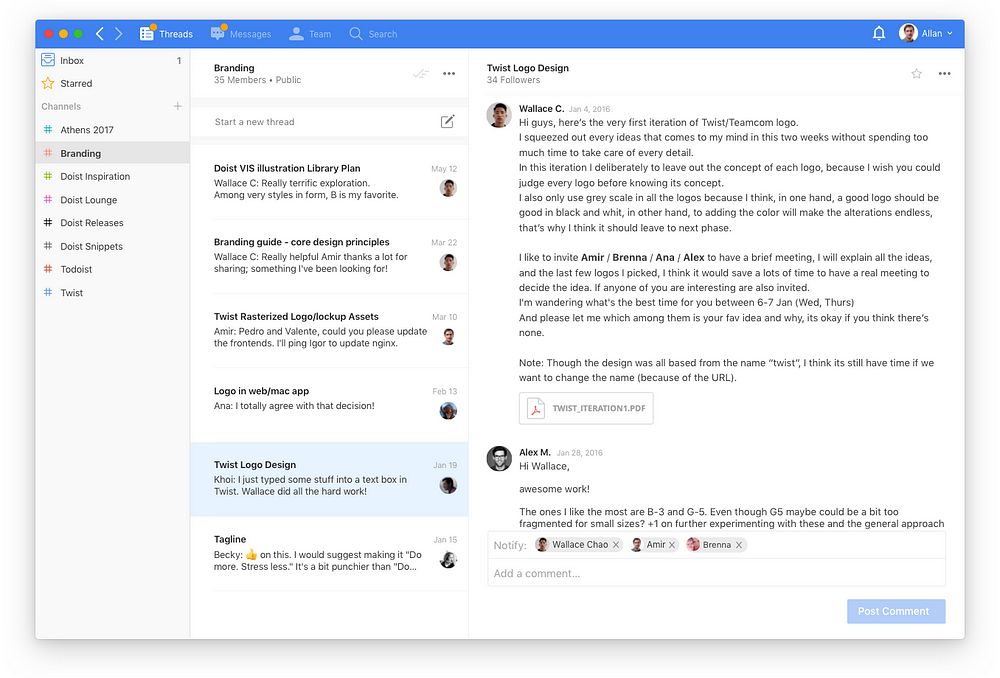
My first thought when I saw https://cdn-images-1.medium.com/max/1000/1*zI94S5XizoB4WickR... was "looks like email"

Re: Why we’re betting against real-time team messaging

#66
post #34

I worked at a Slack shop for several years, and share the author's opinion. I can't think of any five minute period during my entire tenure where the Slack tab didn't have a little red circle telling me that I absolutely needed to check it right this second. There was no way to filter notifications beyond "Everything", so that little bubble would go up every time anybody in the company pressed a key. And heaven forbi…

We've left the "social" era and have entered the era of interruptions. All the innovation this decade is in interruptions no longer human-interconnections. My smart watch for example post dates the social era so it has only minimal social features, but its deep in the interruption zone and spams me mercilessly until I block apps and if I block enough apps I may as well have a cheap dumb watch. Another way to look at…

> My smart watch ... spams me mercilessly until I block apps and if I block enough apps I may as well have a cheap dumb watch.

Definitely block the spammy apps. It makes a huge different to the smartwatch experience if it's only buzzing for things that really are urgent. Once you tune the notifications, it's actually calming - not only because you're not being interrupted as often, but also because you're not constantly thinking "is there something that needs my attention". If there is, the watch will let you know.

Re: Why we’re betting against real-time team messaging

#67
post #18

Just went through Startup School that uses Mattermost, which seems to be a Slack clone (not sure since I never used Slack). It didn't seem to work well. Since all members of all groups were from all over the world and rarely shared a timezone, no conversation could really take place in real time. And since there are no threads or topics or anything, it's almost impossible to go back to something that was said a while…

My company is looking at using Mattermost, but I have the same qualms, since it honestly won't be much better (if not worse) than using our standard enterprise Lync/Skype for IM.

We have an internal reddit-like forum with a "like" model (no dislike/downvote) but it isn't utilized to make work happen. Email is still the way to go...which to my understanding, that's essentially exactly what doist has recreated.

Re: Why we’re betting against real-time team messaging

#68
post #59
post #15

Earlier quoted context omitted.

And heaven forbid somebody typed "Good morning, @channel" (which happened 20 times per morning per timezone), because then you'd get the dreaded Red Exclamation Mark in the tab. That isn't a problem with Slack. That's a problem with the way people are using Slack. If the only workable fix is to use a different tool you have a far bigger problem at your company. I can't fathom how anybody would have been able to work…

> That isn't a problem with Slack. That's a problem with the way people are using Slack. The notion that tools exist in some sort of vacuum away from users baffles me. Since Slack's only purpose is talking with other people, I don't how one can even theoretically evaluate it separate from usage. This is a very common thing that happens with Slack. If it were just one team struggling to use it well, you might have a p…

Imagine your company has a mailing list that goes to everyone (it probably does; most organisations do). In a small company it's fine for anyone to send to it but it's quite annoying and unnecessary so the use of it is discouraged by company culture. As the organisation grows there's a point where the email administrator restricts who can send to it because it would be actively damaging to the email infrastructure if too many people used it, and it'd annoy a lot of people.

Very few people abandon email because their organisation has a mailing list.

Slack's @channel is exactly the same thing albeit on a smaller scale. If it gets too distracting just tell people not to use it so much.

Re: Why we’re betting against real-time team messaging

#69
post #18

Just went through Startup School that uses Mattermost, which seems to be a Slack clone (not sure since I never used Slack). It didn't seem to work well. Since all members of all groups were from all over the world and rarely shared a timezone, no conversation could really take place in real time. And since there are no threads or topics or anything, it's almost impossible to go back to something that was said a while…

> I think a subreddit would have worked much better.

I'm so used to the reddit and hacker news style that I'd also prefer this as well. This Twist App looks too much like another email inbox[1] to me and that puts me off it. Maybe they could offer ways of changing the UI.

[1] https://cdn-images-1.medium.com/max/1000/1*zI94S5XizoB4WickR...

Re: Why we’re betting against real-time team messaging

#70
post #64

Curious question: Isn't this an already solved problem? I've been using plain old emails and quiet free of all the problems of real-time messaging. "Thread-first communication" - We have it. Email threads. I've been using Zoho Mail. It's one step ahead and has modern concepts like streams/commenting and sharing built around emails. Very useful. "Truly transparent conversations" - What this means is, the knowledge has…

Emails are messy, siloed, opaque. Nobody in a team shares the same version of an email chain. No central source of truth means a high chance of not being on the same page. Emails have so many problems. Feel free to read through our comparison Twist vs Emails: https://medium.com/@hfauq/email-or-twist-why-twist-is-better...

I just read your link on Medium. It presents good arguments in favor of Twist versus email. What about comparing Twist to something like Discourse or Usenet forums?
Post reply on HN