Live data from Hacker News

Ultraconserved words in use since the last Ice Age

dailygrail.com

51–60 of 103 posts

Re: Ultraconserved words in use since the last Ice Age

#51
post #8

My favorite example of this is the word "squirrel," which is originally from ancient Greek, σκίουρος (lexical translation: skiouros, which means shadow-tailed). Somehow the notion that Socrates would use approximately the same (rather unlikely) word for this animal that I do is fascinating.

Interesting etymology. Does that mean the in ancient Greek, squirrels were called "shadow tails"?

I find these explanations a bit baffling. That's a much more sophisticated and metaphorical name than you'd expect.

It would be a bit like calling cats "bird scratchers."
Re: Ultraconserved words in use since the last Ice Age

#52

I really like the word "tea" across languages. Japanese - cha Chinese - chá Thailand - chā Russian - чай (chay) Turkish - Çay (chai) Sri Lanka Sinhala - තේ (tē) Arabic - شاي (shay) German - tee English - tea! You have to go out of your way to find a language where "tea" deviates from those patterns.

Interestingly, it's the British who introduced tea to Sri Lanka, so the Sinhalese word තේ (tē) is an adaptation. So is very possibly the word for pineapple: ananas - annasi (අන්නාසි).

However, the following similarities are probably due to the common roots of Latin and Sanskrit:

English/Latin - Sinhalese

Nose - Naas

Dental - Danta

Three - Three

Regina (Queen) - Regina

There are many others...

Words adapted from Sinhalese to English:

Anaconda - Henakandaya (හෙණකඳයා) (Means "Massive Body")

Re: Ultraconserved words in use since the last Ice Age

#53

The 23 words from the PNAS paper (Table 1): Thou I Not That We To give Who This What Man/male Ye Old Mother To hear Hand Fire To Pull Black To flow Bark Ashes To spit Worm http://www.pnas.org/content/110/21/8471/T1.expansion.html

I wonder how many of those would survive multiple hypothesis testing. That is, there are bound to be a number of phonetically similar words that happen to have similar meanings in two different languages. They may not however have common historical roots.

Re: Ultraconserved words in use since the last Ice Age

#54

Earlier quoted context omitted.

Opposite of the topic (ultra-nonconserved?), "butterfly" is a word that is strangely different in even closely related European languages (Romance, Teutonic, Slavic). Doing a cursory check in Google Translate now, but I've one found one language pair where the words appear to be related: French: "papillon", Catalan "papallona". Otherwise: mariposa, бабочка, motyl, schmetterling, vlinder, sommerfugl, fjäril, farfalla,…

Why 'strangely' different? Why would you expect such exotic animals to be ultra-nonconserved? Schmetterling may be semantically linked to butterfly via 'batter-fly' (beater-fly) also: motyl~moth sommerfugl~summer-fly interesting that wiktionary for papillon shows a puppy :) might also be linked to big pupils and fake eyes [0] https://en.wiktionary.org/wiki/papillon

> Schmetterling may be semantically linked to butterfly via 'batter-fly' (beater-fly)

No, it's semantically linked via 'butter'. Schmetterling comes from Schmetten or Schmand which is a sort of heavy cream. There used to be a folk believe that butterflies would consume milk or butter if left uncovered. They were also sometimes called Milkdieb or milk-thief in German.

See: www.etymonline.com/index.php?search=butterfly

Re: Ultraconserved words in use since the last Ice Age

#55

For a good etymological mystery, it's hard to beat "dog." Not only is the word "dog" of unknown origin, its equivalents in Spanish and various Slavic languages also apparently appeared from nowhere. http://www.etymonline.com/index.php?term=dog If that's not fun enough, there's an extinct Aboriginal language from Australia which has a word for dog. That word is also "dog" - apparently pronounced the same as in English…

Opposite of the topic (ultra-nonconserved?), "butterfly" is a word that is strangely different in even closely related European languages (Romance, Teutonic, Slavic). Doing a cursory check in Google Translate now, but I've one found one language pair where the words appear to be related: French: "papillon", Catalan "papallona". Otherwise: mariposa, бабочка, motyl, schmetterling, vlinder, sommerfugl, fjäril, farfalla,…

> All the Slavic languages known to Google Translate have a word related to motyl, except for Russian

In Serbian and Croatian the word for butterfly is лептир/leptir.

Re: Ultraconserved words in use since the last Ice Age

#56

Earlier quoted context omitted.

My Japanese native language speaker in college had an obsession with the word "squirrel". We spent an entire year trying to teach her how to pronounce it. Ssss-ka-wuh-rrr-llll

I am German and 'squirrel' is the one English word I just can't pronounce. I am very good at all the other words, but that one stumps me.

Whereas I have that problem with Eichhoernchen

Re: Ultraconserved words in use since the last Ice Age

#57
post #54

Earlier quoted context omitted.

Why 'strangely' different? Why would you expect such exotic animals to be ultra-nonconserved? Schmetterling may be semantically linked to butterfly via 'batter-fly' (beater-fly) also: motyl~moth sommerfugl~summer-fly interesting that wiktionary for papillon shows a puppy :) might also be linked to big pupils and fake eyes [0] https://en.wiktionary.org/wiki/papillon

> Schmetterling may be semantically linked to butterfly via 'batter-fly' (beater-fly) No, it's semantically linked via 'butter'. Schmetterling comes from Schmetten or Schmand which is a sort of heavy cream. There used to be a folk believe that butterflies would consume milk or butter if left uncovered. They were also sometimes called Milkdieb or milk-thief in German. See: www.etymonline.com/index.php?search=butterfly

> Schmetten or Schmand which is a sort of heavy cream.

Is "smetana" a false friend?

Re: Ultraconserved words in use since the last Ice Age

#58

For a good etymological mystery, it's hard to beat "dog." Not only is the word "dog" of unknown origin, its equivalents in Spanish and various Slavic languages also apparently appeared from nowhere. http://www.etymonline.com/index.php?term=dog If that's not fun enough, there's an extinct Aboriginal language from Australia which has a word for dog. That word is also "dog" - apparently pronounced the same as in English…

Opposite of the topic (ultra-nonconserved?), "butterfly" is a word that is strangely different in even closely related European languages (Romance, Teutonic, Slavic). Doing a cursory check in Google Translate now, but I've one found one language pair where the words appear to be related: French: "papillon", Catalan "papallona". Otherwise: mariposa, бабочка, motyl, schmetterling, vlinder, sommerfugl, fjäril, farfalla,…

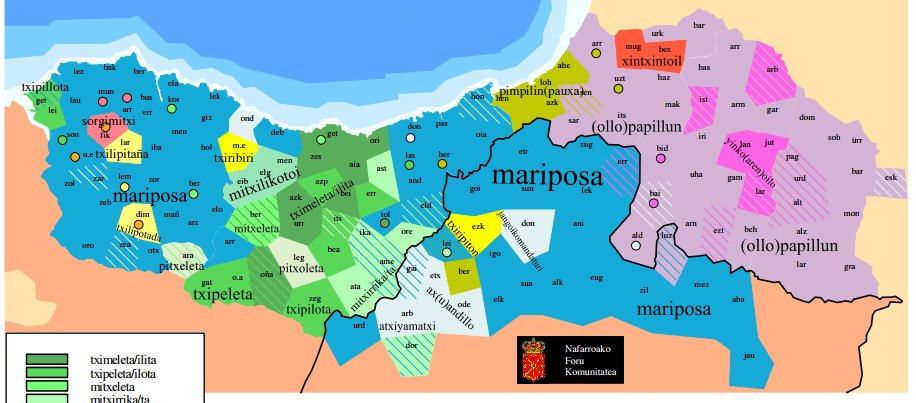
Seems like that word is very fragmented. Here's a map of the different ways of naming it in Euskera (Basque language). In a very small area you have a lot of ways of naming the same animal...

Any reason why there's something special about butterflies that we don't agree on their name?

https://pbs.twimg.com/media/CsK-lFaXEAA7zpT.jpg

Re: Ultraconserved words in use since the last Ice Age

#59
post #8

My favorite example of this is the word "squirrel," which is originally from ancient Greek, σκίουρος (lexical translation: skiouros, which means shadow-tailed). Somehow the notion that Socrates would use approximately the same (rather unlikely) word for this animal that I do is fascinating.

Interesting etymology. Does that mean the in ancient Greek, squirrels were called "shadow tails"? I find these explanations a bit baffling. That's a much more sophisticated and metaphorical name than you'd expect. It would be a bit like calling cats "bird scratchers."

I'm not sure why it baffles you, this type of "names-by-associations" are pretty common. See "woodpecker", "ladybug", "daddy longlegs", "silverback" etc... Not that different.

Also maybe "shadow" had a slightly different meaning back then or the translation is simply not 100% accurate (are they ever?).

Re: Ultraconserved words in use since the last Ice Age

#60

Earlier quoted context omitted.

My Japanese native language speaker in college had an obsession with the word "squirrel". We spent an entire year trying to teach her how to pronounce it. Ssss-ka-wuh-rrr-llll

I am German and 'squirrel' is the one English word I just can't pronounce. I am very good at all the other words, but that one stumps me.

"Fuzzy-tailed picnic-thieving tree rat" is an acceptable alternative. Season to taste with your favorite summer or winter expletives.
Post reply on HN