Live data from Hacker News

On average, skipping college and investing tuition costs nets a higher return

erikrood.com

451–460 of 669 posts

Re: On average, skipping college and investing tuition costs nets a higher return

#451
post #267

Earlier quoted context omitted.

And college got expensive partly through policy choices. Offering easy loans tends to make people price insensitive, so tuitions go up and a lot of that money goes to things like increasingly fancy buildings and making textbook publishers' shareholders rich. Meanwhile often less is going to state schools that, with low in-state tuitions, were historically a way up for a lot of people. (An older friend went to Berkele…

Government spending on higher education peaked in the mid 70s, dropped in the 80s, and has not kept up with the population increases. The focus on loans, instead of government funding, was basically a new tax on the poor and middle classes in order to fund the Reagan tax cuts for the rich.

Tuition rose right along with the inflation through the 80s and 90s, so no real correlation to the federal tax cuts, which you wouldn't expect anyway, since universities are largely state financed.

https://satyagraha.files.wordpress.com/2011/11/uc-tuition-an...
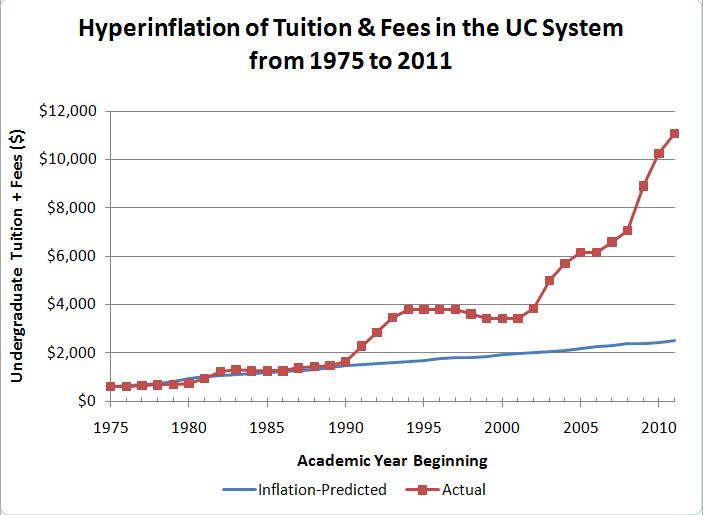
As a California resident, I can tell you there are plenty of taxes and tax hikes, and the money doesn't make it to the Universities anyway.

Re: On average, skipping college and investing tuition costs nets a higher return

#452

Earlier quoted context omitted.

College in the US is used by employers as a proxy for intelligence, something that's an outgrowth of laws and court rulings that date back to the '70s. So if you want to put yourself on the path to the C-Suite in a Fortune 500 company or to a partnership in a major law firm, you have to get into one of the very top colleges in the country. That, in turn, means top colleges can charge pretty much whatever they want an…

But wait. The more colleges charge for tuition, the harder it becomes for intelligent but poor people to get admittance. Therefore, the worse a college degree from a "top college" can act as a proxy for intelligence.

It doesn't make admission harder, it makes attending harder. Or life after attending harder, dealing with the debt.

Re: On average, skipping college and investing tuition costs nets a higher return

#453
Funny, as I have sometimes thought of going to college as a kind of counterargument to the efficient market hypothesis. Since going to college or not is an investment decision, it seemed that going to college is obviously the better decision. Except, apparently it isn't.

Re: On average, skipping college and investing tuition costs nets a higher return

#454

How do you skip college and invest the tuition in the S&P 500? Ah, you can't: Of course, lenders won't give out large loans for an individual to skip college and dump tuition into the stock market, this is just a hypothetical scenario. So this article is unrealistic.

Now I have to ask: to lenders of college tuition consider the subject the borrower chooses? I am just curious - or is it generally the government that does the lending? Otherwise I would be curious to know how lenders see the earning prospects of different majors.

Re: On average, skipping college and investing tuition costs nets a higher return

#455

Earlier quoted context omitted.

And college got expensive partly through policy choices. Offering easy loans tends to make people price insensitive, so tuitions go up and a lot of that money goes to things like increasingly fancy buildings and making textbook publishers' shareholders rich. Meanwhile often less is going to state schools that, with low in-state tuitions, were historically a way up for a lot of people. (An older friend went to Berkele…

This article from 538 argues that almost 3/4 of the rise in tuition is accounted for by a drop in state support. https://fivethirtyeight.com/features/fancy-dorms-arent-the-m...

For a pure apples-to-apples price comparison it's reasonable to use an out-of-state tuition that's free of state support, grants or scholarships, as that reflects the true price sticker.

The rise in college tuition is the most baffling, as this industry refuses the amortize costs. The buildings have been built, the books have been written, the intro courses have been handed down to graduate students, the handouts are sometimes the same handouts that were used a decade ago.

Yet the costs keep on rising.

Re: On average, skipping college and investing tuition costs nets a higher return

#456

Earlier quoted context omitted.

I remember reading an article describing how college costs can be explained by an analysis of supply and demand. There have been a variety of historic reasons for demand rising at different times - mostly related to unemployment and lack of other economic choices. I keep hearing the meme that low-cost college is the cause of college expense - but college is free in many countries where they are doing quite well. So I…

College in the US is used by employers as a proxy for intelligence, something that's an outgrowth of laws and court rulings that date back to the '70s. So if you want to put yourself on the path to the C-Suite in a Fortune 500 company or to a partnership in a major law firm, you have to get into one of the very top colleges in the country. That, in turn, means top colleges can charge pretty much whatever they want an…

> That, in turn, means top colleges can charge pretty much whatever they want and it's still worth the money.

The most prestigious colleges actually don't charge much money, except for families that can easily pay. Financial aid, including stipends for living expenses, is extremely generous at elite schools. The sticker price might be high, but few people actually pay it.

The problem is more with second tier schools that aspire to greater prestige but have more limited financial resources. While many of these schools offer perfectly good educations, they don't really open the same kind of doors that going to a more elite school can. A big tuition price can make parents think they're sending their kid to a really elite school - just like people often will assume a more expensive diamond ring is better than a less expensive one. But it's probably not really worth the money.

Re: On average, skipping college and investing tuition costs nets a higher return

#457

As a culture, we really need to stop telling 17 year olds to not worry about money, go to college, and figure something out. There is always someone ready with a romantic appeal to a classical education, and it is so frustrating for me. Wasting four years is a huge cost. Years, decades of debt is a huge cost. Going to college with no plan about money? The costs are assured. Plus, the degrees people are actually getti…

What about... offering college for free like the rest of the modern world? Then you would only have to worry about living costs and those loans are pretty small. I could pay off mine in like 4-5 years if I really wanted to. Plus, then people still could get an education even if their parents didn't save up for you. What about as a society/culture you start telling people that the country should offer education for fr…

Americans are actually enrolling in college at a rate higher than many other developed countries. A good article in the Economist last year (which I hope to track down if I get the chance) pointed out that 6.25% of the U.S. population was enrolled in university as compared to 3.75% of Germany's population. Other developed countries do provide free and heavily subsidized higher education to their citizens, but they're also more selective in which people go on to university and typically decide which education path students will take at a young age.

While I think that's a more beneficial setup as a whole I think it'd be a tough sell given the attitude the U.S. has towards higher education. I think a lot of people put a value in higher education beyond its economic return on investment. In other words, even if it's a less return on investment pursuing higher education provides the additional benefit of avoiding the stigma of not having a degree.

In my ideal world, the U.S. would offer much greater subsidies to attend university but at the same time be much more selective with who gets into universities to begin with. That, coupled with better connecting high school juniors and seniors into technical education paths.

Re: On average, skipping college and investing tuition costs nets a higher return

#458

Earlier quoted context omitted.

> So, ... what the f@@@ did you do at college that you are calling it a "waste"? I think your mistake is in assuming that your experience is typical.

Out of the 100 or so people I know my experience is very typical.

That's never been a reliable way to determine what's true for millions of other people, and it never will be.

Re: On average, skipping college and investing tuition costs nets a higher return

#459

Skip college, invest in stock market. People love to chart out how great it is to invest in the stock market and how historically it generates great returns. Nobody seems to remember everyone around them losing enormous amounts of money whenever the economy tanks. Where were all those 7.1% earnings going when the banks were getting bailed out and people were camping on wall street because their houses were foreclosed…

You know that 7.1% average doesn't mean 7.1% every year. Anyone that didn't panic sell during the crash has recovered. There are ways to handle the risk of a crash. #1 is to not play the high risk-high reward game if you are near retirement or already in retirement. You can't handle big swings at that point, since recovery could take 10 years and you're already 70. #2 is to have a liquid emergency fund, so you don't…

"Anyone that didn't panic sell during the crash has recovered."

That is simply not true.

Re: On average, skipping college and investing tuition costs nets a higher return

#460

Earlier quoted context omitted.

First you have to factor in the fact that public schools are a competing good, so when public tuition rises private tuition will as well. Then you have to realize that tuition increases at private schools are misleading. You have to look at what people are actually paying not what the sticker prices. At Harvard, for instance, 70% of students receive financial aid, so they are paying $12k a year on average (not the $6…

But private schools have to compete with each other. If this was really about increased demand from students who would have otherwise gone to public schools, what we'd see is an increase in the number of private schools, not an increase in tuition.

You are right, there's no increased demand. Advertised sticker price and actual price of a private education can be substantially different https://www.wsj.com/articles/private-colleges-see-record-dis...

For decades the private sector has been feeding off the gravitas created by Stanford, Harvard, Yale and other superb private institutions. Maybe time has helped, maybe the Internet made comparisons easier, but it's pretty clear that private schools can be separated into three tiers, with tier one (Stanford, Yale) still being top notch, tier two being a questionable proposition for most people, and tier three (U of Phoenix, Trump U) being borderline fraud.

Post reply on HN