Live data from Hacker News

On average, skipping college and investing tuition costs nets a higher return

erikrood.com

141–150 of 669 posts

Re: On average, skipping college and investing tuition costs nets a higher return

#141

I found that investing in bitcoin has outperformed the average post college job. (I conducted my research by comparing 20,000 invested in a college in 2010 vs 20,000 invested into bitcoin in 2010.)

Buying small amounts of many new crypto coins in the hope that some of them goes big is probably possible as well.

Re: On average, skipping college and investing tuition costs nets a higher return

#142

As a culture, we really need to stop telling 17 year olds to not worry about money, go to college, and figure something out. There is always someone ready with a romantic appeal to a classical education, and it is so frustrating for me. Wasting four years is a huge cost. Years, decades of debt is a huge cost. Going to college with no plan about money? The costs are assured. Plus, the degrees people are actually getti…

What about... offering college for free like the rest of the modern world? Then you would only have to worry about living costs and those loans are pretty small. I could pay off mine in like 4-5 years if I really wanted to. Plus, then people still could get an education even if their parents didn't save up for you. What about as a society/culture you start telling people that the country should offer education for fr…

"butthurt americans"

Please don't put insults like this in HN comments. Just one can ruin a whole thread.

Re: On average, skipping college and investing tuition costs nets a higher return

#143
post #87
post #55

Earlier quoted context omitted.

I'm in university right now, and the reason why I'm here is mainly so that I can get a degree in order to get hired for a job in the field I want. My parents probably got me into it beacuse of the appeal of classical education but also the fact that they want me to get a job, too. Is there any solution to getting a job without a degree? Especially in those technical subjects such as electronic engineering (what I'm d…

I've interviewed many people for starting position in software. I've looked at their degree only if there's literally nothing else to look at, and even then it wasn't a major sign. I've seen many people with degrees that are useless, and many people who were very skilled and who I don't even know whether they have a degree and what it is worth. It goes like this: 1. Experience 2. Experience 3. Experience 4. Knowledge…

Sure, this is probably true for people directly looking for jobs on the market. But I'd say most top students are getting internships pre-graduation and getting good return offers, or just using career fairs (that are targeting new grads specifically). From what I've seen that path can get them much higher than average salaries directly out of college, without any experience to speak of (an internship or two and some small side projects). After that first job it may not matter, but there are very large starting salary differences based on college name and performance.

Re: On average, skipping college and investing tuition costs nets a higher return

#144
post #67

Earlier quoted context omitted.

Because the argument is society reaps the benefit of an educated populace, secondly yes, everyone should pay for qualified individuals to go to college, as most or much of the civilized world does. That does not mean free college for everyone. There would still be a stringent entrance exam. It means free college for those who are qualified. Contrast that to the system now where college is seen as just another marketi…

But is the benefit society gets from a college educated populace really worth the cost? I feel like there are a decent number of degree programs which we would never get a return on our investment for subsidizing, so making it free for studying any topic seems foolish. Plus, job specific training could be just as good or better than a 4 year degree in many cases, and that would take far less time and be much cheaper.

It depends on what we feel is beneficial to society. Is financial return the only thing we should care about? I'm not a philosopher/artist, etc, but I feel they are important to society, regardless of whether they generate financial gain. We should be providing as many opportunities as possible, not putting financial barriers on education.

These are the similar arguments that went on in the late 1800's and well into the 1900's. Society (at that time) determined it was not beneficial or better to simply do job-specific training. So they opened up secondary education to everyone, for free. I'm happy they did and feel it was great for society, despite the cost. I'd like to believe we've progressed enough as a society to open the next levels of education to everyone as well.

It doesn't mean it is right for everyone, but the individual should be able to choose. They shouldn't be barred because they don't have money or the right activities on their transcript.

Re: On average, skipping college and investing tuition costs nets a higher return

#145

As a culture, we really need to stop telling 17 year olds to not worry about money, go to college, and figure something out. There is always someone ready with a romantic appeal to a classical education, and it is so frustrating for me. Wasting four years is a huge cost. Years, decades of debt is a huge cost. Going to college with no plan about money? The costs are assured. Plus, the degrees people are actually getti…

What about... offering college for free like the rest of the modern world? Then you would only have to worry about living costs and those loans are pretty small. I could pay off mine in like 4-5 years if I really wanted to. Plus, then people still could get an education even if their parents didn't save up for you. What about as a society/culture you start telling people that the country should offer education for fr…

I say a compromise with free 2-year college is a good one. Most CC's offer trades programs, the ones that don't still let students save 1/3 to 1/2 of the cost of a full bachelors.

Re: On average, skipping college and investing tuition costs nets a higher return

#146

When all you have is Capitalism, everything is a market. What sort of dark world are we living in where we are discouraging people from studying areas that don't have a monitary return on investment?

We don't have a system to give everyone free food, shelter, and clothes. Those are still paid for and you need to work at some level to get those things.

Our dark world looks dark because none of us have lived through millennia

Re: On average, skipping college and investing tuition costs nets a higher return

#147
post #67

Earlier quoted context omitted.

Because the argument is society reaps the benefit of an educated populace, secondly yes, everyone should pay for qualified individuals to go to college, as most or much of the civilized world does. That does not mean free college for everyone. There would still be a stringent entrance exam. It means free college for those who are qualified. Contrast that to the system now where college is seen as just another marketi…

But is the benefit society gets from a college educated populace really worth the cost? I feel like there are a decent number of degree programs which we would never get a return on our investment for subsidizing, so making it free for studying any topic seems foolish. Plus, job specific training could be just as good or better than a 4 year degree in many cases, and that would take far less time and be much cheaper.

And indeed there were people arguing against high school education across the board for everyone: not all students needed to go to high school, they were better served not learning any history or mathematics or science or civics or ethics or English or geography or about the modern world and instead going to an apprenticeship in a trade at 12 or 13, where they would toil for the rest of their lives. The few elites could go to high school and study more lofty topics required to make serious decisions, since they were, after all, destined by virtue of the fortunes of their birth to be the rulers and decision makers in society.

But high school for all is generally considered by everyone to be a Good Thing and having a more educated populace is good for everyone: jobs change, times change, and generally educated, intellectually flexible citizens are better able to adapt with the times, vote intelligently, be part of modern communities, etc. You can go to a trade school after high school.

We've come along far enough it's time to recognize that high school is no longer good enough as a general education, and that's a good thing: a college education where students study philosopy, history, science, mathematics is now the basic standard for an educated citizen and we should provide it to them regardless of how wealthy their parents are or how well they take IQ tests.
Re: On average, skipping college and investing tuition costs nets a higher return

#148

Earlier quoted context omitted.

So you're arguing that everyone should pay for it and go to it until we make it free? Why can't we argue using the reality college tuition payers have today? Instead of arguing from a fairy tale reality for high tuition payers...

I think the best solution for individuals in the US is to move to an european country, stay there and work until you get some kind of permenant stay visa or citizenship so you can enter college for free. That usually do not take long for americans. If you have kids you can do it when they're small so they are ready for university when they come of age.

Isn't it rather difficult for a non-EU citizen to become employed in EU member states?

Re: On average, skipping college and investing tuition costs nets a higher return

#149
post #42

Earlier quoted context omitted.

Actually, from the student's perspective, there would be a 0 investment, so ROI becomes infinite.

I don't understand what you mean by this. Say a grandparent left a grandchild 50k for college. It's the grandchild's money. The grandchild could choose to invest in college or the market. This may not be a common scenario but that's what I meant.

Right but if someone (say a living grandparent) doesn't "leave money for college" but "pays for college", then it's not the grandchild's money. The grandchild isn't paying for college at all. And getting 50k for other purposes was never an option.

Re: On average, skipping college and investing tuition costs nets a higher return

#150
post #27

I wonder how much of this is just a result of US tuition costs being out of control. Does this analysis hold for coding bootcamps? What about Canadian colleges (say, Waterloo, Queens or Toronto)? What about community college? Restricted to only CS/EE degrees? Becoming a doctor? Does it account for the probability of dropping out of various college progams?

> What about Canadian colleges

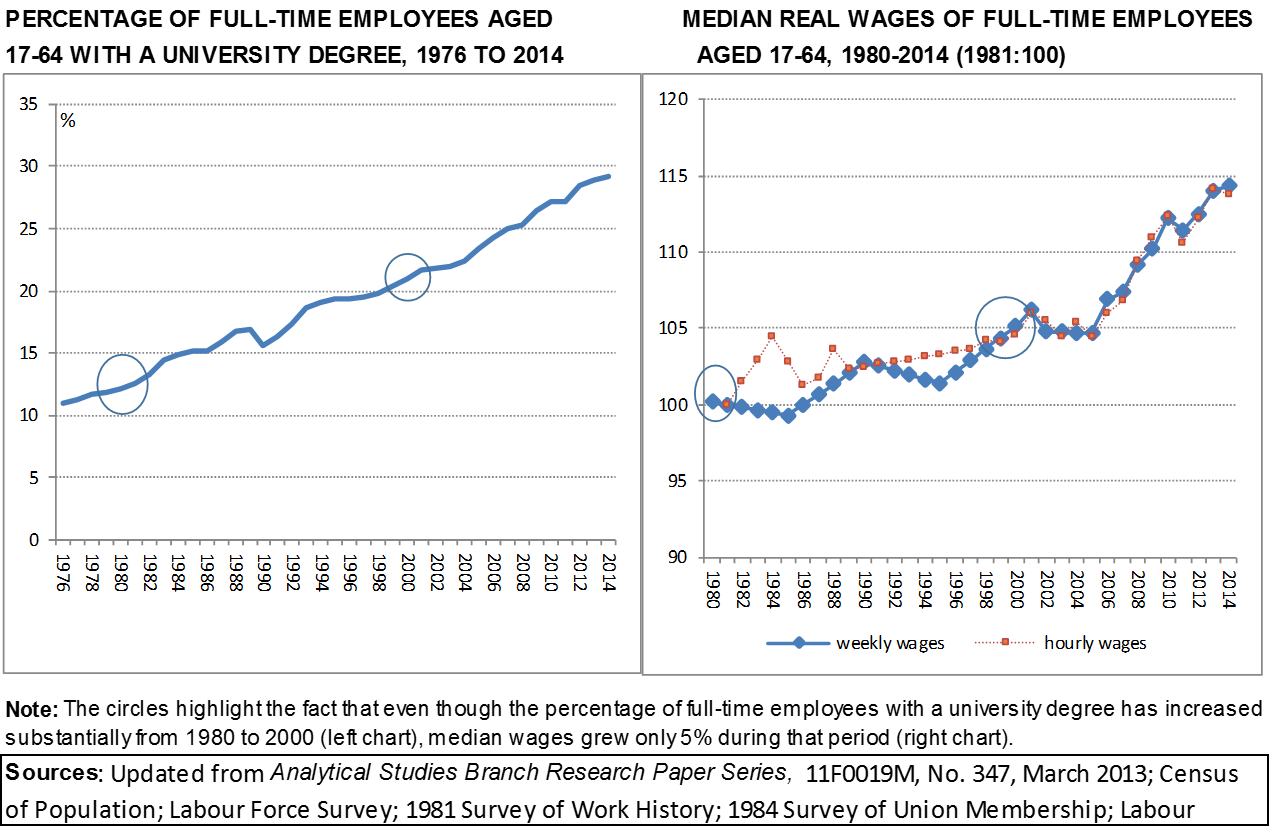
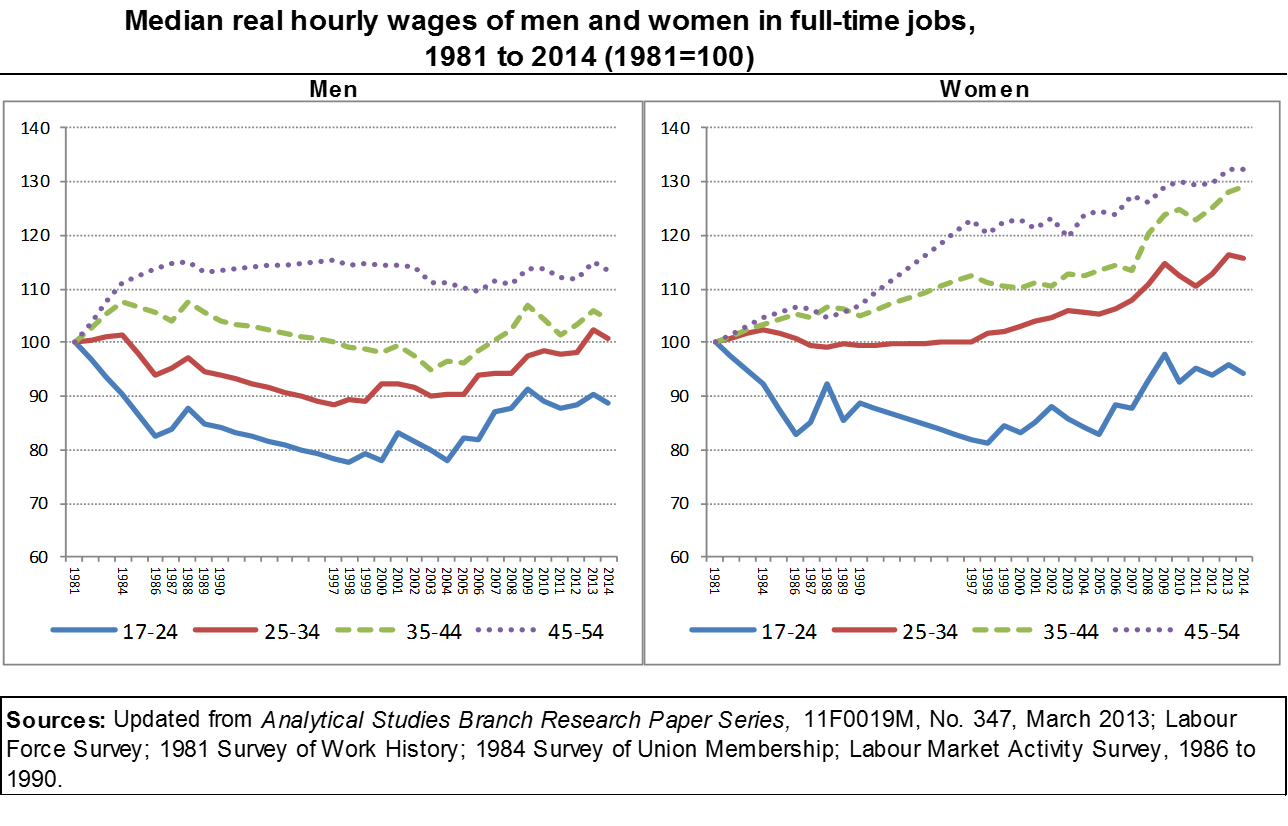
In Canada, no meaningful rise in income due to university attainment has occurred[1]. For young men in particular, increasing rates of university attainment has shown lower real wages[2]. No need for 7% stock market returns to try and make up for lost wages as seen in the article. You could technically put your equivalent student costs into a low-interest savings account and come out further ahead.

[1] http://www.statcan.gc.ca/pub/11-631-x/2016002/c-g06-eng.png

[2] http://www.statcan.gc.ca/pub/11-631-x/2016002/c-g07-eng.png

Post reply on HN