Live data from Hacker News

The US has forgotten how to do infrastructure

bloomberg.com

451–460 of 564 posts

Re: The US has forgotten how to do infrastructure

#451
post #446

Earlier quoted context omitted.

Many people don't just "happen" to be in a situation where they don't need a car, they actively put themselves in that situation by making many lifestyle choices. I changed jobs (twice) to move closer to home. I used to have a job with a 45 - 60 minute car commute (the train was over 2 hours due to the need to make 2 connections), then took a job that was only about 10 miles away (just under an hour by bike, 12 - 30…

Sounds like you have the luxury of picking and choosing your jobs. Most American's don't.

Slavery has been illegal for over 150 years.

Many people say that they don't have the option to change jobs, yet when they get laid off or the factory where they work shuts down, they find a way to survive even if they have to make sacrifices to do so.
Re: The US has forgotten how to do infrastructure

#452

Earlier quoted context omitted.

It was done for a very rational reason: making country more immune to a nuclear attack, especially the retaliation to its own nuclear attack (i.e. a nuclear attack that is coming in convenient time of day and week because you chose the time). It works perfectly to that purpose: it is whole lot better to keep all relevant population in separate houses with basements, with little combustible material around, than in mu…

Have a source for any of that? Sounds like a completely made-up justification after the fact. Surely someone would have raised the point that the soviet union could just launch it's missiles in the middle of the work day. Also, Moscow is tremendously sprawled out.

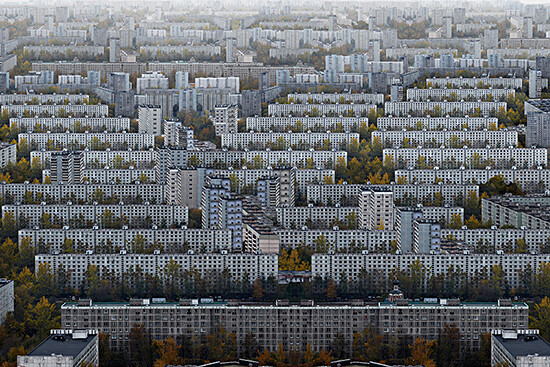
Moscow is also tremendously dense. It's sprawled out because it has so many people in it, but the vast majority of those people are packed into apartment buildings. The same goes for all other major urban centers. A typical Russian (or rather, ex-Soviet) cityscape looks like this, and can go for miles:

http://images.e-flux-systems.com/2014_04_Bric-III-Yugo-Zapad...

Now imagine an airburst nuclear explosion over this, just low enough to maximize the blast wave.

There's a reason why Soviets heavily invested into protecting the populace from such attacks - the entire Moscow Metro system doubles as a nuclear bomb shelter, complete with blast doors.

Re: The US has forgotten how to do infrastructure

#453

Earlier quoted context omitted.

> "I hate that I get so stressed from my daily commute, but being able to drive to the countryside on the weekend is so nice." I have truly never understood this line of thinking. These two are not tied together. I grew up in a car-centric city, but moved away in my teens. I've never personally owned a car and haven't had one in the household since I was 17. I hear this supposed "upside" of cars from my friends who a…

> What prevents you from renting a car when you want to drive out to the countryside? Nothing, but it is a barrier. When you own a car, you just get in, make sure you've got gas, and go. When you don't, you need to go out and find a rental place, get there, find a car you want/like, etc. It's a small barrier, and mostly psychological, but it's there and it affects decisions.

Right, this is the mental speedbump I referred to. I just get tired of people pretending that you're precluded from easily driving out away from cities, instead of the much-lesser inconvenience of "having to get used to the minuscule additional mental barrier". In my own personal experience it took me about three trips before this latter issue vanished.

The difference between the magnitude of the two ways of stating this "downside" are vast, and I hear people conflate them constantly.

Re: The US has forgotten how to do infrastructure

#454
post #385

Earlier quoted context omitted.

> What prevents you from renting a car when you want to drive out to the countryside? Nothing, but it is a barrier. When you own a car, you just get in, make sure you've got gas, and go. When you don't, you need to go out and find a rental place, get there, find a car you want/like, etc. It's a small barrier, and mostly psychological, but it's there and it affects decisions.

Yup. I cycle a lot, and when I first moved to USA I tried to live the car rental only lifestyle in the Bay Area. In someways this was easier than I expected: * Most US car rental price comparison sites let you book a car months in advance to lock in the price, but you don't pay till pick up. There's almost never a penalty for booking and not picking up, so I used to just block book the weekends months in advance, whe…

I've generally optimized for convenience: it's easy for me to ignore the expense when I consider my overall transportation + rent budget (the two aren't really fully extricable).

Re: The US has forgotten how to do infrastructure

#455
post #343

Earlier quoted context omitted.

You are not doing speed limit on average in most cities. You slow down for turns, you wait for red light, you wait for other cars, you are parking. Most importantly, shortcuts available to pedestrians are not available to cars that have to take longer route. I do groceries by walk and it never took 2 hours. The store is not 5km away pretty much from anywhere. You have to be out of city or in the middle of night for i…

Counterpoints: * Slowdowns, sure, but many drivers also exceed the limit, and the walking:driving ratio is still massively lopsided. * Pedestrians are not immune to red lights. * While there are certainly pedestrian shortcuts that are faster than driving, this is definitely not the case for most combinations of start and end points. Far more often, while the pedestrian might gain distance, the car is still literally…

>* A bike is not walking. Most bikes are for one person, so if you're in a group they're not much use.

My favourite part of visiting Amsterdam was the excessive bike usage. Pretty much everyone has 1 or more of them, you just ride together in a group or catch a tram, even out of the city everyone would either catch a train or simply ride on the side of the highway between villages.

Re: The US has forgotten how to do infrastructure

#456
post #80

I don't know the answers, but as someone who works in the industry (on the design side). I think a big unmentioned factor is probably liability and the prospect of litigation. If you look at old blueprints for projects in the past, they are a LOT less detailed. They had to be, because it was physically more difficult to produce them since they had to be drawn by hand. A lot was left to the contractor to figure out in…

Sounds like the future of software development to me.

Depends on the software. In general infrastructure has a much higher liability associated with it, as a failed bridge, road, or building, will quickly kill/injure those making use of it. I could see a similar situation arise for, say, embedded software for medical devices like pacemakers etc.

Re: The US has forgotten how to do infrastructure

#457
post #80

I don't know the answers, but as someone who works in the industry (on the design side). I think a big unmentioned factor is probably liability and the prospect of litigation. If you look at old blueprints for projects in the past, they are a LOT less detailed. They had to be, because it was physically more difficult to produce them since they had to be drawn by hand. A lot was left to the contractor to figure out in…

Anecdotally, having moved to Western Europe, I get the sense that this is the major factor as well. If I walk down the street and there is a group of workers excavating a road, there's a lot more of a relaxed attitude about fencing, walking underneath construction equipment, etc. After all - use your common sense - don't fall into the hole. If you do, isn't it kind of your own fault? Nobody's going to sue anybody. Ad…

As a counter-example, Japan is one of the best in the world at infrastructure while at the same time being incredibly thorough about safety and external impacts. They can do a complete overhaul of the busiest train station in the world with zero downtime and solid walls around all construction.

Re: The US has forgotten how to do infrastructure

#458
post #180

Earlier quoted context omitted.

Anecdotally, having moved to Western Europe, I get the sense that this is the major factor as well. If I walk down the street and there is a group of workers excavating a road, there's a lot more of a relaxed attitude about fencing, walking underneath construction equipment, etc. After all - use your common sense - don't fall into the hole. If you do, isn't it kind of your own fault? Nobody's going to sue anybody. Ad…

> And America's love affair with the automobile is a well-known abusive relationship that America will never have the courage to leave. It's pretty much impossible to leave this relationship unless you live in one of the larger US cities. If you live in a suburb, rural area, or city that's not in the top 10-15 in terms of size there's literally no other option that exists or that could easily exist.

Taken for a ride - https://youtu.be/p-I8GDklsN4

Re: The US has forgotten how to do infrastructure

#459
post #442
post #180

Earlier quoted context omitted.

> And America's love affair with the automobile is a well-known abusive relationship that America will never have the courage to leave. It's pretty much impossible to leave this relationship unless you live in one of the larger US cities. If you live in a suburb, rural area, or city that's not in the top 10-15 in terms of size there's literally no other option that exists or that could easily exist.

Even in San Francisco, widely known for its public transit system, not having a car some of the time sucks. It's much more convenient to get around by car. That's why Uber and Zipcar are ultra popular here.

Is San Fran really known for its public transport system?

New York, sure. Everyone's heard of their subway.

The first time I'd ever heard of BART was when I visited briefly, and in doing so I learnt 2 things:

1) BART is pretty bad: noisy and a small network 2) Talking to people during my short stay made it pretty clear San-Fran and the bay area was considered 99% car territory, and traffic/congestion/commuting around SF was a significant problem commensurate with that fact.

Edit: understand this is a genuine question asked as a foreigner who has only formed an impression from short visits.

Re: The US has forgotten how to do infrastructure

#460
post #332

Earlier quoted context omitted.

Agreed. America's forced dominance of the automobile is pretty grossly unethical. Freedom means the ability to make meaningful choices, and if biking is incredibly dangerous, transit is slow and infrequent, and nothing is within walking distance, then those are hardly meaningful options, are they? Building to support multiple modes of transportation is the freedom-loving thing to do. Want to walk? Go for it! Transit?…

Biking is not "incredibly dangerous". It plenty safe. It is healthy. It however sometimes slows down cars and some drivers are then motivated to frame biking as dangerous activity to stop it. But really really really, biking is not incredibly dangerous.

I live in an area with good roads, good cars. We get a bike fatality a few times a year. At dusk I find even the well-lit bikes a little hard to discern. We also have some bad drivers. In the most recent fatality the lead rider of a bunch riding on a road was decapitated.

I used to ride bikes all the time as a kid but I would not make a habit of riding on our roads. It's too much of a gamble.

Post reply on HN