The preimage strength debacle is probably worth mentioning
Maybe Skip SHA-3
121–130 of 188 posts
Re: Maybe Skip SHA-3
#122Earlier quoted context omitted.
With SHA 224, there is only 32 bits worth of information that are lost. Isn't a LEA "feasible" by generating the ~ 4 billion messages and finding the 1 that validates. With 512/256 this is infeasible. Is this a real concern with 224 in practice?
224 is 512/224.
According to
https://en.m.wikipedia.org/wiki/SHA-2
There is SHA 224 which has 256 bit internal state and SHA 512/224 which has 512 bit internal state. In my previous comment, I was referring to the former.
Re: Maybe Skip SHA-3
#123> SHA-3 did introduce something useful: extendable output functions Much more than that! Keccak (SHA-3) introduced the Sponge construction. This goes _way_ further than extendable output functions: It allows you to build all the symmetric cryptographic primitives from one basic element! This means: hashes, PRNGs, MACs, encryption, AEAD, etc. The only thing you need that looks like crypto code is a single permutation…
Another advantage is that SHA-3 just uses AND, XOR, ROT, NOT, but not SHR (logical shift right) which allows for much easier formal analysis of the algorithm!
Could you comment(or provide a link) on why SHR is more difficult for formal analysis than ROT?
Re: Maybe Skip SHA-3
#124Earlier quoted context omitted.
I'm not sure I understand what you two mean. 1) How does not having SHR makes it easier to audit? 2) how are sha-3 implementations actually using SHR not making the parent's comment moot?
A rotate operation is invertible, a logic shift by itself is not. Another fun one is x ^= x >> n with n some strictly positive constant, this is also invertible. It's used a lot in the murmurhash family of non-cryptograhic hash functions.
Why does invertibility matter? AND and OR are not invertible, but they are used?
Re: Maybe Skip SHA-3
#125Earlier quoted context omitted.
Observe also that Chapoly, which is built on a stream cipher generated from a hash running in counter mode, written by basically one of the pioneers of ciphers-from-hash-constructions, does not use its hash core as its MAC; it's simply faster to use a polynomial MAC.
With a sponge construction the AEAD is a one-pass operation. You feed plaintext in, out comes ciphertext. In the end you crank it one more time and out comes the MAC/tag. This is unlike other constructions, where you need to go over the data twice, with two different crypto algorithms (encryption + mac) that may or may not share a core component.
OCB does the same thing, without a sponge construction.
Re: Maybe Skip SHA-3
#126Earlier quoted context omitted.
SHA-3 is currently a reasonable choice for effectively zero real world use-cases. SHA-2 has many advantages over it, and I can't think of a single disadvantage. SHA-3 has practical value as a moderately well-analyzed cipher in the event of rapid catastrophic cryptanalysis of SHA-2, but barring that kind of event its real value is in the general theoretical advancement of sponge constructions.
I think your mis using "world use case". It's a hash function and so it is usable as a hash function. I'll repeat what was said elsewhere. SHA-2 of vulnerable to length extension attacks.
... if you use full-width SHA-2 256 or SHA-2 512. If you have enough design freedom to choose SHA-3, just use SHA-2 512/256.
Re: Maybe Skip SHA-3
#127Earlier quoted context omitted.
Replying here because you said most of the things I was going to say. This article just makes me sad -- Keccak was chosen for SHA-3 specifically because it turned out SHA-2 wasn't as broken as we feared, and although slow Keccak brings to the table cryptographic diversity and the slew of cool things that can be done with a sponge construction that are now possible using standard cryptographic primitives. NIST made cl…
But NIST didn't make that clear. The thing they made clear is in fact the exact opposite and the OP mentions it. They called it SHA-3, saying to the world that this was a better SHA-2. If they wanted to make clear that SHA-3 wasn't to replace SHA-2, they should really have named it something else. Now everybody not knowledgeable to the details will sadly assume the 3 is better than the 2.
3 doesn't imply better, just n+1.
People who aren't sweating the details aren't the intended audience for NIST.
Re: Maybe Skip SHA-3
#128Earlier quoted context omitted.
Wasn't that more because we had not really thought of aead constructions? I mean we didn't even know we had to mac after encrypting. If we had more stream ciphers at the time we would not have been stuck with beast or rc4. Imo sweet32 was just the weak but well-marketed cherry on the top to get rid of the previous generation. We just had the sha-1 collision.
We had plenty of good ciphers available in TLS when this happened, but because the BEAST bug was in joinery and not in the cipher itself, it didn't help. Cipher agility didn't help, and in fact probably hurt us.
Which "good" ciphersuites [1] were usable in TLS 1.0 when BEAST was made public in June 2011; with BEAST affecting only TLS 1.0?
TLS 1.0 per RFC 2246 defined DES40_CBC, DES_CBC, 3DES_EDE_CBC, RC4_40, RC4_128, and IDEA_CBC.
RFC 4132 added CAMELLIA_128_CBC and CAMELLIA_256_CBC in 2005, RFC 4162 proposed SEED_CBC in 2005, and RFC 6209 in April 2011 informationally specified ARIA_128_CBC, ARIA_256_CBC, ARIA_128_GCM, and ARIA_256_GCM, but the GCM ones only work in TLS 1.2 or later. Same story with CAMELLIA_*_GCM.
Informational RFC 5469 in 2009 deprecated the use of DES and IDEA ciphersuites, so that left RC4, 3DES_EDE, the Korean ciphers SEED and ARIA, and CAMELLIA, with the block ciphers in CBC. Pretty much no one supported the latter three, and when Mozilla rejiggled the ciphersuites in 2013, support for these was removed entirely [2].
Your point still stands about BEAST being a flaw in the glue rather than the ciphers themselves, but I believe the parent poster makes a stronger point about the complete lack of AEAD constructions before TLS 1.2, and the lack of other stream ciphers which were more self-contained in TLS 1.0 and thus unaffected.
[1] https://www.iana.org/assignments/tls-parameters/tls-paramete... [2] https://news.ycombinator.com/item?id=12393683
Re: Maybe Skip SHA-3
#129Earlier quoted context omitted.
My pure JavaScript implementation of blake2s (which is approximately half the speed of parallelized sp variant) on 2.6 GHz Core i5 hashes at 170 MiB/s. JavaScript! Whatever you do with your benchmark, you're doing it wrong. Also, there is no reason to use such large buffer sizes, I suspect this only makes benchmarks more unreliable. For real numbers on many platforms, see https://bench.cr.yp.to/results-hash.html (war…
>My pure JavaScript implementation of blake2s (which is approximately half the speed of parallelized sp variant) on 2.6 GHz Core i5 hashes at 170 MiB/s. If I recompile blake2sp with "/O2" optimization, it improves to 171MB/sec. I ran tests with "/Od" optimizations disabled because the default Crypto++ library project has optimizations disabled when it makes the lib file. Therefore, every hash had no optimizations to…
If I recompile blake2sp with "/O2" optimization, it improves to 171MB/sec.
Too slow! You're doing something wrong or measuring some slow implementation :) It should be more than 500 MB/s.
Therefore, every hash had no optimizations to keep the comparisons apples to apples.
That's not apples to apples at all. Most performant code is written specifically to be optimized by compiler. Use /O3 for benchmarking. Also, you just wrote that you were measuring a hand-optimized assembly version and then compared it to a C version compiled with optimization disabled? O_o
I chose 500MB because I wanted the fastest hashes (CRC32, MD5) to take at least 1 second and many data sizes I want to hash will be 10GB+.
Then call the update function with a reasonable 8K buffer many times. Using such large buffers will generate a lot of noise in benchmarks.
* * *
Speaking of JS, you can try my newer implementations/ports by cloning https://github.com/StableLib/stablelib. run ./scripts/build, cd into packages/blake2s (/sha3, /sha256, etc.) and run: node lib/.bench.js Note that SHA-3 (and SHA-512, BLAKE2b [not implemented yet]) is slow in JS compared to SHA-256, BLAKE2s, etc. because it uses 64-bit numbers, so in JS I have to emulate them by using two 32-bit ones for low and high bits.
* *
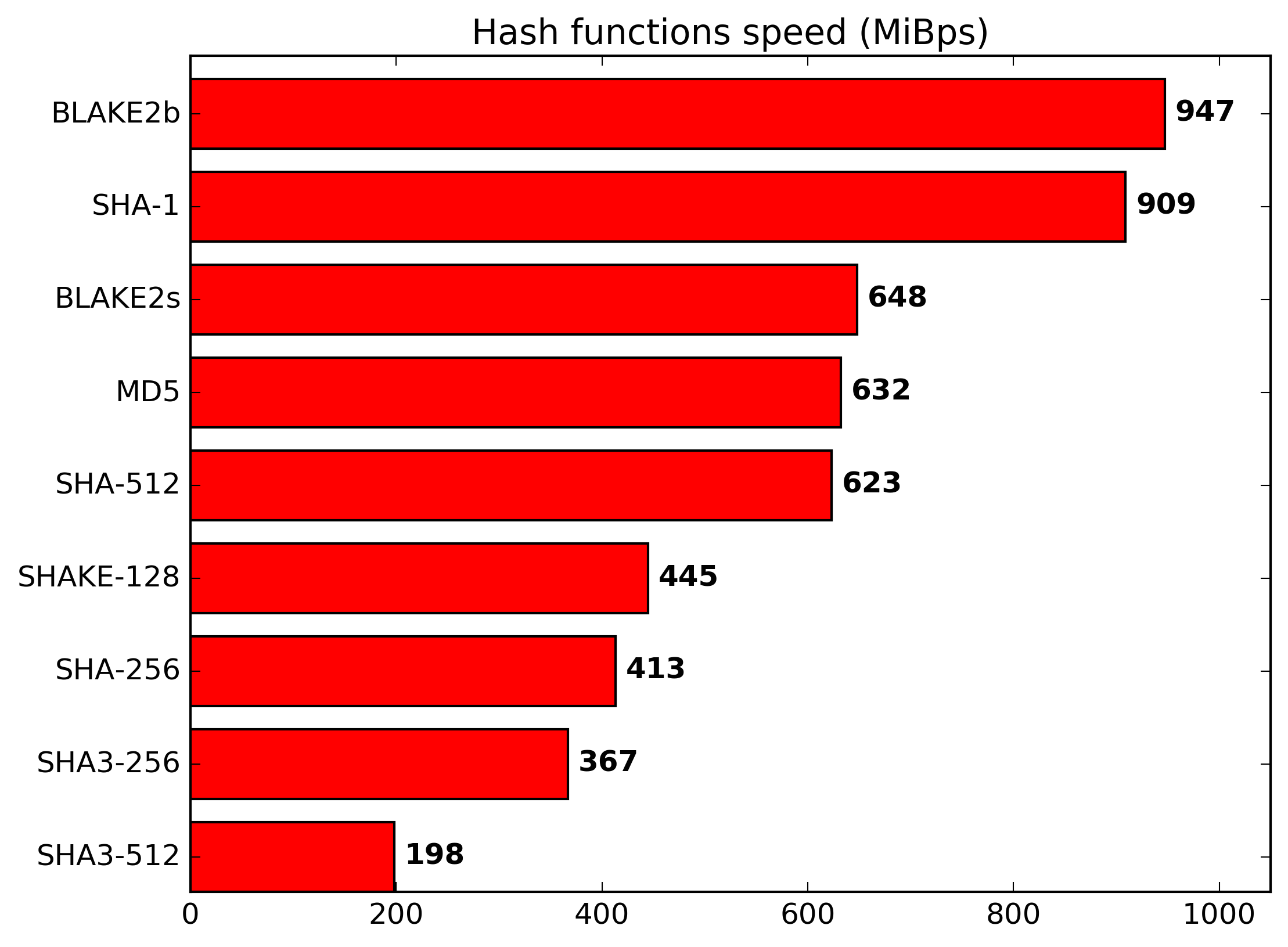
Benchmarks on Intel Skylake:
Re: Maybe Skip SHA-3
#130Earlier quoted context omitted.
I think your mis using "world use case". It's a hash function and so it is usable as a hash function. I'll repeat what was said elsewhere. SHA-2 of vulnerable to length extension attacks.
I said it's not a reasonable choice in the real world. Virtually anywhere you could use it, you would be better off be using a SHA-2 variant instead. Length extension attacks only apply in cases where you've chosen to use the wrong cryptographic primitive (a hash) for your purpose (a MAC).
Being resistant to common misuses is indeed a feature in real world cryptography. We saw that with DSA where you leak the private key if you happen to reuse a nonce; yes, you shouldn't do that, but it's better to choose an algorithm that doesn't suffer from this in the first place.
I'm not rooting for SHA-3; I'm just saying that it's wrong to dismiss length extension attacks only because they're commonly effective agains misuses of hash functions.