Live data from Hacker News

How Can Germany's High-Speed Trains Get Back on Track?

spiegel.de

31–40 of 42 posts

Re: How Can Germany's High-Speed Trains Get Back on Track?

#31

Earlier quoted context omitted.

High speed rail is breathtakingly expensive, especially in urban areas. When BART was planning on a high speed branch out to silicon valley, it was budgeted to run $120,000,000 per mile of track. Part of the cost is that you cannot have any at-grade crossings, every road crossing has to be an over/underpass.

> High speed rail is breathtakingly expensive Expensive yes, breathtakingly no. The recent LGV Est ( http://en.wikipedia.org/wiki/LGV_Est ) has a budget of 4b€ for 406km (252 miles) or about $20m/mile. London's M25 projects £6.5b for 117 miles, so urban motorways are not cheap either. Completely urban stuff is very expensive, but usually HST is mostly out of urban systems, only getting in to land at a given stop and…

In Germany, there is also a problem that many of these new lines are expected to have mixed traffic on them, meaning both fast passenger trains and freight trains. This makes them much more expensive than they would have to be, as both types of traffic have quite different expectations. Passenger trains need curves with very large diameters (~ speed^2 relation, even 7 km diameters) in order to allow the high speeds. Freight trains aren't that fast, so they don't need such a large diameters of the curves, but they can't handle as steep gradients. 4% slope is perfectly OK for an HS passenger train, but at least impractical for a freight traffic.

French HS train lines are for passenger traffic only, they can be (and are) built adjacent to existing highways and so. And of course. They are built as whole new lines, instead of the (not only) German patchwork.

Btw. you are missing HS railways in Spain, where it is built in a similar manner to France, there are already complete operational routes, and the service seems to be very successful as well.
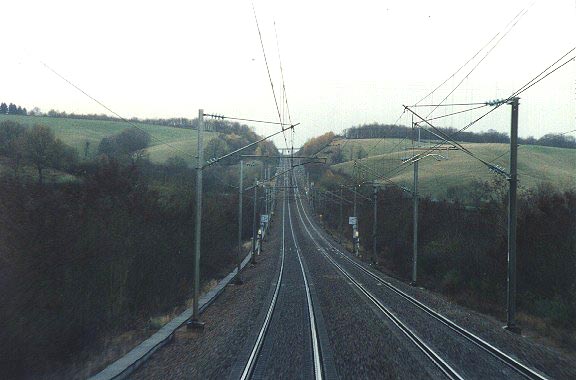
http://www.trainweb.org/tgvpages/images/cab/ln1rampe.jpg

Re: How Can Germany's High-Speed Trains Get Back on Track?

#32
post #8

At this point, for europe it might just be a better idea to let the TGV network grow outwards from France. It's already started to spread its tendrils in other countries anyway. Not that the network is that good in France though, Paris-Lyon-Marseilles has been nice for years, the connection to Lilles (and now to Bruxelles in Belgium as well) and to London via the channel tunnel is nice, a line recently opened to the…

Your point #1 is the inherent problem with rail passenger transport, and why air travel has an advantage. For rail you have to engineer and build both the vehicle and transport medium (rails). This gives you two very different engineering challenges. Building the transport medium between every two points is a new undertaking. Air travel on the other had presents one engineering challenge, creation of the vehicle. (I'm dismissing the airports, because essentially they are very simple structures. Of course the air traffic control system is not simple.) And when you have the vehicle your choice or routes is practically unlimited.

Re: How Can Germany's High-Speed Trains Get Back on Track?

#33
post #8

At this point, for europe it might just be a better idea to let the TGV network grow outwards from France. It's already started to spread its tendrils in other countries anyway. Not that the network is that good in France though, Paris-Lyon-Marseilles has been nice for years, the connection to Lilles (and now to Bruxelles in Belgium as well) and to London via the channel tunnel is nice, a line recently opened to the…

Your point #1 is the inherent problem with rail passenger transport, and why air travel has an advantage. For rail you have to engineer and build both the vehicle and transport medium (rails). This gives you two very different engineering challenges. Building the transport medium between every two points is a new undertaking. Air travel on the other had presents one engineering challenge, creation of the vehicle. (I'…

I am not sure I agree here. It seems to me this is an area where restrictions have both benefits and drawbacks.

Rails seem much more efficient, safe, and have faster terminal service. Riding on any good rail service is vastly more enjoyable to the passenger than flying. I would rather travel Europe, Asia, and North America on high speed trains than by air.

Re: How Can Germany's High-Speed Trains Get Back on Track?

#34
post #18

Earlier quoted context omitted.

At this point, for europe it might just be a better idea to let the TGV network grow outwards from France. I doubt that would solve the problem where political wrangling is the issue. I especially can't see the Germans allowing the French to build and run their trains and lines. ;) The ICE has run to Vienna for a while now, and Austria's ÖBB recently started their high-ish-speed "Railjet" [1] service (vmax currently…

Oh, I don’t think that’s such a big problem. Thalys already exists [1] and they use TGV trains. [1] http://en.wikipedia.org/wiki/Thalys

I'm aware of Thalys, though Aachen/Cologne isn't exactly a long journey.

Re: How Can Germany's High-Speed Trains Get Back on Track?

#35
post #31

Earlier quoted context omitted.

> High speed rail is breathtakingly expensive Expensive yes, breathtakingly no. The recent LGV Est ( http://en.wikipedia.org/wiki/LGV_Est ) has a budget of 4b€ for 406km (252 miles) or about $20m/mile. London's M25 projects £6.5b for 117 miles, so urban motorways are not cheap either. Completely urban stuff is very expensive, but usually HST is mostly out of urban systems, only getting in to land at a given stop and…

In Germany, there is also a problem that many of these new lines are expected to have mixed traffic on them, meaning both fast passenger trains and freight trains. This makes them much more expensive than they would have to be, as both types of traffic have quite different expectations. Passenger trains need curves with very large diameters (~ speed^2 relation, even 7 km diameters) in order to allow the high speeds.…

> French HS train lines are for passenger traffic only

Not 100% correct, the postal service have a pair of trainsets they use for mail.

But yes, mostly the french HST is for people, not freight.

> Btw. you are missing HS railways in Spain, where it is built in a similar manner to France, there are already complete operational routes, and the service seems to be very successful as well.

Correct, the AVE (which is built in a similar manner to France because Alstom got the contract for the first generation "Class 100" AVE in fact the class 100 is basically a Eurostar) and the two network should be linked (so you could take HST from Madrid to Paris) by 2013.

Re: How Can Germany's High-Speed Trains Get Back on Track?

#36
post #22

Earlier quoted context omitted.

That's still fairly reasonable compared to interstate construction costs in a city. For ~30 Billion you could build a DC to NY line that runs through Baltimore and Philadelphia. "The Big Dig was the most expensive highway project in the U.S.[2] Although the project was estimated in 1985 at $2.8 billion (in 1982 dollars, US$6.0 billion adjusted for inflation as of 2006[update]),[3] over $14.6 billion ($8.08 billion in…

PS: It was probably not worth the cost: Perhaps slightly off topic, but I have to disagree - your postscript only looks at one aspect of the CA/T, there were other effects as well. For starters, the old elevated artery was way past it's useful life, and a replacement was absolutely needed. Once you realize that the elevated artery needed replacement, your options start to narrow very quickly: replacing the old elevat…

"Boston city proper had a 2008 estimated population of 620,535" 22,000,000,000$ / 620,535 = 35,450$ per person, for something they helps in some areas but made congestion worse in others.

Other options included reducing the number of cars large toll to get into the city which would for high quality and public bus system.

2% of 22billion is 440 million / year that pays for one hell of a public bus system. Heck, spend 22billion on an above ground mono rail network and you could build one hell of a system (~500 - 1500km). Most Boston traffic is just moving people from point A to B so public transportation is a real option. 13% of all commuting takes place by foot as it is, so even elevated bike paths could have significantly improved things.

Re: How Can Germany's High-Speed Trains Get Back on Track?

#37
post #36

Earlier quoted context omitted.

PS: It was probably not worth the cost: Perhaps slightly off topic, but I have to disagree - your postscript only looks at one aspect of the CA/T, there were other effects as well. For starters, the old elevated artery was way past it's useful life, and a replacement was absolutely needed. Once you realize that the elevated artery needed replacement, your options start to narrow very quickly: replacing the old elevat…

"Boston city proper had a 2008 estimated population of 620,535" 22,000,000,000$ / 620,535 = 35,450$ per person, for something they helps in some areas but made congestion worse in others. Other options included reducing the number of cars large toll to get into the city which would for high quality and public bus system. 2% of 22billion is 440 million / year that pays for one hell of a public bus system. Heck, spend…

"Boston city proper had a 2008 estimated population of 620,535" 22,000,000,000$ / 620,535 = 35,450$ per person, for something they helps in some areas but made congestion worse in others.

The presumption is that the artery is only being used by Boston residents. It's used by Boston residents to get out the city, by other MA residents to get into the city, and by non-MA residents to get in & thru the city, as well as delivering goods received in Boston ports to points north, south and west. Freight rail can (and does, vis the huge CSX yard in Allston) move a huge portion of that load, but you're still going to have trucks for the last-mile delivery to the industrialized areas in EMass. (and where has it made congestion worse?)

But even if you want to put everyone on buses, those buses still have to drive on something - the old artery couldn't be that something because it was falling apart, and alternatives have the same problem as an alternative highway system does. IOW. you're still talking about a tunnel system.

Re: How Can Germany's High-Speed Trains Get Back on Track?

#38
post #33

Earlier quoted context omitted.

Your point #1 is the inherent problem with rail passenger transport, and why air travel has an advantage. For rail you have to engineer and build both the vehicle and transport medium (rails). This gives you two very different engineering challenges. Building the transport medium between every two points is a new undertaking. Air travel on the other had presents one engineering challenge, creation of the vehicle. (I'…

I am not sure I agree here. It seems to me this is an area where restrictions have both benefits and drawbacks. Rails seem much more efficient, safe, and have faster terminal service. Riding on any good rail service is vastly more enjoyable to the passenger than flying. I would rather travel Europe, Asia, and North America on high speed trains than by air.

> Rails seem much more efficient, safe, and have faster terminal service.

While that may be true, those aren't the only criteria. (And, the efficiency is only fuel efficiency.)

> Riding on any good rail service is vastly more enjoyable to the passenger than flying.

When the journey is the goal, that's great, but I'm usually travelling because I want to get somewhere else.

Re: How Can Germany's High-Speed Trains Get Back on Track?

#39
post #9

Earlier quoted context omitted.

> The U.S. lacks both the population density and the dearth of a legacy bulk airline/airport network to make large-scale roll-out of high-speed rail service viable. As a whole yes, but that's not really relevant. The US have several big metropolitan areas or groups for which HSR would be perfect: the western corridor between San Diego and SF, the north-east around NY, Ohio (Chicago area), ... Is HSR competitive for N…

And don't forget that our current "solution" ... AmTrak ... is probably the worst public train system in the developed world. I've had the pleasure of riding the ICE and as an American who never knew such a train service, it was awesome. If we could break a few misconceptions, setup a high speed corridor along the east coast, along the west coast, and a few cross-country lines through the north and south, we could ha…

I had a very pleasant (though not high speed) ride from Santa Barbara to San Diego via LA Central 10 years ago.

Re: How Can Germany's High-Speed Trains Get Back on Track?

#40
post #10
post #5

A accurate portrayal of the problems, but I would very much like to add that actually going to places with a ICE really is a joy. I always prefer it to traveling by car, even if I have to travel some part of the way with a slower regional train. (That might be because traveling by train is just plain cool, period. I once took that Russian night train to Krakow – that was a unique experience.)

I love trains, too. Using high speed rail to see my parents is one the favourite things about my decision to move back to Germany. ICEs are great and it is such a shame that the network is so patchy. When they actually do go up to speed it's thrilling.

The really cool trip is the one from Copenhagen to Hamburg on the ICE - they actually load the entire train onto the ferry, kick you off it for an hour so you can swan about on deck, and then it's back onto the train once you dock. Very cool.
Post reply on HN