Gender and verbs across 100K stories: a tidy analysis
varianceexplained.org
Gender and verbs across 100K stories: a tidy analysis
1–10 of 178 posts
Re: Gender and verbs across 100K stories: a tidy analysis
#2The author failed to mention the context of the data chosen; specifically the dates. For example, rob vs. steal, would change depending on the century the work was created.
Re: Gender and verbs across 100K stories: a tidy analysis
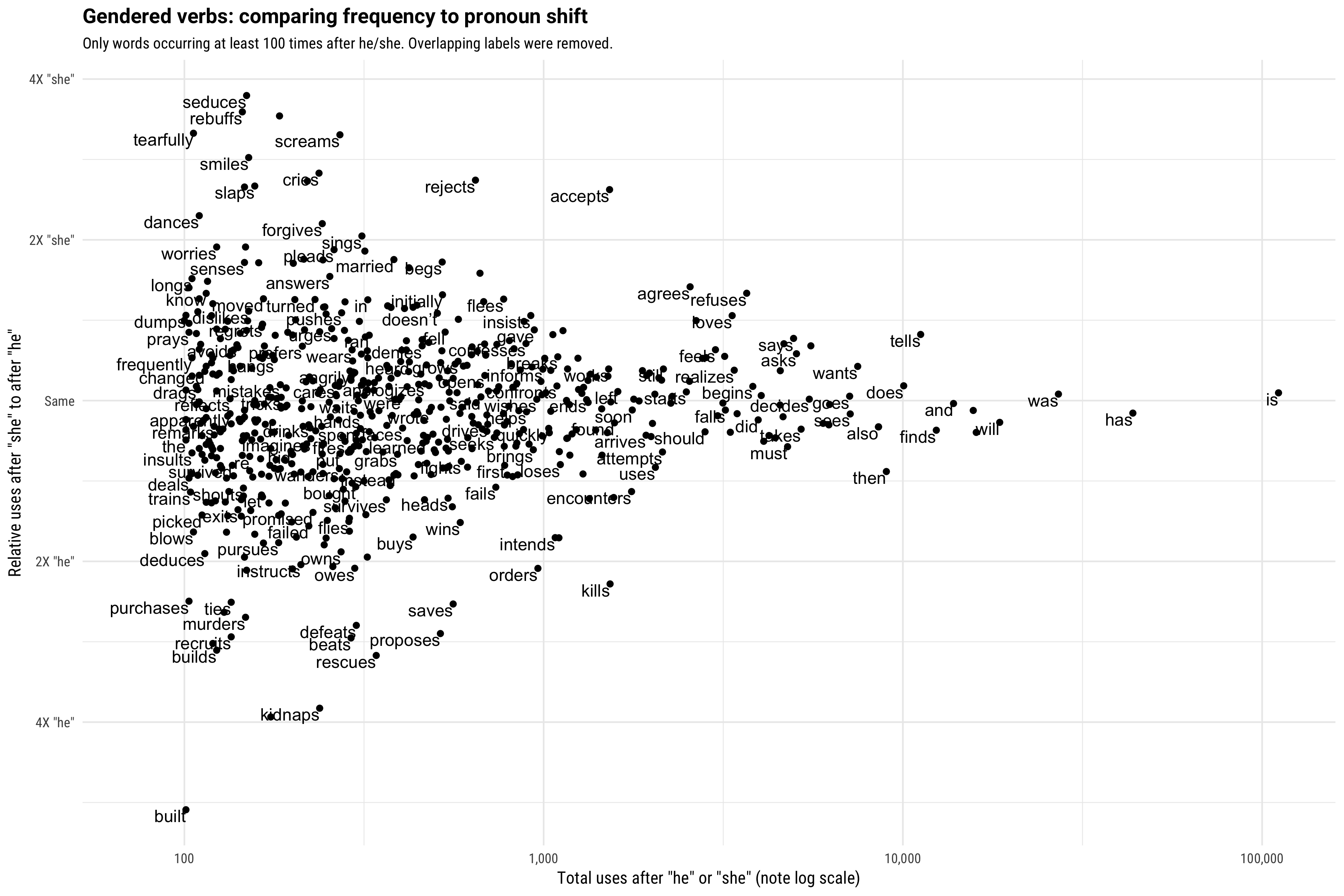
#3Direct link to a scatter plot (x axis: quantity, y axis: gender):
http://varianceexplained.org/figs/2017-04-27-tidytext-gender...
Re: Gender and verbs across 100K stories: a tidy analysis
#4The author failed to mention the context of the data chosen; specifically the dates. For example, rob vs. steal, would change depending on the century the work was created.
The author mentions in the second paragraph that the data comes from scraping Wikipedia articles' plot descriptions. So the plots might be old, but the descriptions (and language) were all written recently.
Re: Gender and verbs across 100K stories: a tidy analysis
#5The author failed to mention the context of the data chosen; specifically the dates. For example, rob vs. steal, would change depending on the century the work was created.
[deleted]
Re: Gender and verbs across 100K stories: a tidy analysis
#6It's interesting how thoroughly ingrained sexist concepts are in the language. Even a verb that's fairly active like 'resist' assumes a power relation in which they are in a worse position.
I'd like to see this done by country or year or language or genre.
Re: Gender and verbs across 100K stories: a tidy analysis
#7I dont see apache helicopters mentioned anywhere, which makes me doubt this works rigor.
Re: Gender and verbs across 100K stories: a tidy analysis
#8The reference at the end talking about comparing changes over time reminded me of a problem I've been kicking around. For this particular system that's not too hard, since you're putting each word on a one-dimensional femininity/masculinity scale, so you could plot a word on a line graph or something. But what do you do if you want to evaluate the changes of more complex relationships over time? Not just mapping words to a constant vector space, but modeling the relationships between words, such as clusters or word2vec representations. With something like word2vec you can take a bunch of words and project the vector space onto a plane so you can see the relative distances, but how do you express changes over time? You could show a bunch of planar projections for different instants in time, but it's hard to look at that and capture the changes.
So how do you visualize changes to these more complex interactions between data points, and also how do you mathematically quantify some of these changes? I'd really appreciate any advice on this. And sorry that this is kind of off topic for the article :)
Re: Gender and verbs across 100K stories: a tidy analysis
#9It's interesting how thoroughly ingrained sexist concepts are in the language. Even a verb that's fairly active like 'resist' assumes a power relation in which they are in a worse position. I'd like to see this done by country or year or language or genre.
Heh. You have no idea. English doesn't even have proper genders. You're on easy mode.
If I say: "Your manager is good.", it's neutral. You can't figure out if I'm talking about a man or a woman without something additional.
In Romanian, and I guess in most Latin languages, no such luck. Except for a handful of neologisms, everything clearly mentions the gender, for better of for worse.
The direct translation in Romanian: "Managerul tău e bun" is masculine (both the noun and the adjective make that obvious).
The whole neutral gender movement in English sounds kind of funny for us... we could try to do it Romanian but it would be like lobotomizing the language.
Re: Gender and verbs across 100K stories: a tidy analysis
#10The reference at the end talking about comparing changes over time reminded me of a problem I've been kicking around. For this particular system that's not too hard, since you're putting each word on a one-dimensional femininity/masculinity scale, so you could plot a word on a line graph or something. But what do you do if you want to evaluate the changes of more complex relationships over time? Not just mapping word…
measure change in relativity