Live data from Hacker News

Alphabet's Self-Driving Cars to Get Their First Real Riders

bloomberg.com

231–240 of 411 posts

Re: Alphabet's Self-Driving Cars to Get Their First Real Riders

#231
post #172

Earlier quoted context omitted.

Serious question: why is cost such a common argument made here against emerging tech? This argument seems to come up every time some new expensive technology is transitioning closer to consumers' hands, and the current price, which is obviously expected to go down at scale as it does for nearly all widely useful technology, is used as evidence nobody will be able to afford it. I've seen this argument made for technol…

Serious counter question; Why is nobody talking about cost? Cars are very expensive... is self-driving tech going to increase or decrease the cost of a vehicle? Do people generally want more freedom or less freedom choice? Why does everyone assume the cost will decrease with scale? How many people can afford a Tesla right now? Let alone a fully autonomous car? If flying were more affordable and less strict more peopl…

"Serious counter question; Why is nobody talking about cost? Cars are very expensive... is self-driving tech going to increase or decrease the cost of a vehicle? Do people generally want more freedom or less freedom choice?"

Because you don't need to own the car - you could feasibly rent one on demand (like a taxi), since you can now rent a car without the necessary wage overhead of the taxi driver, or the minimum costs of car-rental (i.e. car rental typically is per-day, for logistical reasons) or the logistical problems of car-rental (i.e. you need to drive to and from the car-rental place, to pick up and drop off the car - and by "drive" I mean "get a lift or use public transport").

Plus, the self-driving stuff shouldn't be particularly expensive, and will be counterbalanced by lower insurance premiums, and likely tax incentives once voters realise that they really do save lives.

"Why does everyone assume the cost will decrease with scale? How many people can afford a Tesla right now? Let alone a fully autonomous car?"

Because just about everything decreases with scale, and it's not inherently hard tech. Tesla's main problem is their lack of scale. As are autonomous cars.

"Why does everyone assume that most people want to share a vehicle?"

Money. It's not "want", it's "can tolerate so as to save money". Your car, when adding together all the costs (purchase, fuel, rego, maintenance, interest payments if you borrow instead of buying outright) is one of the biggest expenses that most people have. Sharing a car between several people should decrease the costs by an order of magnitude, which could be used to buy whatever people spend their money on these days, or saved.
Re: Alphabet's Self-Driving Cars to Get Their First Real Riders

#232

Earlier quoted context omitted.

I'm curious - where did you come up with your $75k cost for retrofitting existing vehicles?

Out of thin air. Why would it be cheaper? If you made the product, would you try to maximize profit or do it for SAFETY and the good of society?

Got it. I admittedly know nothing about what the pricing will be here - and comparing to Tesla may be apples to oranges, but per The Verge (https://www.theverge.com/2016/10/20/13346512/tesla-self-driv...) the hardware for a Tesla is under $10k.

Additionally maximizing profit (and this may read as condescending but I do not intend for it to be so) does not necessarily mean maximizing price. Obviously if you are not selling at a loss you can potentially make more money with a cheaper price point on volume.

I do agree, however, that first adopters will likely pay a premium.

Eventually I imagine insurance companies will help subsidize these things too - if the price does not become trivial.

Re: Alphabet's Self-Driving Cars to Get Their First Real Riders

#233

Am I the only one feeling the press + big tech narrative of "driverless vehicles = safety" is way ahead of itself? OK, "driver error is blamed for 94% of crashes", but what is the validation strategy to show where driverless cars can quantifiably improve? In 2016, Philip Koopman of CMU discusses that there are non-trivial engineering challenges of achieving safety in NHTSA Level 4 vehicle automation: https://users.ec…

Waaay ahead of itself. There are just some people who see a catastrophe around ever corner, despite all the progess we've made in the last century (so called, "catastrophists"). At the same time, wild optimism about how we're going to have fully-autonomous, Level 5 vehicles doing our errands in 2030.

Re: Alphabet's Self-Driving Cars to Get Their First Real Riders

#234

Earlier quoted context omitted.

Well for one, you don't need to own your car. You just use it. If you (or anyone you know) owns a traditional automobile, it sits unused for 90% of its life. In a driveway, on the sidewalk, in a parking lot, etc. You pay for 100% of the car, but only use 10% of it. If you could rent it out to others ('the grid') while you're not using it, they would share some of the burden, lessening yours. They make things safer be…

You know there is a whole legion of jobs that require a vehicle? All construction jobs for example. Most service techs require a bunch of expensive tools and need a secure place to keep them on site. The list literally goes on and on... Can an hunter ride share the pacifica out to the forest with his/her hunting gear? How about bicyclists? People with kids know about activity shuffling... I am not sure that sharing w…

Can an hunter ride share the pacifica out to the forest with his/her hunting gear? How about bicyclists? People with kids know about activity shuffling... I am not sure that sharing will work for my families schedule.

Easy: many households now have two (or more cars), but self-driving cars will allow many of them to reduce to a single car. One people carrier for family outings, on-demand robot taxis for commutes and quick errands. Maybe not a total revolution, but a 50% reduction in household car ownership would be a pretty big deal (it'd make neighbourhood parking a lot easier for a start).

Re: Alphabet's Self-Driving Cars to Get Their First Real Riders

#235

Earlier quoted context omitted.

In my opinion, the primary use case of self-diving cars aren't personal ownership. Society as a whole wastes a lot of resources when every household has a car that stands still 95% of the time. With self-driving cars, we can plausibly improve that.

We could significantly improve it now with more Zipcar type apps (at least in cities where people live close together) but the most people want guaranteed access to a vehicle at 8am and 5:30pm weekday situation isn't easily solved just by making them mobile when not in operation. Nor - at least in the short term - is people's tendency to use cars, and especially cars with no previous owners, as a status symbol (many…

Agreed. I also think another big reason for personal car ownership is having kids. With the increasing ages/weights recommended and/or required by law for car seats, that can be a hassle if trying to use a ride sharing service. It increases difficulty with increased number of kids at varying ages. For those without kids, while it's not crazy difficult to install a car seat, it can still take upwards of 5-15 minutes (depending on the style of seat). This amount of time lost can be a big hindrance.

Yes, I know that Uber has started to tackle this problem, but as far as I know it only provides 1 car seat, and a car equipped this way may not always be nearby. Maybe this will be a completely solved problem soon, which would be great!

Re: Alphabet's Self-Driving Cars to Get Their First Real Riders

#236
post #54

Earlier quoted context omitted.

Killing a few extra people today to bring self driving cars to market faster could actually save more lives in total. I have much more respect for Tesla for shipping something.

The system that killed people didn't represent a point of progress for their self driving tech. They decided to abandon the hardware package it was using. Their current implementation doesn't seem to be learning any higher level behaviors (there's a Youtube video of guy using it in a park where it repeatedly accelerates towards islands in the road and then flails off the road as it goes too fast around the island).

Using a billion miles of real world experience to decide that that technology was insufficient is, in fact, progress.

It may have gone the other way. Remember, the primary sensor technology in 99.999% of cars out there is two front facing visual-light cameras pointing the same way on a swivel and couple of mirrors.

Re: Alphabet's Self-Driving Cars to Get Their First Real Riders

#237

Am I the only one feeling the press + big tech narrative of "driverless vehicles = safety" is way ahead of itself? OK, "driver error is blamed for 94% of crashes", but what is the validation strategy to show where driverless cars can quantifiably improve? In 2016, Philip Koopman of CMU discusses that there are non-trivial engineering challenges of achieving safety in NHTSA Level 4 vehicle automation: https://users.ec…

No you are not! HN seems to think the same way, and it is one of the worst cases of rose colored glasses I have ever witnessed. What about the cost? Who is going to be able to afford this? Also, what about people that rely on a vehicle for work? Retrofit $75K work trucks with another $75K in self driving gizmos? Find me a practical plumber, carpenter, A/C, lock smith, self-employed guy/gal that will sign up for that!…

That's why society needs rich people. They buy emerging tech first, then the tech drops in price as initial capital costs are recouped, manufacturing costs come down, and the tech improves.

Remember when LCD screens came out and very few people could afford them? We were complaining then too about how could people possibly afford this and who will buy it??!

Re: Alphabet's Self-Driving Cars to Get Their First Real Riders

#238

Am I the only one feeling the press + big tech narrative of "driverless vehicles = safety" is way ahead of itself? OK, "driver error is blamed for 94% of crashes", but what is the validation strategy to show where driverless cars can quantifiably improve? In 2016, Philip Koopman of CMU discusses that there are non-trivial engineering challenges of achieving safety in NHTSA Level 4 vehicle automation: https://users.ec…

Imagine ransomware infecting your car that gives you 30 minutes to pay or you'll be rammed into a tree at 90mph. I don't care about any contrived and well-funded narratives about how unthinking, unfeeling, driverless cars will somehow save lives. No thanks, I'd rather take my chances continuing to share roads with human drivers who are careful because they fear their own death just as much as I do.

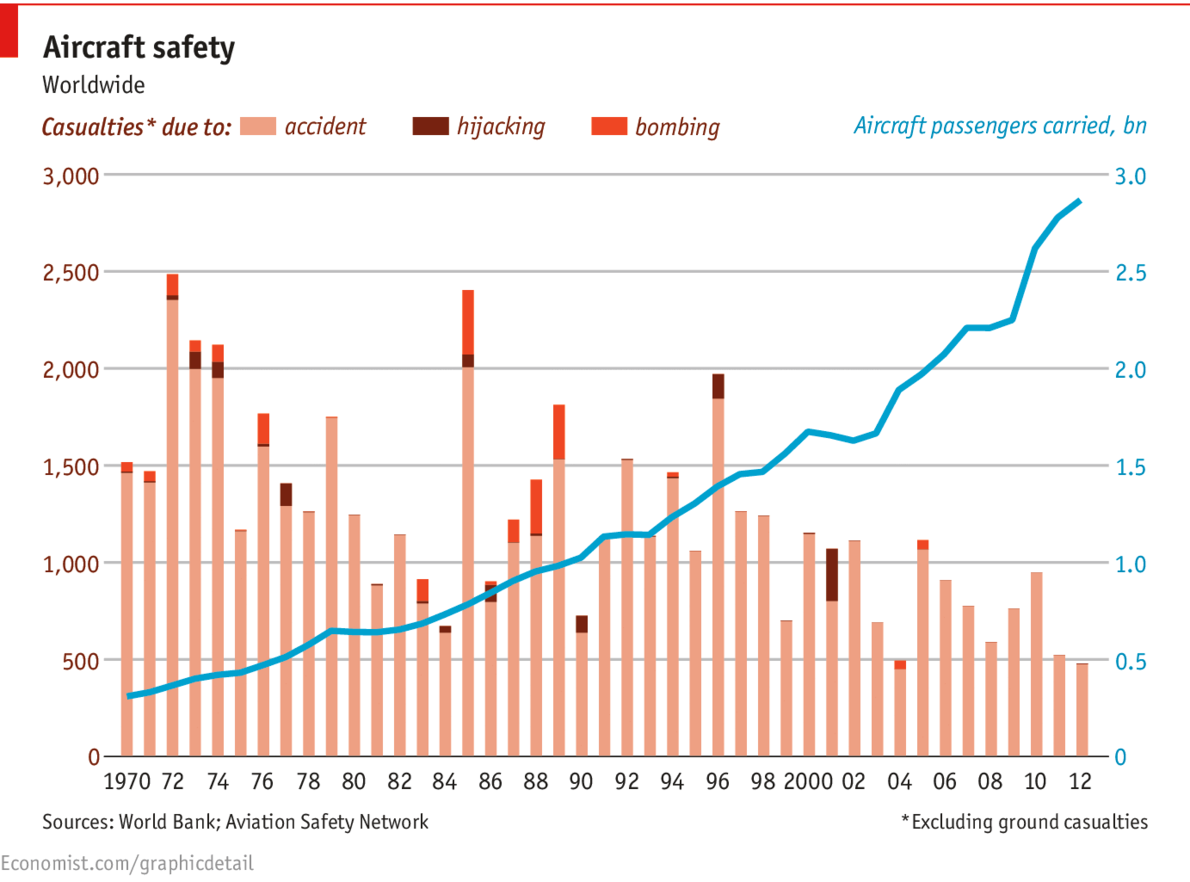
Check out this graph about airplane accidents:

http://cdn.static-economist.com/sites/default/files/images/2...

Since 1970 total airplane casualties have halved, while there are now 7 times the number of passengers. Much of this improvement has been due taking decisions away from pilots and into the hands of 'unfeeling' automated systems.

Re: Alphabet's Self-Driving Cars to Get Their First Real Riders

#239

Earlier quoted context omitted.

if you take out alcohol and cell phones, you've reduced 70-80% of driving related fatalities with those two alone.

>take out alcohol that one worked out beautifully last time around

The problem was caused by the underlying political problems - namely, people didn't necessarily want to ban it, there was just a very ruthless political organisation that essentially destroyed any politicians who opposed the bans, regardless of what the constituents wanted. Politicians were forced to pass it.

If the alcohol ban had arisen organically - namely, as a genuine result of democratic support, the prohibition wouldn't have been such a spectacular failure.

Re: Alphabet's Self-Driving Cars to Get Their First Real Riders

#240

This is an important step for testing, and I'm surprised that this is being spun as a move towards commercialization. As of right now, waymo has only been doing what could metaphorically be called unit testing. That is, they test the cars behavior in very controlled but unrealistic environments, looking for very specific responses. The accident rate that they've incurred is likely ridiculously skewed: they've been dr…

> they test the cars in very controlled but unrealistic environments

Are you sure about this? Google has had self-driving cars in Austin for years and I'm pretty sure there's never a good time to be driving here.

Post reply on HN