https://twitter.com/harisamin/status/727634194814373889
https://pbs.twimg.com/media/ChkTccjVAAAZ0Kt.png https://pbs.twimg.com/media/ChkTcbMUkAIYolx.png
171–180 of 1001 posts
https://twitter.com/harisamin/status/727634194814373889
https://pbs.twimg.com/media/ChkTccjVAAAZ0Kt.png https://pbs.twimg.com/media/ChkTcbMUkAIYolx.png
Earlier quoted context omitted.
That's nonsense . Desktop apps have been frequently released since forever. The underlying issue here is that Electron reduces the barrier to entry for cross-platform development . That is, it's cheaper to build a single cross-platform application in Electron than it is to build two or three native applications, and you can re-use your existing web experience. I can completely understand why companies might choose th…
What you call "trade-offs" appears to me to be developers externalizing their costs onto users. There are costs to developing desktop applications and developers don't want to pay them, so they make users pay for them in wasted hardware dollars, bandwidth, RAM, battery life, and poor integration.
There may be an interesting economic lesson here: it really is not that easy to externalize costs. It surely can be done (air pollution), but it requires some special circumstances for those costs not to be internalized in a different form. (These special circumstances might include information asymmetries, harm to a public good, enjoyed by people other than a firm's own customers, etc.--themselves classic risk factors for market failure.)
By the same token, there probably are some truly externalized costs in this example, but I would expect them to be very minor and indirect. For example, most people probably do not pay the 'true' cost of their electricity. So to the extent electron wastes power, some of the cost will be internalized in the form of user dissatisfaction. But some will also be externalized either because the user doesn't know about the extra power consumption, or because the user herself doesn't fully internalize the costs of her power consumption and therefore doesn't care as much as she might if all costs were properly internalized.
Here's the thing. You know what the alternative to all of these Electron apps coming out is? If your answer is "A native Cocoa/WPF app", you are on another planet, the answer is, "It wouldn't exist at all". Nobody in the last 5-10 years cared about writing Desktop apps before Electron came along, there's basically zero money in it, and it's massively expensive, both in terms of actual dev time per feature (easily 10x…
A single page web app?
That's all most of these are. Particularly the Slack/Hipchat/Discords of the world.
> People are excited about the Desktop again
If by desktop, you mean "need to be connected to mains power to run for more than 10 minutes", yeah, people are excited for desktops again.
Electron only really makes Javascript developers happy; they don't have to learn another language or framework to make "desktop" apps now. As a consumer, I fail to see the value in having to download large single page webapps that are equivalent (or worse) than their online counterparts.
Cross-platform applications like Chrome and Firefox and Steam and Doom and Factorio and... these have existed for years, and so have cross-platform programming languages and frameworks. Java, TCL, Qt, Flash... Electron is simply the lastest in a long line of cross platform frameworks, which is currently in-vogue with developers solely because it uses HTML and JavaScript.
Here's the thing. You know what the alternative to all of these Electron apps coming out is? If your answer is "A native Cocoa/WPF app", you are on another planet, the answer is, "It wouldn't exist at all". Nobody in the last 5-10 years cared about writing Desktop apps before Electron came along, there's basically zero money in it, and it's massively expensive, both in terms of actual dev time per feature (easily 10x…
Nobody in the last ~20 years has cared about writing Web apps before JS came along. There's basically zero money in it, and it's massively expensive, both in terms of actual development time per feature (easily 10x the cost of working in sane languages with sane runtimes), and also in finding trendy hipsters who don't know algorithms or data structures but took four weeks of coding academy classes a couple years ago. And as for Electron, Electron has existed for over three decades (Project Athena launched in 1983) -- if its massive "Nixon throwing the peace signs before getting on the plane" moment hasn't happened by then, sorry, but it's not going to happen.
But now? People are making all kinds of great new languages, and more often than not, they don't repeat JS's mistakes. People are excited about programming again -- JS is so bad that it's single-handedly revitalizing interest in languages which two of the largest tech companies in the world are behind, yet couldn't make popular.
This is a Big Deal.
(You are being parodied mostly for being a Slack developer, not disclosing it up front, and then trying to convince folks that Electron is good, which makes you sound a lot like a pig farmer trying to sell pigs' feet.)
Earlier quoted context omitted.
Bingo--half these diatribes against Electron just seem to be making the case for premature optimization.
Spotify, Slack and Atom are no longer hip startups though - they're established applications, and at least two of them have a very lucrative monthly subscription model. They can afford to optimize.
EDIT: thanks for the downvotes. I'd love to hear your thoughts on how electron is keeping Slack and Spotify from building a massive business and how their desktop users find the experience so bad they don't use the tools obsessively. Clearly there are things to improve w/ Electron (energy usage), but "terrible experience" is not how I'd describe Spotify and Slack on desktop, and their businesses clearly reflect that.
Moving to a native stack has major tradeoffs, would it 10x their business at least? I strongly believe that answer is "no."
Telegram Desktop is very good example of modern desktop client done in the most efficient way. C++ and qt, nothing else. Works like a charm an all major operating systems. Easy to install, use and update. Great stuff.
This doesn't break the trend.
Some problems:
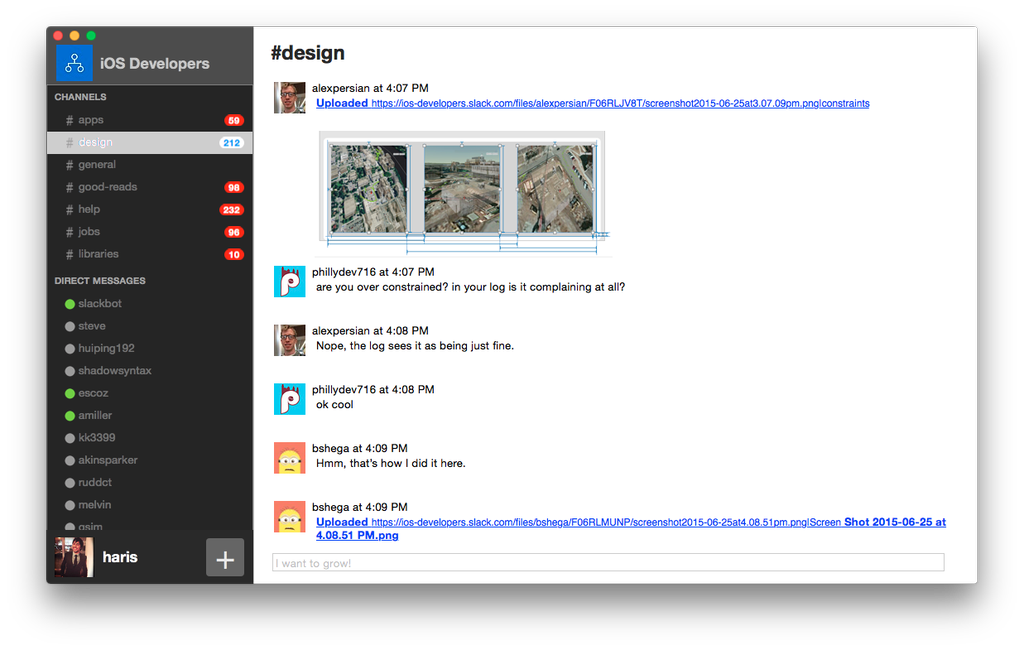
- Text boxes are non-native and do not support any standard keystrokes for navigation (this is huge!)
- The division between the titlebar and the main app body is weird looking
- Highlighting around a focussed text box is weird
- Weird inline dialogs
- No bounce scroll
Some of those are debatable (not everything has to be done using the standard system stuff, of course), but to me the overall effect is very alien.
Slack, for all its inefficiency & handful of annoyances (not actually using unicode / text to represent emoji, anyone?), "feels" like a better Mac citizen than this app.
FWIW, we're working on https://github.com/nidium/Nidium presicely to fix this. A new kind of browser engine, not based on any existing engine, allowing developers to use a subset of the web (webgl, 2d, layout) without being forced to use a bloated ecosystem (and which also works on mobile and low end device). Previous HN discussion : https://news.ycombinator.com/item?id=6314961
Earlier quoted context omitted.
That's nonsense . Desktop apps have been frequently released since forever. The underlying issue here is that Electron reduces the barrier to entry for cross-platform development . That is, it's cheaper to build a single cross-platform application in Electron than it is to build two or three native applications, and you can re-use your existing web experience. I can completely understand why companies might choose th…
> The underlying issue here is that Electron reduces the barrier to entry for cross-platform development. It's very far-fetched to call a lower barrier to entry an issue. The easier we can make it for people to get started, the better, isn't it?
Would you like to use an application that would not have been written without a low barrier of entry? Powerfull and easy tools are not necessarily the same thing.
If you like Node.js and HTML/CSS, just have a node daemon running in the background with an HTTP server to your app! It's just like Electron, but without the CPU/RAM/Battery usage. You can even have binaries that stay open after a double-click and automatically open your browser to localhost:40023 (or whatever).
Here's the thing. You know what the alternative to all of these Electron apps coming out is? If your answer is "A native Cocoa/WPF app", you are on another planet, the answer is, "It wouldn't exist at all". Nobody in the last 5-10 years cared about writing Desktop apps before Electron came along, there's basically zero money in it, and it's massively expensive, both in terms of actual dev time per feature (easily 10x…
What Electron did is it enabled all those web devs (even front end guys) to write "desktop" apps. And trade offs are certainly visible.
I am boycotting Electron. I have zero Electron apps installed, and recommend strongly against it. I hate that web dev mindset that has been pushed into desktop userland. It just doesn't work that way. Write native desktop app yourself and you will see how wrong it is.