Closing nuclear power plants and replacing them with coal power plants is simply criminal. In Europe, coal pollution kills ~20,000 people each year ( ), nuclear never killed a single person, and no study could ever provide any mortality increase due to nuclear energy (outside the Tchernobyl accident, which killed between 200 and 4000 people depending on estimations, after 20 years of study) To be clear: nuclear is no…
> (outside the Tchernobyl accident, which killed between 200 and 4000 people depending on estimations, after 20 years of study) Wikipedia seems to give 4000 as an estimate on those exposed to the highest levels of radiation alone https://en.wikipedia.org/wiki/Chernobyl_disaster#Cancer_proj... On the other hand coal, wind and solar never poisoned our food (wild boars in Germany thousands of km away still often are too…
Nuclear plant shutdowns tied to coal pollution, decreased birth weights
21–30 of 193 posts
Re: Nuclear plant shutdowns tied to coal pollution, decreased birth weights
#22Closing nuclear power plants and replacing them with coal power plants is simply criminal. In Europe, coal pollution kills ~20,000 people each year ( ), nuclear never killed a single person, and no study could ever provide any mortality increase due to nuclear energy (outside the Tchernobyl accident, which killed between 200 and 4000 people depending on estimations, after 20 years of study) To be clear: nuclear is no…
> (outside the Tchernobyl accident, which killed between 200 and 4000 people depending on estimations, after 20 years of study) Wikipedia seems to give 4000 as an estimate on those exposed to the highest levels of radiation alone https://en.wikipedia.org/wiki/Chernobyl_disaster#Cancer_proj... On the other hand coal, wind and solar never poisoned our food (wild boars in Germany thousands of km away still often are too…
Burning coal for electricity generation has released in to the environment more radiation, heavy metals, and other pollutants than civil nuclear power could ever hope to.
Re: Nuclear plant shutdowns tied to coal pollution, decreased birth weights
#23Closing nuclear power plants and replacing them with coal power plants is simply criminal. In Europe, coal pollution kills ~20,000 people each year ( ), nuclear never killed a single person, and no study could ever provide any mortality increase due to nuclear energy (outside the Tchernobyl accident, which killed between 200 and 4000 people depending on estimations, after 20 years of study) To be clear: nuclear is no…
> (outside the Tchernobyl accident, which killed between 200 and 4000 people depending on estimations, after 20 years of study) Wikipedia seems to give 4000 as an estimate on those exposed to the highest levels of radiation alone https://en.wikipedia.org/wiki/Chernobyl_disaster#Cancer_proj... On the other hand coal, wind and solar never poisoned our food (wild boars in Germany thousands of km away still often are too…
Don't mix coal... with wind and solar.
Coal releases proportional amounts of carbon dioxide when used to generate power. On the other hand, wind and solar release fixed amounts of carbon dioxide (during construction and transport) then generate energy C02 free.
Re: Nuclear plant shutdowns tied to coal pollution, decreased birth weights
#24Closing nuclear power plants and replacing them with coal power plants is simply criminal. In Europe, coal pollution kills ~20,000 people each year ( ), nuclear never killed a single person, and no study could ever provide any mortality increase due to nuclear energy (outside the Tchernobyl accident, which killed between 200 and 4000 people depending on estimations, after 20 years of study) To be clear: nuclear is no…
In other words nuclear never killed anybody apart from the ones it killed: https://en.wikipedia.org/wiki/List_of_nuclear_and_radiation_...
Re: Nuclear plant shutdowns tied to coal pollution, decreased birth weights
#25A very weird way to study the outcome of coal air pollution. It seems like this is not really about air pollution but trying to push nuclear energy. Luckily shutting down nuclear plants does not necessarily mean turning on coal power (e.g. in Germany they were replaced by renewables). Some questions arise though: Which coal power air pollutant is to blame for the birth weight decrease. Which coal pollution mitigation…
> Germany they were replaced by renewables This is unfortunately inaccurate ( http://www.euractiv.com/section/health-consumers/news/report... ), and Germany is one of the country where coal is the deadliest in Europe, thanks to anti-nuclear campaign from the green party.
> Germany buys cheap coal-fired energy from Poland to pick up the slack left by the abandonment of nuclear power after the Fukushima disaster.
Germany is a net electricity exporter.
> Germany is one of the country where coal is the deadliest in Europe
PM pollution is lower than average in the EU for one: http://ec.europa.eu/eurostat/tgm/graph.do?tab=graph&plugin=1...
Re: Nuclear plant shutdowns tied to coal pollution, decreased birth weights
#26Earlier quoted context omitted.
Really? Have you already forgotten about this: https://en.wikipedia.org/wiki/Kingston_Fossil_Plant_coal_fly... If coal plants had the same radiation rules as nuclear plants, they couldn't run.
> If coal plants had the same radiation rules as nuclear plants, they couldn't run. I think you mean if nuclear plants had the same radiation output as coal plants, they would be required to shut down. Edit: thanks for the downvotes, I realise now that I'm basically stating the same thing as OP. Quite the double standard that coal plants are allowed to spew so much radiation when all other forms of power generation a…
There's no way we could hope to capture all the radioactive particles from a coal plant exhaust, not in the foreseeable future with any reasonable efficiency.
Re: Nuclear plant shutdowns tied to coal pollution, decreased birth weights
#27A very weird way to study the outcome of coal air pollution. It seems like this is not really about air pollution but trying to push nuclear energy. Luckily shutting down nuclear plants does not necessarily mean turning on coal power (e.g. in Germany they were replaced by renewables). Some questions arise though: Which coal power air pollutant is to blame for the birth weight decrease. Which coal pollution mitigation…
in Germany they were replaced by renewables Do you have a reference for this? Germany has a very aggressive (and highly commendable) plan to move to renewables, but my understanding was that the closing of nuclear plants post-Fukushima was covered by coal. Wikipedia seems to agree ( https://en.wikipedia.org/wiki/Nuclear_power_in_Germany ): At the same time, Germany continues to rely heavily on coal power, with usage…
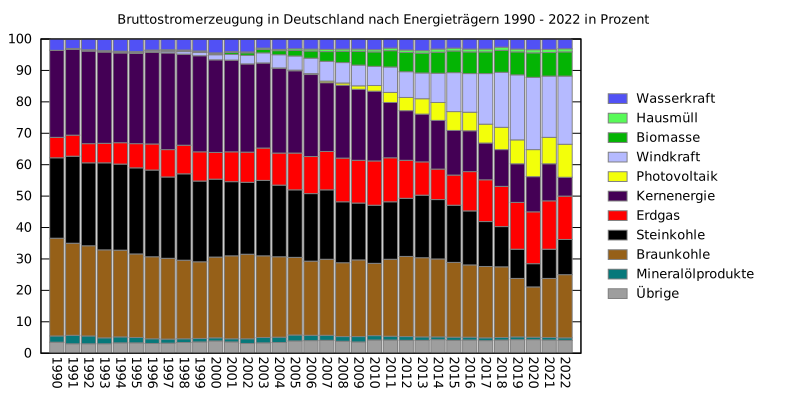
Purple is nuclear energy. Dark green is biomass, light blue is wind power, yellow is solar power
Re: Nuclear plant shutdowns tied to coal pollution, decreased birth weights
#28Earlier quoted context omitted.
Fukushima has demonstrated that humans aren't great at controlling or predicting the real risk of nuclear. The fact is, even if no one dies from acute radiation poisoning, nuclear disasters are costly and devastating.
Fukushima has demonstrated that relying on 60's technology and refusing to upgrade or invest because of political sensitivities exposes you to disasters 50 years down the line. It's like if everyone got afraid of airplanes in the 1980's and kept flying the same ones from the 60s through today because people were afraid to build new ones. Would you say air travel was unsafe, or that we made poor technology investments…
Tepco from Fukushima claimed until the day their plants were hit, that everything was totally safe. Politics supported them. Nobody was questioning them.
Re: Nuclear plant shutdowns tied to coal pollution, decreased birth weights
#29Closing nuclear power plants and replacing them with coal power plants is simply criminal. In Europe, coal pollution kills ~20,000 people each year ( ), nuclear never killed a single person, and no study could ever provide any mortality increase due to nuclear energy (outside the Tchernobyl accident, which killed between 200 and 4000 people depending on estimations, after 20 years of study) To be clear: nuclear is no…
> (outside the Tchernobyl accident, which killed between 200 and 4000 people depending on estimations, after 20 years of study) Wikipedia seems to give 4000 as an estimate on those exposed to the highest levels of radiation alone https://en.wikipedia.org/wiki/Chernobyl_disaster#Cancer_proj... On the other hand coal, wind and solar never poisoned our food (wild boars in Germany thousands of km away still often are too…
https://en.wikipedia.org/wiki/Mercury_in_fish#Origins_of_mer...
Re: Nuclear plant shutdowns tied to coal pollution, decreased birth weights
#30Earlier quoted context omitted.
Fukushima has demonstrated that humans aren't great at controlling or predicting the real risk of nuclear. The fact is, even if no one dies from acute radiation poisoning, nuclear disasters are costly and devastating.
Fukushima has demonstrated that relying on 60's technology and refusing to upgrade or invest because of political sensitivities exposes you to disasters 50 years down the line. It's like if everyone got afraid of airplanes in the 1980's and kept flying the same ones from the 60s through today because people were afraid to build new ones. Would you say air travel was unsafe, or that we made poor technology investments…