Live data from Hacker News

They Used To Last 50 Years

recraigslist.com

801–810 of 877 posts

Re: They Used To Last 50 Years

#801
post #774

Earlier quoted context omitted.

Ironically, I work for a manufacturer who tries to support their product for at least 20-30 years, but obsolescence is an incredible challenge due to use of a lot of commercial of the shelf electronics which themselves go obsolete at a ridiculous pace. What I'm saying is, even if you try to engineer a product to last, if the supply chain supporting you isn't to doing the same, the problem often compounds. In my case,…

What if your company decided to sacrifice features for maintainability and kept the electronics in the product to a minimum? There might be a strong market for something that does only 1-2 things but can be maintained indefinitely with simple materials and tools.

Yes, actually this is a strategy for sure.

Historically, the company I work for has been a market leader in the niche they serve, and as such, their products were initially incredibly complex as they were first to market and invented a lot of the technology. Over time, those products have been simplified and cut down, with only the most important features kept (and a few "whiz-bang" features).

Interesting issue with this, though - while I completely agree with your suggestion, some of the pushback for taking that direction involves the perception that the inherent complexity of the products is a strategy in and of itself. If the product is simplified and streamlined then it is easier to copy and harder to protect, according to some who think that way.

Personally, the competition is going to be there if it really is that much simpler to make the same product with less components/features and easier to maintain. Patents, etc. protect a business' position to an extent but, ultimately, competition still often points the way to more efficiency that benefits everyone.

I think much like companies use "planned obsolescence" to try to control their market position, they also use "intentional complexity" to try to do so as well. Both strategies have their pros and cons.

I think really strong companies maintain market dominance with simply constructed, simply understood offerings, done well, at a fair market price, with the related mind-share branding that goes with it. But that definitely sounds a lot easier than it is in reality.
Re: They Used To Last 50 Years

#802

When I went to the first semester of engineering school at the University of Wisconsin - Madison, there was a class called Engineering Professional Development 160: Introduction to Engineering. One of the early class sessions was a lecture from a guy at a power tool company, making some kind of jigsaw or handheld cutting tool. He explicitly told us, paraphrasing, "You don't want to make your product too reliable, bec…

I also studied engineering and I think your professor missed the point. You don't overengineer stuff anymore nowadays, not because you want to scam your consumer out of money (aka planned obsolence) but because the design tools got better and every gram of metal or plastic and every screw and every operation like welding, glueing and so on costs money. Nowadays simulation tools, new manufacturing processes and experi…

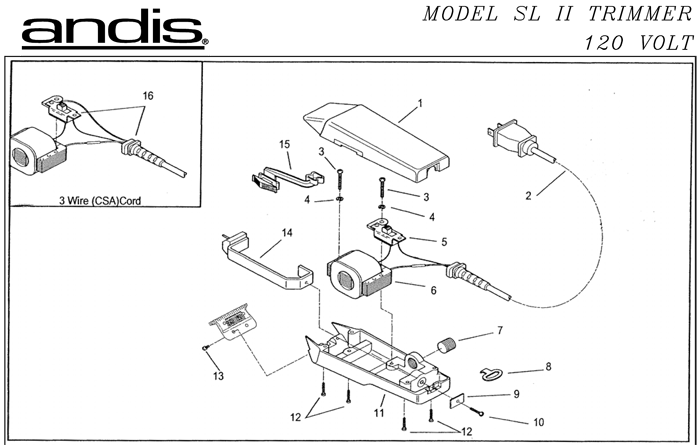
That lifetime perspective is really on point. I recently bought some used barber supplies from a guy who's mom is in the styling business. There's been a shift for them to go cordless/battery powered for convenience and I wound up buying some trimmers and clippers from him for a fraction of the cost. The lifetime these tools were designed at far exceeds the lifetime of my usage with my family and stuff; they'll go the distance for sure. I've since come to learn that this little market does appear to have pretty serviceable parts as you can see with a lot of exploded diagrams they put out https://www.proproductsandmore.com/images/andis_sl2_trimmer.... I'm trying to remember what the lifetime quote to me was, something like these clippers were meant to cut 20 heads a day, day after day for some number of years. I realized at the rate I was going they'd be heirlooms to pass on to my son and stuff.

Re: They Used To Last 50 Years

#803
post #788
post #783

Earlier quoted context omitted.

> If enough consumers do this the market for junk should fail I think over the long run we've seen evidence for the opposite due to consolidation. Markets aren't perfect; so I am highly skeptical of such a claim. it almost seems like the more the market matters to society, the less choice consumers actually have. I am more interested in trends over time than point-evaluations of dynamics at a specific moments.

I think in some markets it has worked great. My cheap car, a Hyundai Elantra is at just about 100,000 and I have not had to replace any major components. Back in the 80s and 90s Ford and Chevy were making real junk that wouldn't last long, and people that wanted better and started buying Toyota, Honda and Hyundai. If my Elantra is anything like my aunt's it will last until I wreck it. Hers was wrecked when another dr…

Sure some markets like autos are like as you say. Many others, much less so.

Re: They Used To Last 50 Years

#804

Earlier quoted context omitted.

How do you propose you get in-traffic updates without some sort of data feed? You can't turn it off in any apps? Also, does your in-built navigation have this feature?

I think we really are talking at cross purposes. Yes, my in-built navigation system requires me to tether my phone to receive traffic updates. No tethering, no traffic updates or traffic camera alerts. I don't have an alternative solution and understand a data connection is required for this functionality to work. My point was that already I lose this service if I travel out of my own country and turn the data connec…

What other services would require no data if it were integrated into your car but would require data if it were integrated into your phone?

Re: They Used To Last 50 Years

#805
post #206

Earlier quoted context omitted.

That's what I do. I bought the "dumbest" TV I could find; I just want a display with speakers and HDMI inputs. Give me something I can plug the latest smart streaming box into and change that box as needed.

I think it should be that way with cars. Just include a screen and some buttons, then let people connect their smart phones.

On a similar note, I've always wondered why when MP3 players started to become popular in the late 90s and early 2000s but cars were still stuck in the tape/CD stage, no car offered a stripped down entertainment system with just speakers, amplifier, and a 3.5mm jack.

Re: They Used To Last 50 Years

#806
post #430

Earlier quoted context omitted.

I've had many cars with electric windows. They all eventually failed, usually when it was raining, and the windows could not be raised. Fixing them would cost over $500. My truck now has hand cranked windows, and mechanical door locks. They're no trouble at all, and I'm happy with them.

I live in Europe, and my feelings About us cars is the same as the story about washing machines: somewhere in the '80 the quality got from superb to rubish. Where Honda cars of the nineties stil drive around, american cars dont. You see the old american cars of the sixties and seventies, but then you get a gap to only those almost new.

It's not that older American cars are more reliable, but that they have enough charm for people to maintain them and a healthy aftermarket to support them. '80s and '90s American cars, on the other hand, were with a few exceptions ugly as shit.

Re: They Used To Last 50 Years

#807

Earlier quoted context omitted.

Heaven forbid said company should use that quality to build their brand reputation, charge more to funnel back into R&D to create another product to fulfill a different consumer need, grow, get more profitable, and continue the virtuous cycle. That'd be, like, justifying capitalism or something.

This should be the default state of every appliance, just because it should outcompete every other player. (Who would buy something that breaks?) It isn't. So, there's something very flawed on my reasoning above. Do people want stuff that breaks, is the problem a market for lemons? Or what else?

> Do people want stuff that breaks

No, people want the thing that is the cheapest to buy, not the thing with the lowest total lifetime cost.

Re: They Used To Last 50 Years

#808

Earlier quoted context omitted.

"That is partially true, of course. Energy saving makes devices more complex, thus they have more things that can be broken. However, it is also clear that e.g. control electronics is simply not made to last. E.g. they use the cheapest of electrolytic capacitors, which will leak and break in 5-10 years. Using proper ones might cost 1-2 cents more per device. This also means that old dead TVs and stuff may often be re…

The problem with modern vechicles is that automatic transmission--still. At around 135,000 those sensors, those plates, that OD unit just start to wear out. ... but when it's the Over Drive unit, or the transmission needs a rebuild ... I don't think OD units are a thing on modern cars anymore. That higher top gear is just going to be another gear inside the transmission. Indeed, on FWD cars with a transaxle, there's…

Yes. I was very confused when I got a rental car in the U.S. in about 2004 and it had a separate switch and yellow indicator light for "OD". In Europe such a thing was so ancient history that I'd never seen one and I had to read the car's handbook to understand what it meant.

Re: They Used To Last 50 Years

#809

Earlier quoted context omitted.

In Europe you will find nowhere toploader. We know they are poor engineering: Bad water and electricity efficiency combined with more stress and wear out for the fabrics during washing. Only plus side I can see is that it is faster... but wasting so much resources does not justifies it IMHO.

This is not true. Modern top loaders, such as Samsung High Efficiency top loaders don't waste water like the old mechanical top loaders. They weigh the clothing, adjusting the water levels accordingly. They also don't have agitators, and wear fabrics less than the spinning action of a rotating drum. For a 2nd story laundry, they are a no-brainer, because the spin cycle (which is much faster than an old-school top loa…

They also have ridiculously long cycles. No thanks, I'll take the front loader and 22 minute cycles.

Re: They Used To Last 50 Years

#810
post #773

Earlier quoted context omitted.

This is so I don't see why people ignore. I bet you can go buy high end appliances that will last 50 years. But would anyone want to be using it in 50 years?

> But would anyone want to be using it in 50 years? I would happily use a washing machine, dishwasher or fridge that is 50 years old. The only tech advances related to those gadgets that would concern me are CFCs in the refrigerant.

Newer fridges have drastically better energy efficiency. It literally takes less resources to make and throw away 5 fridges over these 50 years than to produce the electricity that this old monster wastes uselessly over the same time.
Post reply on HN