I think the version in this link may be an old one. In the version on Github (https://github.com/mairin/selinux-coloring-book/blob/4ac589b...), I see at least one typo that's fixed and I believe there are other differences as well.
The SELinux coloring book [pdf]
51–57 of 57 posts
Re: The SELinux coloring book [pdf]
#52This trend of using illustration to explain complex topics is really wonderful. I know that people may criticize it as childish, but I find it helpful and enlightening. The illustrations that I've found most amazing and well done are created by people like: Lin Clark ( https://code-cartoons.com/ ) Julia Evans ( http://jvns.ca/zines/ ) Linda Liukas ( http://www.helloruby.com/ ) Amy Wibowo ( https://shop.bubblesort.io/…
>I personally believe that women have a better sense for simplifying complex ideas SELinux is not a "complex idea", SELinux is a tool with subpar documentation. A coloring book does nothing to fix that.
Comments like this, while factually correct, are the reason why we need these books.
Re: The SELinux coloring book [pdf]
#53Just curious, anyone here not working on government systems ever enabled MLS mode and used it successfully?
Yes, mostly just to learn more about it.
Finally managed to get it working and get all my sensitivities and categories set up the way I wanted them. Wasn't fun at all.
Before I started I had this idea I was going to use it all the time for all my data. That didn't last long.
Re: The SELinux coloring book [pdf]
#54The problem with SELinux is not really in the beginner documentation, but in the documentation of the policy macro packages eg. in Fedora -- which are what you in the end should/need to use for actually writing or modifying policies.
Answers to questions on eg. finding the difference between "userdom_user_application_domain" and "application_domain", or learning that "~/.local/share" has the symbolic name "data_home_t" are very difficult to find. Everything in SElinux has a symbolic name, so there's also at least one more layer of indirection as compared to apparmor.
Re: The SELinux coloring book [pdf]
#55From @lattera on Twitter:
here's a couple lost pages found by the grsecurity folks:
https://grsecurity.net/~spender/pics/lost_selinux_coloring_b...
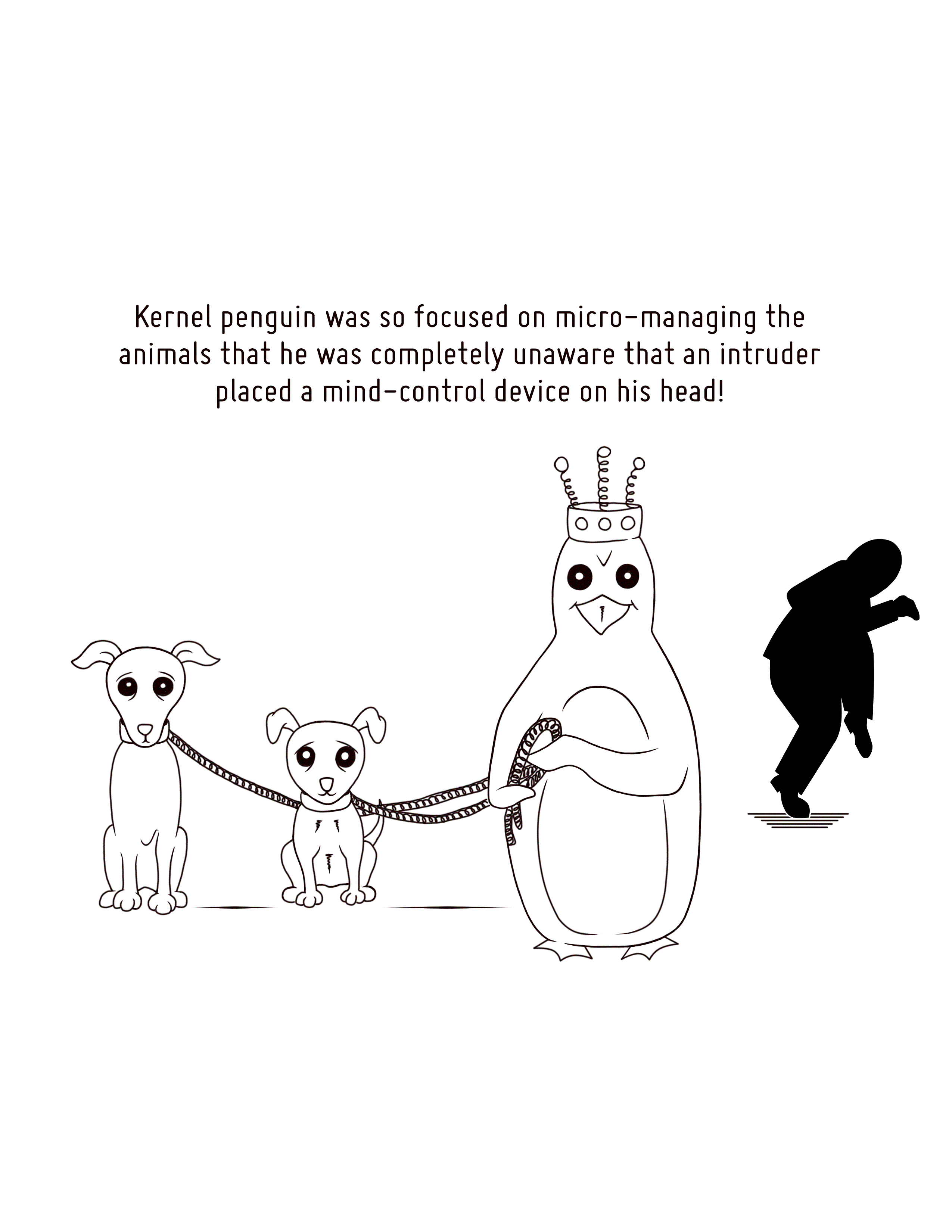
https://grsecurity.net/~spender/pics/lost_selinux_coloring_b...

:)
Re: The SELinux coloring book [pdf]
#56I don't necessarily think that the illustrations are what makes this great. They're cute, but the simple and explicit examples with uncontrived situations are what really makes this worthwhile.
It may be that getting into "writing for a coloring book" mode makes people think simpler and "cuter," which lends itself well to quick illustration of complex ideas.
I'd like to see more of this kind of explanation in guides and manuals in general, with the "normal" manuals being for reference when people need to drill down into something specific.
Re: The SELinux coloring book [pdf]
#57This trend of using illustration to explain complex topics is really wonderful. I know that people may criticize it as childish, but I find it helpful and enlightening. The illustrations that I've found most amazing and well done are created by people like: Lin Clark ( https://code-cartoons.com/ ) Julia Evans ( http://jvns.ca/zines/ ) Linda Liukas ( http://www.helloruby.com/ ) Amy Wibowo ( https://shop.bubblesort.io/…
When Google Chrome first came out in 2008, they used a series of cartoons to explain their innovations (multi-process browsing, JIT compilation for JS, etc).