Intel can't beat the heat.
10GHz at under 1V by 2005 - The future of Intel’s manufacturing processes [2000]
81–90 of 180 posts
Re: 10GHz at under 1V by 2005 - The future of Intel’s manufacturing processes [2000]
#82Earlier quoted context omitted.
Example 1, if we're referring to the likes of Siri and Alexa isn't thanks to improvements in personal computer technology - said platforms send your speech recording off to a massive datacenter for processing, no need for 10Ghz processors there. Example 2 requires the use of depth-sensing and heat-sensitive cameras to avoid trivial "show a photo of an authorized user" attacks - that's not really CPU-dependent either.
Not sure if Siri and Alexa (and Google Now) send every recording to a data center - the .NET speech recognition libraries ship with Windows, so all audio data stays local to your PC, afaik. I'd expect Cortana leverages these libraries as well, instead of sending all data to a remote server. You can build basic functionality into a speech bot in Powershell ("PowerShiri, what time is it?" "PowerShiri, what is the weath…
Cortana sends it off to a server like everyone else. Those libraries are probably not Microsoft's latest and greatest.
Modern speech models are quite big, not so big that you couldn't load it on your desktop, but big enough that you would notice. Couple that wih the fact that search/or a service is going to happen on a server anyways, client side processing doesn't make sense beyond a few functions.
Re: 10GHz at under 1V by 2005 - The future of Intel’s manufacturing processes [2000]
#83Earlier quoted context omitted.
Is this really the experience of voice recognition people have? I can't get Siri to reliably create appointments... takes about 3 tries for the voice recognition to work correctly.
Definitely. Google Home picks up everything perfectly on the level that I'm really surprised the few times it actually fails.
With Amazo nEcho this was exactly my experience for the first week. Since then, I've learned where it fails and are
becoming more annoyed by it. The clear difference between current voice recognition and a real person is that they don't adapt to the way you talk. They don't learn if they misunderstood you once.
As an example, if I ask Alexa to play a certain kind of music and she plays the wrong one, I'll have to specify it further to get the correct music. Next time I'd expect her to get the clue, but she'll make the same mistake again.
Even though the most annoying thing is that chain commands don't really work with any assistant. I'd expect to give 4-5 commands at once and get them executed. Activating it for each command is very annoying.
Re: 10GHz at under 1V by 2005 - The future of Intel’s manufacturing processes [2000]
#84It is about having vision really. Appreciate their vision from back then, and embrace what they have achieved so far
Re: 10GHz at under 1V by 2005 - The future of Intel’s manufacturing processes [2000]
#85Earlier quoted context omitted.
The functionality existed on desktop computers at the time, so it's not really a prediction.
I certainly don't remember anything of usable quality being available to end-users. My Windows 98 machine could barely play 360p videos and didn't even have a camera. The voice recognition that I do remember trying was of very low accuracy. Do you remember any specifics of where & how exactly these features were available?
Dragon Dictate worked pretty well in 2001 from what I recall, if you were willing to train it.
Re: 10GHz at under 1V by 2005 - The future of Intel’s manufacturing processes [2000]
#86Article says: Obviously this 8 – 10GHz clock range would be based on Intel’s 0.07-micron process that is forecasted to debut in 2005. These processors will run at less than 1 volt, 0.85v being the current estimate. Intel introduced a 65 nm (0.065 micron) process in 2006. The "Cedar Mill" Pentium 4 processor ran at 3.6 GHz at a whopping 1.3V although a small double-pumped part of the processor ran at 7.2 GHz. It could…
Yes, more about the end of Dennard scaling: https://en.wikipedia.org/wiki/Dennard_scaling#Breakdown_of_D...
Re: 10GHz at under 1V by 2005 - The future of Intel’s manufacturing processes [2000]
#87Anecdotally, I've heard that Everquest 2 (released 2004) is still impossible to run at 60FPS with all graphical settings maxed; the devs attempted to future-proof it with speculative high-end graphics options, but they optimized for high-GHz processors which never arrived.
No single GPU could run Crysis (2007) at 1080p / 60fps until last year!
Re: 10GHz at under 1V by 2005 - The future of Intel’s manufacturing processes [2000]
#88So, what was the reason CPUs could not scale vertically (higher frequency)? Temperature? Stability?
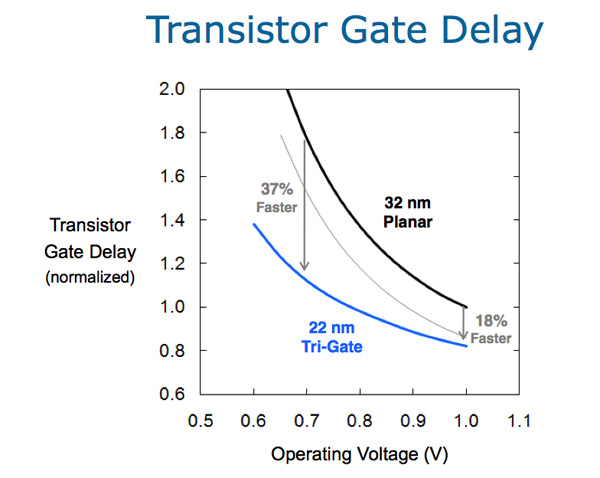
Each switch of a gate causes energy to be expended. When a transistor switches, there is some current flowing and some voltage across the source and sink. That voltage * current is greater than zero, and therefore requires power. This is opposed to the stable non-switching state where there is no current and therefore no power. So, because each switch consumes the same amount of power, the power consumed is directly…
it's even worse - transistors require more voltage to reliably switch at higher frequencies, e.g. http://images.anandtech.com/reviews/cpu/intel/22nm/powersm.j...
Re: 10GHz at under 1V by 2005 - The future of Intel’s manufacturing processes [2000]
#89It's interesting that while we aren't at 10 GHz quite yet, the functionality that was mentioned in the article [1][2] is here and works even on budget smartphones. -- [1] Imagine being able to speak normally with your computer as you would a secretary sitting next to you and have your computer accurately and quickly take notes from your speech. [2] Imagine logging onto your computer not via a user name and a password…
Example 1, if we're referring to the likes of Siri and Alexa isn't thanks to improvements in personal computer technology - said platforms send your speech recording off to a massive datacenter for processing, no need for 10Ghz processors there. Example 2 requires the use of depth-sensing and heat-sensitive cameras to avoid trivial "show a photo of an authorized user" attacks - that's not really CPU-dependent either.
Siri sends data to the cloud for processing what you're asking for, but the actual speech-to-text can work locally these days. Try it - out your iPhone in airplane mode and fire up dictation - works like a charm.
Re: 10GHz at under 1V by 2005 - The future of Intel’s manufacturing processes [2000]
#90So, what was the reason CPUs could not scale vertically (higher frequency)? Temperature? Stability?
There is also another fundamental limit, the speed of light. Because of the special relativity theory nothing including electrical current can transmit information faster than the speed of light (c = 3*10^10 cm/s). So if maximum size dimension of your CPU is say 2cm (I'm ignoring that they actually can have multiple smaller cores), then the maximum physically achievable frequency is upper bounded by size/c = 15 GHz.…
Thank you for your synaptic sugar this morning. It saved an incredibly boring meeting during a long track implementation project.