Read Complex Worlds from Simpler Nervous Systems [1] if you want more information on how very complex behavior can emerge from jumping spiders and bees. After reading that book, it seemed to me that AI researchers should focus much more time on duplicating the feats of these simpler animals (in similarly computationally limited contexts) rather than focusing on duplicating extremely high level human faculties like re…
How insects like bumblebees do so much with tiny brains
111–120 of 143 posts
Re: How insects like bumblebees do so much with tiny brains
#112Earlier quoted context omitted.
Doesn't that imply that people who live in hotter climates have...how can I put this politely?...a disadvantage when it comes to the stability of their brains? I would assume that the brain has a certain amount of redundancy, but has this ever been researched: How hot can it get before people start getting noticeably "stupider"?
Our bodies can cool themselves decently well by sweating. I think that if the climate was affecting you to the point where your brain was getting cooked, the symptom would probably be less "slightly dumber" and more "seizures and organ failure". But I'm not a doctor or a scientist, so I could be completely wrong. Hopefully someone more informed will weigh in.
Re: How insects like bumblebees do so much with tiny brains
#113None of this is "clever" -- it's some amazing mechanisms they've selected into, but it's not figuring things out, using logic, or using tools. It's much more akin to a simple learning network playing super mario brothers and dying frequently until it eventually succeeds. It shouldn't surprise us that it only takes a few hundred thousand neurons to do (including a tiny, low-res, colorless visual cortex and olfactory system that maintain a tiny, low-res representation of their surroundings).
I'm not dismissing the wonders of nature, just trying to add some detail to a write-up that glosses over _how_ these things are working.
Re: How insects like bumblebees do so much with tiny brains
#114Earlier quoted context omitted.
What, it's a trilogy? Has Watts confirmed a third novel? Last I saw, was what looked like a video game based on Blindsight.
He mentioned it in a blog post sometime ago [0]. No news on it's status, alas. [0] http://www.rifters.com/crawl/?p=5438
I'm now more excited for this than winds of winter, wow.
Re: How insects like bumblebees do so much with tiny brains
#115Earlier quoted context omitted.
Maybe something along the lines of "our brains would overheat" - there's a small temperature window in which proteins won't denature, it takes k T log 2 joules to erase one bit of information (Landauer's principle), and our brain uses around 20 Watts of power. Maybe tin foil hats make good heatsinks.. Interestingly enough there is some evidence that the Gibbs free energy of ketone metabolism is more thermodynamically…
Doesn't that imply that people who live in hotter climates have...how can I put this politely?...a disadvantage when it comes to the stability of their brains? I would assume that the brain has a certain amount of redundancy, but has this ever been researched: How hot can it get before people start getting noticeably "stupider"?
If you get hotter than your behavioural adaptations (shade seeking, splashing yourself with water, turning on the air conditioner) plus your own inbuilt capabilities (vasodilation, sweating) can handle, then you pretty much overheat and die.
Re: How insects like bumblebees do so much with tiny brains
#116Earlier quoted context omitted.
If I had to guess: neural networks have to operate on pixel data whereas real neurons don't. Brains and eyes have evolved in tandem. Perhaps what makes them so efficient is that the eyes handle some of the processing as a consequence of their physical shape and characteristics. Look at the eyes of bees. Very different from our own (and from the cameras we build) and perhaps very specialized to the limited set of task…
The neurons in the eyes pre-process a huge amount of information converting data from about 126M rods and cones to 1M ganglion cells - a pretty amazing amount of data compression. Ref: https://www.amazon.com/Visual-Thinking-Kaufmann-Interactive-...
Re: How insects like bumblebees do so much with tiny brains
#117Earlier quoted context omitted.
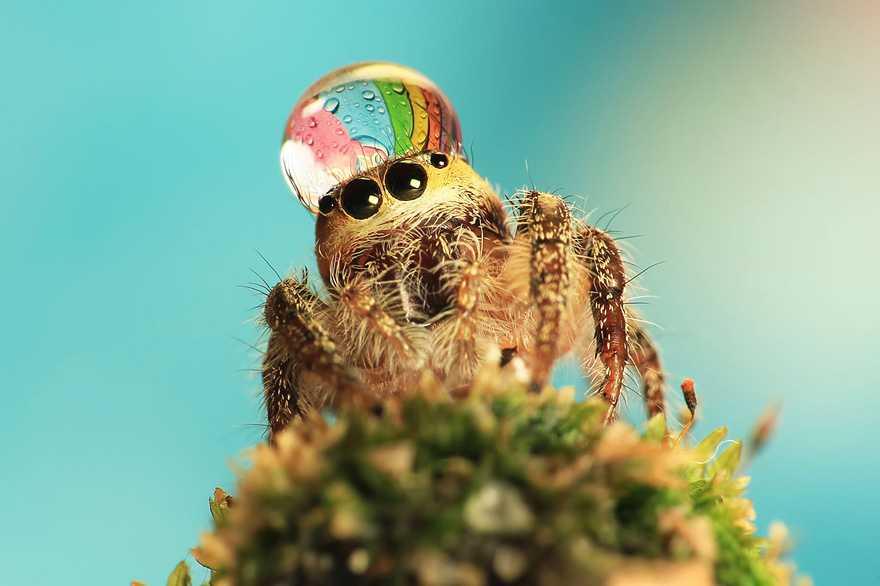
For people who don't believe that spiders can be cute: https://adlayasanimals.files.wordpress.com/2015/01/u2byv.jpg Also, I got interested and tried to find some documentation on Portia Labiata after reading Watts' book, and there's very, very little, but what he says appears to be true. They do have telescopic eyes with vibrating retinas. They do spend ages painstakingly scanning a scene before moving. They are absu…
If you're afraid of spiders, I would suggest not clicking on that link. I was hoping for cute, but that is just a very large closeup of a spider, and it definitely just hit the fear instinct.
http://static.boredpanda.com/blog/wp-content/uuuploads/jumpi...
Re: How insects like bumblebees do so much with tiny brains
#118Highly relevant is the Portia genus of spiders ([0], [1]) and apparently other related jumping spiders ([2]). One of my favorite excerpts from [1]: > Harland says Portia’s eyesight is the place to start. Jumping spiders already have excellent vision and Portia’s is ten times as good, making it sharper than most mammals. However being so small, there is a trade-off in that Portia can only focus its eyes on a tiny spot…
Re: How insects like bumblebees do so much with tiny brains
#119Earlier quoted context omitted.
If you're afraid of spiders, I would suggest not clicking on that link. I was hoping for cute, but that is just a very large closeup of a spider, and it definitely just hit the fear instinct.
Palate cleanser (warning pic of a spider) http://static.boredpanda.com/blog/wp-content/uuuploads/jumpi...
https://s-media-cache-ak0.pinimg.com/originals/ef/ca/4d/efca...
Re: How insects like bumblebees do so much with tiny brains
#120Earlier quoted context omitted.
For people who don't believe that spiders can be cute: https://adlayasanimals.files.wordpress.com/2015/01/u2byv.jpg Also, I got interested and tried to find some documentation on Portia Labiata after reading Watts' book, and there's very, very little, but what he says appears to be true. They do have telescopic eyes with vibrating retinas. They do spend ages painstakingly scanning a scene before moving. They are absu…
If you're afraid of spiders, I would suggest not clicking on that link. I was hoping for cute, but that is just a very large closeup of a spider, and it definitely just hit the fear instinct.