Live data from Hacker News

China has built the world’s largest bullet-train network

economist.com

31–40 of 251 posts

Re: China has built the world’s largest bullet-train network

#31
post #20

Earlier quoted context omitted.

That's a valid point. And there is always a tendency to see the good points in other countries and the bad points in your own. In this case (and also in e.g. building new power stations, new housing, widening roads, expanding London's airports, etc) the contrast is so stark. For sure the UK needn't abandon rule of law in order to build infrastructure in a timely manner.

Yes you do. If the rail goes across any freehold, you'll have to negotiate and compensate for the owners loses. This process takes years if not decades. The only reason China is able to build so quickly is because the government tramples on people rights (does private ownership of real estate exist in China?) like there's no tomorrow. I attended a seminar in UCL a few months ago where the panelist shared the number o…

>Yes you do. If the rail goes across any freehold, you'll have to negotiate and compensate for the owners loses. This process takes years if not decades. The only reason China is able to build so quickly is because the government tramples on people rights

Actually the Chinese government builds a lot of the high speed rail tracks on elevated tracks in order to avoid interfering with the owner. Which is why most of it looks likes this:

http://www.people.com.cn/mediafile/pic/GQ/20160229/56/325223...
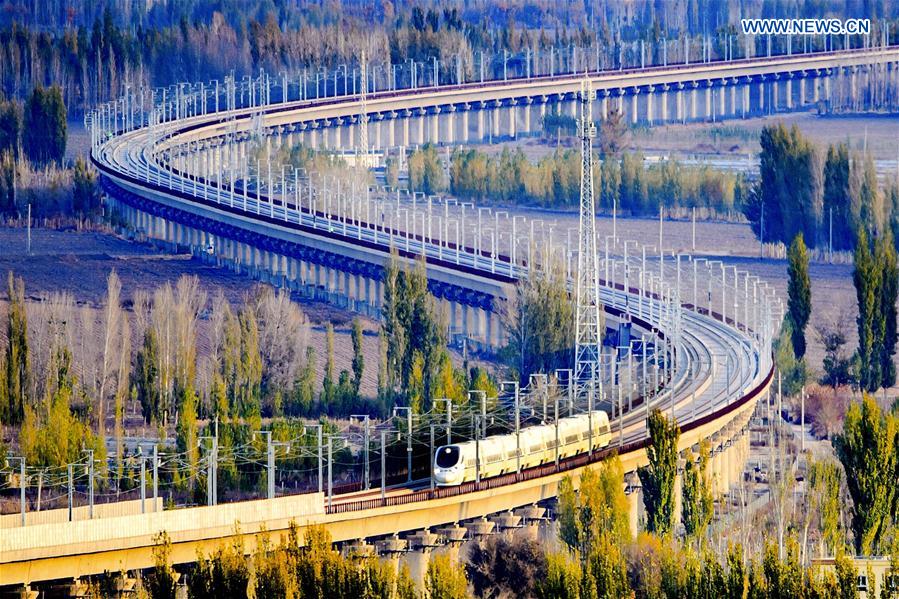
If you have, say, farmland beneath a track you are virtually unaffected after that section of the track is completed.

They also build a lot of the stations on the outskirts of cities for the same reason (and then connect it up to the center with a metro).

Re: China has built the world’s largest bullet-train network

#32
post #8

"Less than a decade ago China had yet to connect any of its cities by bullet train. Today, it has 20,000km (12,500 miles) of high-speed rail lines, more than the rest of the world combined. It is planning to lay another 15,000km by 2025" The contrast to the UK, where we might someday build the HS2 line London-Birmingham-Manchester, is massive. I am left with a feeling of awe at China's development, and frustration at…

> I am left with a feeling of awe at China's development, and frustration at the UK's stagnancy. While the UK does feel particularly stagnated on several fronts, I'm not sure abandoning the rule of law, protection of private property, labour protections, at least an attempt at the appearance of corruption-free tenders, high safety standards and the principle that people who are affected should be consulted is worthy…

That's exactly the reason; people own land, buildings are protected, etc. China has less of this problem (benefits of an oppressive or at least assertive regime that puts economic progress first).

I'd compare what China is doing with the high speed trains now with what the US did with the regular train tracks. Look at what it did to the US in terms of economy, and the cost for the native people and nature.

Re: China has built the world’s largest bullet-train network

#33
post #20

Earlier quoted context omitted.

Yes you do. If the rail goes across any freehold, you'll have to negotiate and compensate for the owners loses. This process takes years if not decades. The only reason China is able to build so quickly is because the government tramples on people rights (does private ownership of real estate exist in China?) like there's no tomorrow. I attended a seminar in UCL a few months ago where the panelist shared the number o…

Isn't it possible to have something in between those two extremes? The opposite of showing up one morning unannounced with a bulldozer to take land uncompensated doesn't have to be an eminent-domain and planning-approvals process that is so bureaucratic and slow that it takes decades to complete. The U.S. has some of this problem as well, though more in its environmental legislation. Having environmental legislation…

I'd argue that the main problem with US environmental law is that it isn't handled by a beaurocracy in a straightforward way but rather by giving pretty much everybody the right to sue to stop a project on environmental grounds. If the St. Louis only had to jump through the EPA and FRA's hoops then the whole thing would be much, much simpler and easier.

Re: China has built the world’s largest bullet-train network

#34
post #8

"Less than a decade ago China had yet to connect any of its cities by bullet train. Today, it has 20,000km (12,500 miles) of high-speed rail lines, more than the rest of the world combined. It is planning to lay another 15,000km by 2025" The contrast to the UK, where we might someday build the HS2 line London-Birmingham-Manchester, is massive. I am left with a feeling of awe at China's development, and frustration at…

> I am left with a feeling of awe at China's development, and frustration at the UK's stagnancy. While the UK does feel particularly stagnated on several fronts, I'm not sure abandoning the rule of law, protection of private property, labour protections, at least an attempt at the appearance of corruption-free tenders, high safety standards and the principle that people who are affected should be consulted is worthy…

As someone who works in the planning and urban design field the real issues are private property and heritage. China doesnt care about either. The UK cares too much. The answer is of course somewhere in the middle. Lets not forget most of the UKs existing infrastructure (including railways, roads, canals) was built on private property and through heritage items too, just in a different environment where this was easier to do.

Where there is clear wider community benefit, IMO consultation should be relatively narrow ('we will build this but if small changes can provide major benefit please make sure we know about them and we should be held to account in planning for them') however compensation should be generous. Few heritage items should be sacrosanct however not many will be affected and losses in heritage should be compensated by greater heritage contributions elsewhere (eg money for conserving heritage items on the at risk register). It really shouldnt have to be so controversial if the right systems are in place. We have to plan for the future and this should not be questionable...

Rule of law, labour practices and corruption-free practices arent incompatible with these projects.

Re: China has built the world’s largest bullet-train network

#36

Earlier quoted context omitted.

China is huge, though, and the UK is not. HS2 is dragging in the UK because it's a massive amount of money to spend in order to shave 45m off a trip to Scotland. The cost/benefit ratio is totally different - and with the Hitachi training they're bringing in, the saving goes further down. HS2 is a large waste of money.

Rail is typically never profitable unless the increase in land value around stations is captured. In the UK they typically leave those spoils to private land owners. Japanese rail companies manage this: they run the trains at cost - or even a loss - and make profits back from (for example), building malls around the stations and leasing space to retailers. The UK could really use high speed rail around the London com…

   Rail is typically never profitable 
   unless the increase in land value 
   around stations is captured.
This is really interesting. Have you got a pointer for me where I can read more on the economics of railways along those lines?

I wonder if the same is also true with public transport in cities, in particular rail-based underground system like London's tube.

Re: China has built the world’s largest bullet-train network

#37
post #20

Earlier quoted context omitted.

Yes you do. If the rail goes across any freehold, you'll have to negotiate and compensate for the owners loses. This process takes years if not decades. The only reason China is able to build so quickly is because the government tramples on people rights (does private ownership of real estate exist in China?) like there's no tomorrow. I attended a seminar in UCL a few months ago where the panelist shared the number o…

>Yes you do. If the rail goes across any freehold, you'll have to negotiate and compensate for the owners loses. This process takes years if not decades. The only reason China is able to build so quickly is because the government tramples on people rights Actually the Chinese government builds a lot of the high speed rail tracks on elevated tracks in order to avoid interfering with the owner. Which is why most of it…

Perhaps a better photo to make your point: http://en.people.cn/n3/2016/0229/c90000-9022441-11.html

So it does seem like they're using tracks elevated by concrete pillars pretty widely, but are you sure your image shows a high-speed rail track? To my untrained eye that seems like a really aggressive curve radius for a high speed rail track. See also:

https://en.wikipedia.org/wiki/Minimum_railway_curve_radius#L...

Re: China has built the world’s largest bullet-train network

#38
post #20

Earlier quoted context omitted.

Yes you do. If the rail goes across any freehold, you'll have to negotiate and compensate for the owners loses. This process takes years if not decades. The only reason China is able to build so quickly is because the government tramples on people rights (does private ownership of real estate exist in China?) like there's no tomorrow. I attended a seminar in UCL a few months ago where the panelist shared the number o…

>Yes you do. If the rail goes across any freehold, you'll have to negotiate and compensate for the owners loses. This process takes years if not decades. The only reason China is able to build so quickly is because the government tramples on people rights Actually the Chinese government builds a lot of the high speed rail tracks on elevated tracks in order to avoid interfering with the owner. Which is why most of it…

That's true. I've seen them all over north western China. although I know what the true purpose of them are. The pillar look pretty dense to me, so I'm not what to think about "avoid interfering". I suspect they are used to keep the rails level since the network goes thru a pretty wide range of elevation.

Re: China has built the world’s largest bullet-train network

#39
post #8

Earlier quoted context omitted.

> I am left with a feeling of awe at China's development, and frustration at the UK's stagnancy. While the UK does feel particularly stagnated on several fronts, I'm not sure abandoning the rule of law, protection of private property, labour protections, at least an attempt at the appearance of corruption-free tenders, high safety standards and the principle that people who are affected should be consulted is worthy…

As someone who works in the planning and urban design field the real issues are private property and heritage. China doesnt care about either. The UK cares too much. The answer is of course somewhere in the middle. Lets not forget most of the UKs existing infrastructure (including railways, roads, canals) was built on private property and through heritage items too, just in a different environment where this was easi…

I'm always amazed when I see more detail about the UK's canals. They are individually quite small (e.g. when you go for a walk) but the national network is huge. One day when I can take a sabbatical, I'm going to try and navigate from one end of the country to the other on them.

Re: China has built the world’s largest bullet-train network

#40
post #30
post #5

Earlier quoted context omitted.

Forget high speed rail. It would be great if the trains weren't 30+ years old. On the lines I most often use the carriages don't have automatic doors. I'm constantly embarrassed when I have to show visitors how to open the window, stick their hand out and use the handle on the outside to open the door (which is how it's done).

Yes, I've always thought it was completely ridiculous. What's the 'justification' for it ?

Guess: when originally built those carriages didn't have door locking. It was felt it would be unsafe to have a handle on the inside that could be accidentally opened while the train was moving at high speed. So the handle is on the outside so that it takes a very deliberate effort to open the door (and hopefully people know better than to reach out of a window at high speed).
Post reply on HN