Earlier quoted context omitted.
What would you suggest for the case of someone wanting payment for the connection? Like it or not, a lot of places do that.
Honestly? It's 2017. Just throttle bandwidth and give your internet away for free. There are some obvious cases in which this is unacceptable, but they are few and far between. The overwhelming majority of captive portals I see are just trying to get your contact info... so now you have two reasons why they should disappear.
NeverSSL
121–130 of 212 posts
Re: NeverSSL
#122Earlier quoted context omitted.
What would you suggest for the case of someone wanting payment for the connection? Like it or not, a lot of places do that.
Honestly? It's 2017. Just throttle bandwidth and give your internet away for free. There are some obvious cases in which this is unacceptable, but they are few and far between. The overwhelming majority of captive portals I see are just trying to get your contact info... so now you have two reasons why they should disappear.
Re: NeverSSL
#123Re: NeverSSL
#124Can some ELI5 (explain like I'm 5) to me? I don't get this. Seems like something I should know about.
Re: NeverSSL
#125Re: NeverSSL
#126Earlier quoted context omitted.
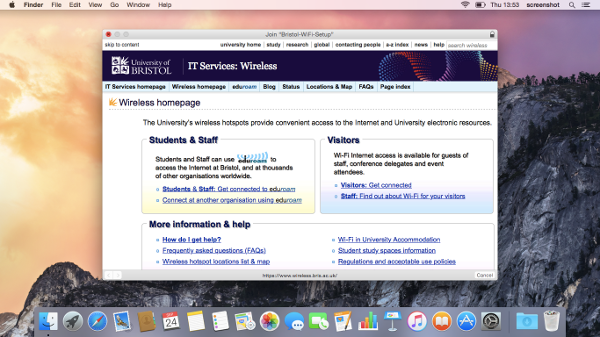
The captive portal browser (pop-up on macOS, slide-over on iOS) doesn't support full JavaScript or cookies (or previously didn't, maybe that has changed), so some captive portals specifically allow the captive portal test domains through. There's actually a huge list of domains that macOS/iOS try: http://stackoverflow.com/questions/18891706/ios7-and-captive...
> The captive portal browser (pop-up on macOS, slide-over on iOS) I have never seen a captive portal interceptor on MacOS (much to my disappointment), only iOS. Is there some setting I previously screwed up?
Here's a screen shot I found: https://www.wireless.bris.ac.uk/gfx/eduroam-osx/captive_port...
Re: NeverSSL
#127Not sure about Apple, but isn't this automatically handled by Android these days? Every time it connects to a network it pings http://google.com/generate_204 and if the response code isn't 204 then it should prompt you to open the browser to the redirected URL.
Re: NeverSSL
#128Earlier quoted context omitted.
How do you see this scaling? Do you think hotels and restaurants can deliver reliable internet without charging for it? Is it reasonable to assume that companies that don't charge for wifi can afford the staff to make sure that users don't abuse it? I am considering your proposal & I don't see it working at all.
I see it scaling the same way hannob's example does, with water. Who charges for a drink of water?
Re: NeverSSL
#129Earlier quoted context omitted.
My real plan with NeverSSL.com is to use the access logs to publish an up-to-date database of broken networks and what the rough popularity of each broken network is. I'm hopeful that these kinds of public analytics could lead to solutions, or at least who to start talking to.
Since this involves information capture, you should let people know on the page. Although admittedly the naive user, for whom this is intended, may be confused by that. Good idea by the way!
Re: NeverSSL
#130Earlier quoted context omitted.
There is; both Router Advertisements and DHCP include options for captive portals[1]. In the case of DHCP for example, the DHCP server can send the URI of the portal, which the OS can display to the user. The mechanism in [1] is what OS X uses, I believe. [1]: https://tools.ietf.org/html/rfc7710
I think OS X opens captive.apple.com