Live data from Hacker News

The Middle Class Can't Afford to Live in Cities Anymore

wired.com

231–240 of 363 posts

Re: The Middle Class Can't Afford to Live in Cities Anymore

#231

This article reflects my wife and my experience: just a month ago we left San Diego for a small town north of Salt Lake City. We make over six-figures and San Diego held only poor economic prospects for us. We'd have a very difficult time buying a decent home (2000 sq ft, good neighborhood, reasonable commute) for a price which wouldn't jeopardize other essentials like retirement savings, kids college savings, saving…

Just a minor nitpick. If you are buying a home, and are also fortunate enough to be able to manage "retirement savings, kids college savings, savings in general, and debt payoff and avoidance", you are likely not strictly middle class. Most people who are classified as middle class can't afford any one of those, let alone the entire set.

You don't come across as negatively "privileged", but perhaps if you can afford to send your kids to college, and plan for retirement, and have a rainy day fund to boot, you might consider yourself blessed compared to the situation many people find themselves in. I'm well enough off, but I'd give an arm to be in your position. :)

Re: The Middle Class Can't Afford to Live in Cities Anymore

#232
post #140

Earlier quoted context omitted.

It's not just housing policy that's gone wrong, it's transit policy. We haven't built good public transit in our cities, and now that cars are filling all available roads, even houses far away from cities are too expensive for how long commutes are. We wish we had a train system in many cities that allowed the middle class to live 40-60 minutes away from their jobs. Ultimately however the main problem is wealth inequ…

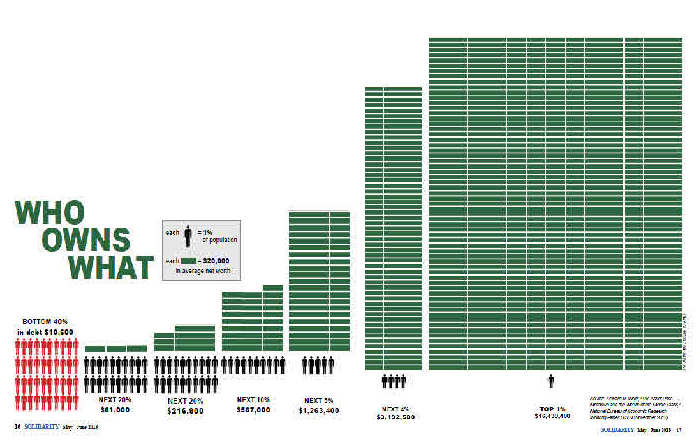
> Ultimately however the main problem is wealth inequality. If median income had increased with GDP since 1980, instead of all gains going to the 0.01%, you would be able to afford to live in the suburbs of San Diego. The problem of income inequality is one and the same as the housing crisis - ie, the wealth gap is nearly entirely explained by real estate.

Can you give a cite to any statistics or resources that suggest that real estate fully explains the wealth gap? The ultra-wealthy tend to have much higher percentage of their assets in securities than real estate. So that real estate explains the entire wealth gap sounds curious, although perhaps not impossible. I just have no idea how that could be.

Re: The Middle Class Can't Afford to Live in Cities Anymore

#233

Earlier quoted context omitted.

The fix is to make more areas desirable to live in by reducing income inequality and stimulating local economies (which in turn creates more desirable locations). Simply saying build "more houses" in clustered cities along the coasts doesn't solve anything in the long run. Cities are in it for the long run.

San Francisco is not nearly dense enough. It can support a lot more housing. Easily. It's just NIMBYs and cronies in the way. Despite having significant growth opportunity San Fran is already twice as dense as Seattle. Therefore Seattle has room for explosive housing growth. It would need more changes than just housing of course. But that's to be expected and totally doable. Cities are huge economic multipliers. We d…

>It can support a lot more housing

So long as you also build all the transportation, schooling, utility, and other infrastructure needed to support it.

Re: The Middle Class Can't Afford to Live in Cities Anymore

#234
post #215

Earlier quoted context omitted.

There you go then. You can raise a family in NYC.

I am doing just that? Apparently others are as well since school enrollment keeps growing.

So is it not sustainable for a family then?

Re: The Middle Class Can't Afford to Live in Cities Anymore

#235
post #201
post #5

Strange, I'm middle class and I live in a city. There are other cities than NYC, SF, LA and Boston.

It all depends on what exactly you mean by the word "city". A lot of the US population is in rural areas or small towns. Their idea of a city is definitely going to be very different from the idea of someone who grew up in NYC, Chicago or San Francisco. Even within those metropolitan areas, ideas may differ between those from the suburbs and those from the city proper. Personally, I think that a metro/subway system i…

[deleted]

Re: The Middle Class Can't Afford to Live in Cities Anymore

#236
post #83

Earlier quoted context omitted.

A rule of thumb (admittedly arbitrary) for housing is to keep costs below 30% of gross income. That is why I compared median housing prices against median gross income. If someone making the median income in a city can afford a median house with 21% of their gross income, yes, I deem that "affordable." To go back to my example, the family making $41k net annually is paying $10,800 (ish) annually in mortgage costs. Th…

Honest question... where does the 30% income/housing ratio come from? I always assumed it was pushed by the housing industry to "con" us into more housing than we need.

A lot of it is enforced by landlords. Go apartment hunting, and they'll all tell you they'll only lease to you if the rent on the unit is less than 1/3 your gross income.

Re: The Middle Class Can't Afford to Live in Cities Anymore

#237
post #140

This article reflects my wife and my experience: just a month ago we left San Diego for a small town north of Salt Lake City. We make over six-figures and San Diego held only poor economic prospects for us. We'd have a very difficult time buying a decent home (2000 sq ft, good neighborhood, reasonable commute) for a price which wouldn't jeopardize other essentials like retirement savings, kids college savings, saving…

It's not just housing policy that's gone wrong, it's transit policy. We haven't built good public transit in our cities, and now that cars are filling all available roads, even houses far away from cities are too expensive for how long commutes are. We wish we had a train system in many cities that allowed the middle class to live 40-60 minutes away from their jobs. Ultimately however the main problem is wealth inequ…

London, cities in Europe in general have good transport but not great housing options. London just overtook the pre war population (within a green belt set just after the war). Nearly everywhere is within a mile of a station, only one tiny spot is four miles away. It's all about affordable housing. We as a country are building half of what we need.

Re: The Middle Class Can't Afford to Live in Cities Anymore

#238
post #162

I live in SF, and am flabbergasted at the number of 1- or 2- floor single-family homes. A city the size of SF (46 sq mi) and population (850K+ and growing) simply can't afford so many SFHs. I was in Barcelona recently (yay NIPS!) and Barcelona is smaller than SF (36 sq mi) and has nearly twice the population! Everywhere you see are 6-floor buildings, with the bottom reserved for shops and people living above them. It…

> why can't SF be more like BCN? 1. Earthquakes. 2. City planning policies over the years (or lack thereof).

San Francisco really doesn't have Earthquake safe housing. It's been over 100 years (1906) since the last major earthquake (7.0+), which ended up destroying most of the city.

A large portion of the housing in San Francisco dates to that era. However, rather than learn from the mistakes made pre-1906, San Francisco just rebuilt things exactly the way they were before. Look how much damage the 1989 earthquake caused, and that was a sub 7.0 earthquake. Another major earthquake would result in similar devastation to the 1906 earthquake.

The best part is the NIMBYs who refuse to allow earthquake deathtraps to be destroyed for more modern buildings. They've become so complacent and ignorant to the reality of a major earthquake, that they feel the character of the city is more important than the lives of the people in it.

Re: The Middle Class Can't Afford to Live in Cities Anymore

#239
post #140

Earlier quoted context omitted.

It's not just housing policy that's gone wrong, it's transit policy. We haven't built good public transit in our cities, and now that cars are filling all available roads, even houses far away from cities are too expensive for how long commutes are. We wish we had a train system in many cities that allowed the middle class to live 40-60 minutes away from their jobs. Ultimately however the main problem is wealth inequ…

> Ultimately however the main problem is wealth inequality. If median income had increased with GDP since 1980, instead of all gains going to the 0.01%, you would be able to afford to live in the suburbs of San Diego. The problem of income inequality is one and the same as the housing crisis - ie, the wealth gap is nearly entirely explained by real estate.

>wealth gap is nearly entirely explained by real estate.

1) Reagan fired the air traffic controllers in 1981.

2) This set off a wave of anti-union action - http://www.alternet.org/story/154595/how_ronald_reagan_broke... - causing the great decoupling of wages and productivity: https://upload.wikimedia.org/wikipedia/commons/4/45/Producti...

3) ...which caused staggering levels of wealth inequality: http://www.bankers-anonymous.com/wp-content/uploads/2015/04/...

4) And all that accumulated wealth ended up being lent back in the form of loans (e.g. student loans), mortgages as well as bidding up the price of real estate which your grandma - a 'boomer' profited a small amount from - which is why this is actually all her fault.

Re: The Middle Class Can't Afford to Live in Cities Anymore

#240
post #233

Earlier quoted context omitted.

San Francisco is not nearly dense enough. It can support a lot more housing. Easily. It's just NIMBYs and cronies in the way. Despite having significant growth opportunity San Fran is already twice as dense as Seattle. Therefore Seattle has room for explosive housing growth. It would need more changes than just housing of course. But that's to be expected and totally doable. Cities are huge economic multipliers. We d…

>It can support a lot more housing So long as you also build all the transportation, schooling, utility, and other infrastructure needed to support it.

All the city needs to do is literally nothing. Just stand back and stay out of the way. Sadly this is one of the hardest things for a bureaucracy to do.
Post reply on HN