Live data from Hacker News

Small payments sharply diminish gap in responses to partisan factual questions

nber.org

161–170 of 173 posts

Re: Small payments sharply diminish gap in responses to partisan factual questions

#161

Earlier quoted context omitted.

Congestion tolls are great -- they encourage better utilization of a scarce resource (the road at a certain point in time).

> Congestion tolls are great -- they encourage better utilization of a scarce resource (the road at a certain point in time). Congestion tolls are the rich man's way of getting the government to build enough infrastructure for them without having to pay for enough infrastructure for everybody. If there is congestion it's either because you don't have enough roads or because you don't have good enough mass transit whi…

You've missed a third potential fault.

Congestion also happens because the market is distorted and decisions have not been made to build quality, affordable, housing near the jobs that workers have. (Which reduces the need for commuting at all.)
Re: Small payments sharply diminish gap in responses to partisan factual questions

#162
post #67

Earlier quoted context omitted.

Which seems like harmless, lightheared tribalism, sure, but there are many forms of tribalism that have quantifiable negative impact. Even for Midwest football: http://qje.oxfordjournals.org/content/early/2011/03/21/qje.q...

I meant to be subtle about this, and you raise an excellent point. Tribalism is great for the in-group members and the in-group itself, but it can be horrifying to out-group members and greater society.

The point was that suspending critical thinking to belong to a tribe has consequences when reality catches up, unless you're trying to imply that abused wives are not part of an out-group.

Re: Small payments sharply diminish gap in responses to partisan factual questions

#163
post #63

Earlier quoted context omitted.

Doesn't matter. It's a red herring because the question itself was a rate of change over time , for which the answer is given in a 1.0% range. Irregardless of whether you focus on U-5 (the reported statistic) or U-6 (the denier's statistic), it's still only about a -0.2% and +0.1% change, respectively. Even if you did the math on U-5, you would still get the answer right for every of the 6 numbers.

the denier's statistic is closer to use U-5 for a starting point then switch to U-6 as an end point.

Wherein lay the bias that they're trying to capture. Of course, for this question even that nuance isn't caught.

Re: Small payments sharply diminish gap in responses to partisan factual questions

#164

Earlier quoted context omitted.

> For any given amount of infrastructure, proper pricing makes its use more efficient (of course, minus the inefficiency of actually implementing tolls), by shifting demand towards less busy times or encouraging use of mass transit and pooling. You also have the inefficiency of destroying demand outright. Some people will just stay home. It also seems like the presence of congestion would already be diverting traffic…

I think the strongest argument against congestion pricing is the cost of infrastructure to collect it. All the other arguments apply equally well to other consumables that are normally priced, like food and energy. Consumption taxes are inherently regressive, and poor people consume more of their income than their rich, but the solution is not to simply price consumables at $0. IMO, the burden should be to show why r…

> IMO, the burden should be to show why roads are such a special good that they should always be free, regardless of externalities.

They're special because essentially the entire cost is the construction cost. If you want another loaf of bread then the farmer has to grow more wheat. It has a unit cost.

If you want to drive on the road then either the road capacity already exists or it doesn't and your choice of whether to drive doesn't change that. If you decide to stay home it doesn't save the government money. It's having the ability to drive on the road that costs money, not exercising it once the road is already there.

What congestion pricing does is suppress demand, i.e. to remove the (economic) ability of some people to drive, which can reduce the need for transportation capacity. But we don't want to suppress demand. Demand is good. People going out and participating in the community and the local economy is good. It might be better that people use mass transit than drive cars, but the way to achieve that isn't to make driving worse, it's to make mass transit better -- to stimulate demand rather than suppress it.

The apparent appeal of congestion pricing is that it nominally generates revenue, as opposed to improving or subsidizing mass transit which nominally consumes revenue. But in practice the result is the opposite because suppressing rather than stimulating demand for local transportation would mean there is less activity in the local economy.

Re: Small payments sharply diminish gap in responses to partisan factual questions

#165

Earlier quoted context omitted.

> Congestion tolls are great -- they encourage better utilization of a scarce resource (the road at a certain point in time). Congestion tolls are the rich man's way of getting the government to build enough infrastructure for them without having to pay for enough infrastructure for everybody. If there is congestion it's either because you don't have enough roads or because you don't have good enough mass transit whi…

You've missed a third potential fault. Congestion also happens because the market is distorted and decisions have not been made to build quality, affordable, housing near the jobs that workers have. (Which reduces the need for commuting at all.)

> You've missed a third potential fault.

> Congestion also happens because the market is distorted and decisions have not been made to build quality, affordable, housing near the jobs that workers have. (Which reduces the need for commuting at all.)

You are entirely correct. Building more housing near where the jobs are is an excellent alternative.

Re: Small payments sharply diminish gap in responses to partisan factual questions

#166

Earlier quoted context omitted.

C can be a problem. It's how the military industrial complex that Eisenhower warned us about is structured. "C" is what leads to things like corporate bail outs. Parenti talked about this with Conrail in the 80s. It was a train system that was put in public trust because it couldn't make money in the 70s. Then after the public made it profitable, under Reagan, it was reprivatized - not because it didn't work, but bec…

Suppose we have the government build the roads. Are they also going to manufacture their own steamrollers and mine their own gravel all the way down the stack? If so you're at Pure Communism. If not then you still have exactly the same problems to deal with when the government goes to buy those things from private industry. The thing you're really criticizing is government corruption. A corrupt government will screw…

Stepping back, it's the capital doing the corrupting. The private/public interplay creates incentives to pilfer the public coffers in exchange for campaign contributions if you stick around and a cushy job if you don't.

It is the exploitation of government that is inherently corrupt and the exploiter who is the corrupter. The commingling of such interest leads to the pursuit of private profit in the name of the public trust.

The calls for less government are constantly in the name of removing the watchdogs and observers, the enforcers and regulators - the only counterbalance to this incestuous relationship.

They call for a removal of oversight to alleviate corruption and a forfeiture of authority and action to increase responsibility.

The only perplexing thing is how so many continue to be startled and bewildered by the direct consequential policies of encouraging such statecraft.

Re: Small payments sharply diminish gap in responses to partisan factual questions

#167

Earlier quoted context omitted.

In a) and c), corruption is inescapable. It is an unavoidable consequence of centralized power, not something that can be fixed with endless (corruptible) oversight committees or particularly prescient design. It is cot an implementation bug, it is a bug in the spec. Meanwhile in b), corruption is a feature that looks like a bug. Self-interest is harnessed instead of ignored. And while b) certainly has its problems (…

I'm shocked that anyone actually disagrees with this.

Privately owned things have been around as long as private property: ~20,000 years. Greed predates that quite a bit more - let's cut it off at the rise of modern humans: ~70,000 years.

Yet the "greatest reduction in both poverty and mortality" is a relatively recent phenomena happening during the rise of publicly accountable civic institutions. [1]

To then attribute this with something that did not lead to this process in the first 69,800 or so years is, in my opinion, pretty poor logic.

----

[1] In fact, in Africa the greatest rise came after the decolonization post-ww2 and the establishment of states and representative governments. To say the predecessor extractive industries under colonialism weren't "capitalist" is also, quite incorrect.

Re: Small payments sharply diminish gap in responses to partisan factual questions

#168

Earlier quoted context omitted.

It's a pro-private, anti-democratic push by chicago school, objectivists, and other groups, to essentially slander civic institutions as terrible and "privatize" them with capital extracting robber barons. "Government" is a 4 letter word and some people are insufferable in their hatred for it - thinking that some private selfish interest of people would magically make the world ... look, it's all preposterous ... it'…

"People think differently than me cause they're brainwashed by charlatans." Don't try to give any benefit of the doubt to the people you disagree with on this. Don't try to see things from their perspective, and whatever you do, don't assume they have good intentions - you might just end up understanding someone else a little better and be forced to change your world view.

That's not it at all. AEI, Heritage, Cato, Hoover, Heartland, these are real groups putting out literature advocating these actual positions.

They receive multi-million dollar contributions from organizations whose riches were made from things like defense contracts, for-profit education and for-profit prisons.

You are advocating to what? Ignore that?

Beyond that their claims are faulty and not reflective of reality.

I used to have a facebook group where I'd take the AEI posts and dissect them. They'd do something like have two circles representing values, but the values are actually the radius of the circles ... so they are off by 3.14*r^2 in representation of the differences.

There were many other things where they would do something like float some chart so the bottom value is only 5% less than the top, and then zoom in so it covers a very small time period, and then purport it as being significant.

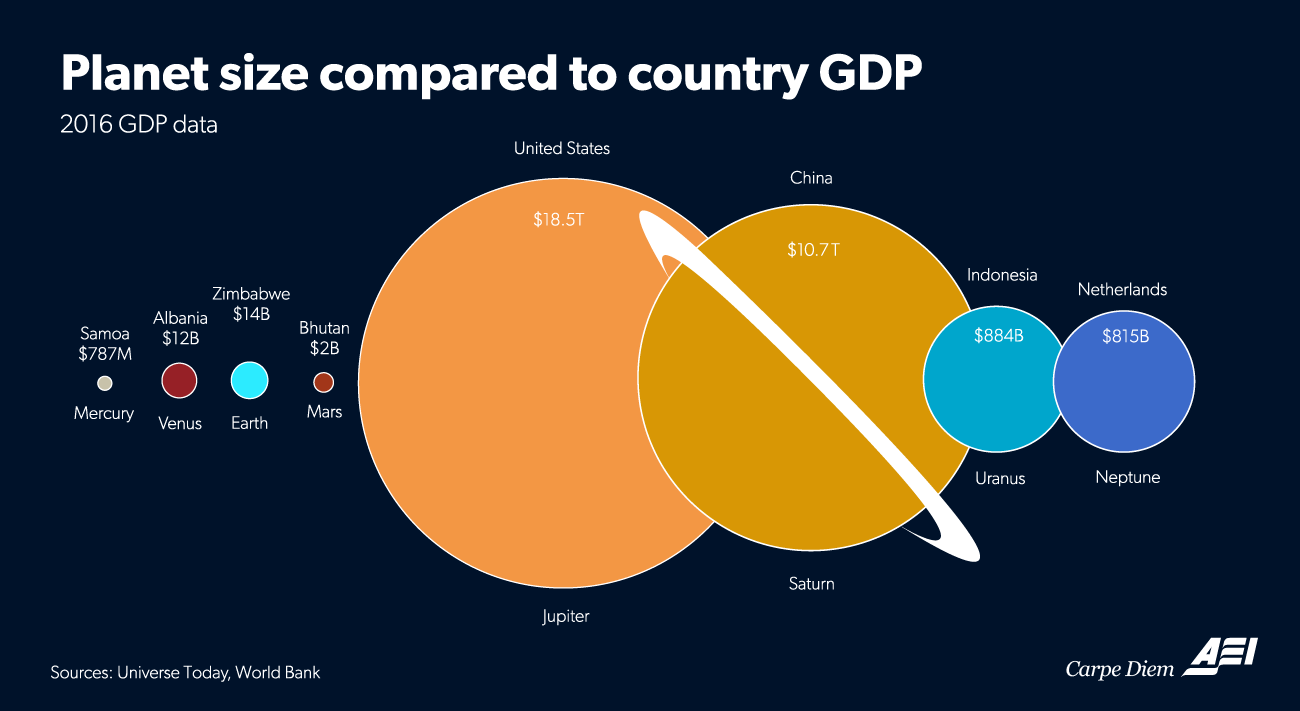
Literally every day. It was amazing. I went there right now, second post, comparing planets to GDP (http://9ol.es/planet.png) using inaccurate metrics of planet size and inaccurate calculations with relative mass along with depicting 3d objects as 2d... it's wildly inaccurate.

Re: Small payments sharply diminish gap in responses to partisan factual questions

#169

Earlier quoted context omitted.

It's a pro-private, anti-democratic push by chicago school, objectivists, and other groups, to essentially slander civic institutions as terrible and "privatize" them with capital extracting robber barons. "Government" is a 4 letter word and some people are insufferable in their hatred for it - thinking that some private selfish interest of people would magically make the world ... look, it's all preposterous ... it'…

A huge part of the problem is that people think one system is better than the other when it's really a spectrum where both extremes are absurd. Suppose you want to have some roads, how do you do it? a) Pure Communism. The state builds the roads. The state needs road workers and workers need food so the state grows food. The workers need steamrollers so the state manufactures steamrollers. The workers need asphalt so…

I think the biggest issue is everyone thinks they know what would work, when there's no single model that can capture the complexity of real life. Just as we don't even have a unified model of physics, much less is there an obvious way to run a society.

The thing in the US is that I don't hear anyone talking about what they're even trying to accomplish. Do citizen even agree there? Why isn't there a conversation about that?

If we had a testing function, something we all agree on that this is the outcome we all or at least the majority wants for the society we're in.

Then we'd have a way to judge how a government did, or what worked and what didn't, and we could focus on iterating and improving our output towards what we all want.

Unfortunately, I think some minority groups, often corrupt, often in power or rich, they spend a lot of money and effort to switch up the conversation away from what people want and towards what they want, and then they have massive teams working to realize their vision.

Re: Small payments sharply diminish gap in responses to partisan factual questions

#170

Earlier quoted context omitted.

a) it's ridiculous to summarize the collapse of the USSR as being due to centralized planning. There were grocery stores sitting empty and corruption saw wealth going towards fewer and fewer hands. Plus they were more of a totalitarian dictatorship than communism b) dramatized perhaps but ok c) layers on ridiculous rule after rules, hands out contracts then only to those than can afford to abide all the rules (conven…

In a) and c), corruption is inescapable. It is an unavoidable consequence of centralized power, not something that can be fixed with endless (corruptible) oversight committees or particularly prescient design. It is cot an implementation bug, it is a bug in the spec. Meanwhile in b), corruption is a feature that looks like a bug. Self-interest is harnessed instead of ignored. And while b) certainly has its problems (…

Well, you'll need to write a pretty great proof that it was exactly that which caused the reduction in poverty and mortality. You'll also have to prove that there even was a reduction in both, and you'll need to be more precise about where and when exactly.

I tend to belive it was more the morals of the age of enlightenment and the progress in modern science, which was probably accentuated by those same morals which caused all that. And today, I see a move away from those morals, which is a little alarming I think. But I'd similarly would need to come up with a pretty good proof for all that, as nothing is obvious when so many variables are at play.

Post reply on HN